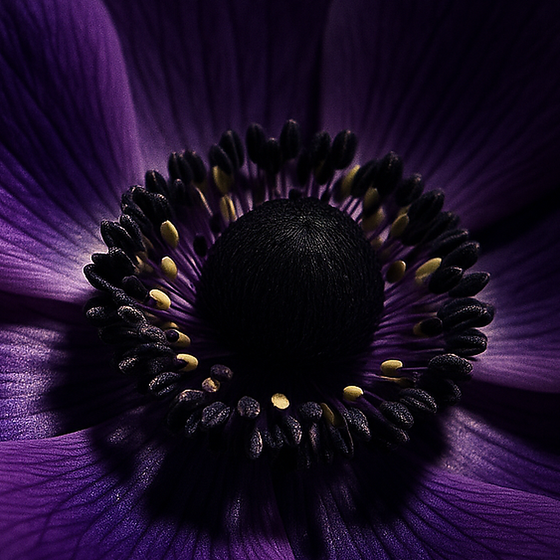
Despite its common name, Anemone coronaria is an anemone of the buttercup family and not a poppy, which belongs to the Papaveraceae. It is a herbaceous perennial tuberous plant growing to 20-40 cm tall, rarely to 60 cm. The flowers are 3-8 cm in diameter, with 5-8 showy petal-like tepals that are red but may be white or blue, and a black centre. Anemone coronaria means crown anemone, referring to the central crown of the flower.
The genus name Anemone and the English "windflower" are conventionally derived from the Greek ánemos ("wind"). The genus is native to the temperate and subtropical regions of all continents except Australia and Antarctica. As of April 2020, 63 species were listed in the genus.
The species ranges along the Mediterranean littoral from Greece, Albania, southern Turkey, Syria, Iraq and northern Arabia to the Sinai Peninsula, with sporadic extension east to Iran and west along the Mediterranean shores of Italy, southern France and North Africa. It still grows wild, particularly in Israel, southern Turkey, Syria and Greece. Anemone coronaria is widely grown for its decorative flowers. Modern cultivars have very large flowers, with diameters of 8-10 cm, and a wide range of bright and pastel colours.
In the 2014 season, fruit set ranged from 95.8% to 100% under free pollination and from 90.3% to 96.1% under nets that allowed only wind pollination. Fruit set under wind pollination alone was only a little but significantly less than under free pollination, and no spontaneous self-pollination was found. In 2011 and 2012, the flower visitors were mostly honeybees, solitary bees and flies, while almost no beetles were observed.
Ranunculin is a glycoside found in many members of the buttercup family, including species of Helleborus, Anemone, Clematis and most commonly Ranunculus. When the plant is wounded or macerated, ranunculin is enzymatically broken down into glucose and protoanemonin. Many Ranunculaceae members contain protoanemonin, which is toxic to humans and animals. Protoanemonin has vesicant properties, which cause rashes or blistering upon contact with the skin or mucosa.
Protoanemonin has the formula C₅H₄O₂ and is a pale yellow oil. Its CAS number is 108-28-1. At room temperature, protoanemonin spontaneously dimerizes into anemonin. Anemonin has the formula C₁₀H₈O₄, and its CAS number is 508-44-1. The formation of anemonin from protoanemonin is most likely a photochemical process. Protoanemonin dimerized in 75% yield under UV radiation from a mercury lamp, and in very poor yield without it.
Ranunculin, protoanemonin and anemonin
Ranunculin is a glucoside: glucose is the sugar bound to its aglycone protoanemonin. It is very stable in acidic medium and fresh plant tissues, but in alkaline solution or damaged plant cells it is hydrolyzed into the unstable toxin protoanemonin and glucose. Protoanemonin has a molecular weight of 96.08 and boils at 73 °C. Anemonin is a dibutenolide natural product, a colourless, odourless solid that melts at 158 °C. It is a homodimer formed from two protoanemonin subunits. X-ray crystallography in 1965 showed that its two butenolide rings are exclusively in a trans relationship. Unlike its parent monomer, which irritates, anemonin is anti-inflammatory.
Volatile fractions of the genus
Aldehydes made up 30.9 to 42.4 % of the volatile fractions, sesquiterpenoids 7.9 to 18.9 % and organic acids 4.2 to 15.8 %.
Growth and cultivation
The flowers of Anemone coronaria bloom in winter to early spring in the Mediterranean range, and later in spring in cooler climates. The plant is hardy in USDA zones 7 to 10 and prefers full sun to part shade. It forms hard black tubers as storage organs, and the flowers produce 200 to 300 seeds. The most popular cultivar groups are De Caen (single) and St Brigid (semi-double and double).
—
Related: Abelia · Almond Blossom · Alpha Terpineol · Alstroemeria · Alumroot · Amarillys · Amazon Moonflower · Amethyst Flower