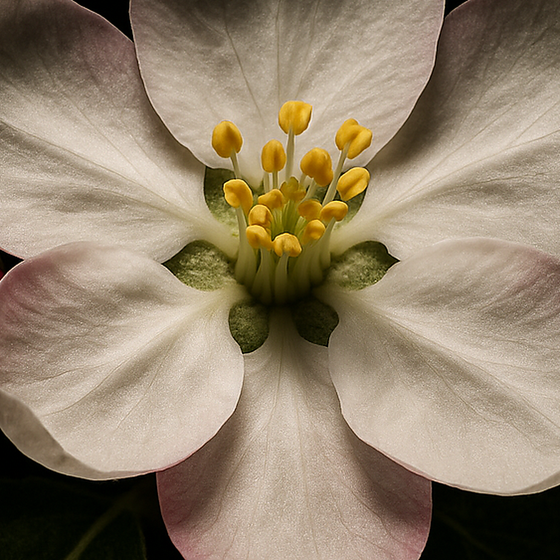
The binomial name is Malus domestica (Suckow) Borkh., 1803, and the genus is Malus. Blossoms are produced in spring at the same time as the leaves bud, on spurs and on some long shoots.
Taxonomy
When Linnaeus first classified the pears, apples and quinces in 1753, he combined them in one genus, Pyrus, and named the apple Pyrus malus. In 1754 the botanist Philip Miller separated the apple from Pyrus in an alternate classification. The General Committee of the IAPT approved the conservation of the name M. domestica in June 2017, though some works published after 2017 still use M. pumila as the correct name under an alternate taxonomy. Other synonyms include M. communis, M. sylvestris and Pyrus dioica.
The Flower
When the flower buds first begin to open, the petals are rose-pink. They fade to white or light pink when fully open. Each flower is 3 to 4 centimeters in diameter. The five-petaled flowers are grouped in a cyme of 3 to 7 flowers. Open apple blossoms are damaged by even brief exposures to temperatures of -2 °C or less.
The Fruit
The fruit is a pome that matures in late summer or autumn. The edible flesh is formed from the receptacle at the base of the flower. There are usually five carpels inside an apple, but there may be as few as three, and each chamber contains one or two seeds.
Pollination
Apples are self-incompatible, so they must cross-pollinate to develop fruit. During flowering, apple growers often use pollinators to carry pollen, and honey bees are the most common choice.
Origin
The apple tree originated in Central Asia, where its wild ancestor, Malus sieversii, is still found. Orchard trees of Malus domestica, the most widely grown in the genus, are cultivated worldwide. The wild ancestor grows in the mountains of Central Asia, in southern Kazakhstan, Kyrgyzstan, Tajikistan and northwestern China. Cultivation most likely began on the forested flanks of the Tian Shan mountains and progressed over a long period. Apples were grown for thousands of years in Eurasia before European colonists introduced them to the American continent. Apples grown from seed tend to differ greatly from their parents, so cultivars are propagated by clonal grafting onto rootstocks. There are more than 7,500 known cultivars of apples.
Production
In 2024, world production of apples was 98 million tonnes, with China producing 52% of the total. The United States, Turkey and Poland were the secondary producers.
Chemistry of the Flower
More than 40 compounds were identified in samples of domestic apple flowers. Besides the terpenic compounds limonene, 3-carene, alpha-pinene, alpha-humulene, terpinolene, geraniol, linalool and (Z)- and (E)-citral, the main headspace constituents are benzaldehyde, eugenol and benzyl alcohol, accompanied by the acetates of these and other alcohols. Linalool is a naturally occurring terpene alcohol found in many flowers and spice plants. Linalool is a colourless oil and is classified as an acyclic monoterpenoid. Its formula is C₁₀H₁₈O, its molar mass is 154.253 g/mol and its boiling point is 198 to 199 °C. Its scent is floral with a touch of spiciness. It exists as two enantiomers: the (S)-form is perceived as sweet and floral, while the (R)-form is more woody and lavender-like. Together with geraniol, nerol and citronellol, linalool is one of the rose alcohols.