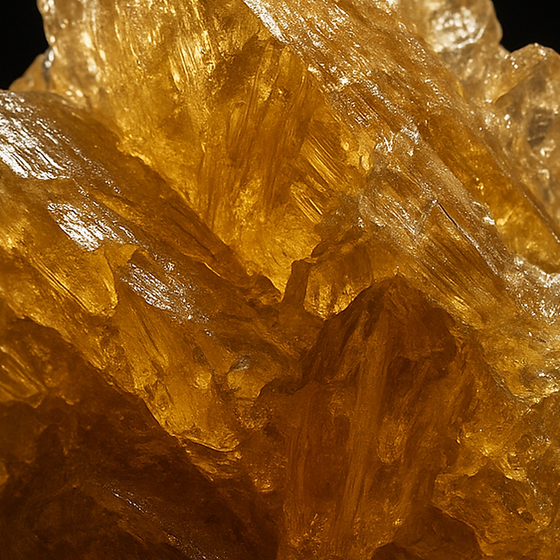
CAS 104-65-4. The formate ester of cinnamyl alcohol. Cinnamyl formate has a softer, more fruity-balsamic character than cinnamyl alcohol — the formate group adds a sweet, slightly cherry-like quality while retaining the warm, spicy backbone.
The scent is warm, sweet, gently balsamic, with a subtle fruity-cherry top note. It is milder than cinnamaldehyde, sweeter than cinnamyl alcohol, and has a particular ester brightness that makes it diffusive and pleasant. The material is used in balsamic-amber compositions and in certain floral accords where warm, spicy sweetness is needed.
Cinnamyl formate is one of several cinnamyl esters used in perfumery — each with a slightly different character. The formate is the lightest, most volatile, and most fruity of the series.
Cinnamyl formate is made by synthesis; The Good Scents Company reports it at about 0.01 % in champaca concrete [3]. It boils at about 250 °C [5] and has a vapour pressure of 0.020 mmHg at 20 °C [3], more volatile than cinnamyl acetate (262–265 °C; 0.011 mmHg) [4]. This places it in the heart of a formula, yet it lasts about 244 hours on a smelling strip at 100 % [3], and Arctander called it "powerful and of good tenacity" [9]: a heart note that carries into the base. Its volume of use is 0.1–1 metric tons per year (IFRA 2015, cited by Api et al. 2021) [11]. It is not the subject of an IFRA Standard and is not an EU labelling allergen [12][13]; most companies notifying ECHA classify it as a possible skin sensitiser (H317) [1].
Explore all seven extraits in the Discovery Set.
—
Related: Accord Eudora · African Marigold · Alpha Amylcinnamaldehyde · Alyssum · Angels Trumpet · Aquaflora · Ashoka Flower · Aurantiol
Sources
- Cinnamyl formate (CID 5354883), CAS 104-65-4. PubChem, NCBI (incl. GHS classification from the ECHA C&L Inventory). https://pubchem.ncbi.nlm.nih.gov/compound/5354883
- 2-Propen-1-ol, 3-phenyl-, formate, CAS 104-65-4. NIST Chemistry WebBook, SRD 69. https://webbook.nist.gov/cgi/cbook.cgi?ID=104-65-4
- Cinnamyl formate, 104-65-4 (rw1020931). The Good Scents Company Information System. https://www.thegoodscentscompany.com/data/rw1020931.html
- Cinnamyl acetate, 103-54-8 (rw1003372). The Good Scents Company Information System. https://www.thegoodscentscompany.com/data/rw1003372.html
- Cinnamyl formate, JECFA No. 649. Specifications for Flavourings, FAO. https://www.fao.org/food/food-safety-quality/scientific-advice/jecfa/jecfa-flav/details/en/c/181/
- Cinnamyl formate. Summary of Evaluations Performed by the Joint FAO/WHO Expert Committee on Food Additives (2000, TRS 901). IPCS INCHEM. https://www.inchem.org/documents/jecfa/jeceval/jec_427.htm
- Cinnamyl formate, FEMA 2299. FEMA Flavor Ingredient Library. https://www.femaflavor.org/flavor-library/cinnamyl-formate
- Hall, R.L.; Oser, B.L. (1965). "Recent progress in the consideration of flavor ingredients under the Food Additives Amendment. 3. GRAS substances". Food Technology 19 (2, Part 2): 151–197. Listed at FEMA, GRAS Publications. https://www.femaflavor.org/gras-publications
- Arctander, S. (1969). Perfume and Flavor Chemicals (Aroma Chemicals), monograph 636 "Cinnamyl formate". Montclair, N.J.: the author.
- "Cinnamyl formate" (1976). Fragrance raw materials monograph. Food and Cosmetics Toxicology 14: 719. https://doi.org/10.1016/S0015-6264(76)80089-2
- Api, A.M. et al. (2021). "RIFM fragrance ingredient safety assessment, cinnamyl formate, CAS Registry Number 104-65-4". Food and Chemical Toxicology 153 (Suppl. 1): 112366. https://doi.org/10.1016/j.fct.2021.112366
- CINNAMYL FORMATE (substance 39335). CosIng, European Commission. https://ec.europa.eu/growth/tools-databases/cosing/details/39335
- IFRA Standards Library (51st Amendment). International Fragrance Association. https://ifrafragrance.org/standards-library