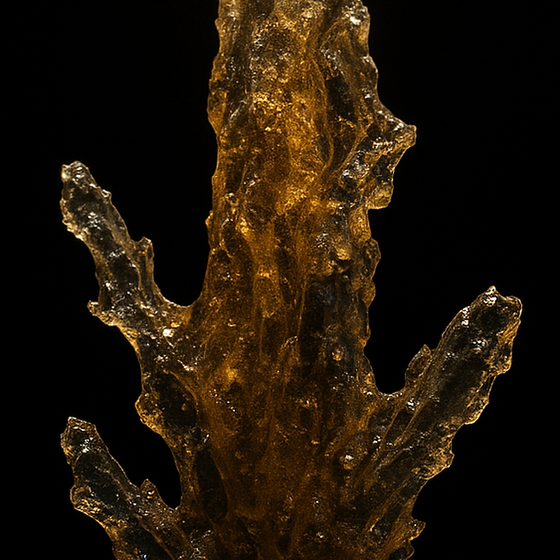
Farnezol

PolusintetičkaCVETOVIcvetni · lipa
Srednje notePiramida
—Jačina
—Trajnost
—Poreklo
Uzorak
Farnezol kao sirovina za parfeme
Srednje note
N/A — found in many essential oils (rose, citronella, neroli)
Definicija

Farnesol is a natural acyclic sesquiterpene alcohol with 15 carbons. Its aroma is described as fresh, sweet, linden flower, floral, angelica and dry.

CVETNI SLADAK SVEŽ
trans-trans farnesol
Type
Sirovina
Olfactive family
Cvetni
Source
industrial synthesis from linalool
Chemical class
acyclic sesquiterpene alcohol
Instrumenti
Piramida
GGornje note
SSrednje note
BBazne note
—Jačina
nizak
nizak

Miris

Its odor is delicate and floral. Another description gives a mild, oily, floral aroma. A weak citrus-lime odor is also reported. A further description of the aroma reads fresh, sweet, linden flower, floral, angelica and dry.

Detaljno

What it is

Farnesol (CAS 4602-84-0, C₁₅H₂₆O, MW 222.37) is an acyclic sesquiterpene alcohol. It is hydrophobic, and thus insoluble in water, but miscible with oils. It is soluble in three volumes of 70% alcohol. It boils at 283 to 284 °C at 760 mmHg. It is a constitutional isomer of nerolidol. The trans-trans isomer is also soluble in ether, acetone and organic solvents.

Chemistry

Farnesol can exist as both E and Z geometric isomers at both the 2/3 and 6/7 double bonds, for a total of four possible isomers. Commercial samples of farnesol exist both as a mixture of isomers and as the pure (E,E)-isomer. The systematic name of the (E,E)-isomer is (2E,6E)-3,7,11-trimethyldodeca-2,6,10-trien-1-ol, and the -ol ending marks an alcohol. In a gas chromatography analysis, a commercial mixed-isomer sample gave three peaks with relative areas of 6:57:37, while the commercial (E,E)-isomer gave a single peak.

Occurrence and name

Farnesol is present in many essential oils such as citronella, neroli, cyclamen, lemon grass, tuberose, rose, musk, balsam, and tolu. Farnesol was named after the Farnese acacia tree (Vachellia farnesiana), since the flowers from the tree were the commercial source of the floral essence in which the chemical was identified. The naming dates from about 1900 to 1905. The tree is named after Odoardo Farnese (1573-1626) of the Italian Farnese family, which maintained some of the first private European botanical gardens in Rome, the Farnese Gardens. Plants of this acacia were grown in Rome in the Farnese Gardens from seed collected in Santo Domingo, in what is now the Dominican Republic, which germinated in 1611. The plant itself originates in the Caribbean and Central America and was brought to the Farnese gardens from there. The flowers are processed through distillation to produce a perfume called cassie.

Biochemistry and regulation

As the pyrophosphate ester, farnesol is a precursor to many terpenes and terpenoids. The pyrophosphate ester of farnesol is a building block of possibly all acyclic sesquiterpenoids. Doubled, these compounds form 30-carbon squalene, the precursor of steroids in plants, animals and fungi. Farnesyl pyrophosphate is the precursor to all sesquiterpenes, a group of thousands of compounds, and also to sterols and carotenoids. Farnesol is used by the fungus Candida albicans as a quorum sensing molecule that inhibits filamentation. The farnesol that the fungus excretes stops the yeast-to-mycelium conversion without influencing cellular growth rates. In biofilms treated with farnesol, the expression of HWP1, which encodes a hypha-specific wall protein, is lower than in controls. Farnesol and its ester derivatives are important precursors for a variety of other compounds used as fragrances and vitamins.

Cosmetic use

Farnesol is used as a deodorant in cosmetic products.

Explore all seven extraits in the Discovery Set.

—

Related: Abelia · Almond Blossom · Alpha Terpineol · Alstroemeria · Alumroot · Amarillys · Amazon Moonflower · Amethyst Flower

Dobijanje i hemija

Način dobijanja

Obtaining farnesol from natural sources is uneconomical. In industry, farnesol is produced from linalool. Geranylacetone is converted to nerolidol, which can be isomerized to farnesol. Nerolidol is produced commercially from geranylacetone, for example by the addition of vinyl Grignard reagent. Farnesyl pyrophosphate is produced from the reaction of geranyl pyrophosphate and isopentenyl pyrophosphate, and it is the precursor to farnesol and farnesene.

Formula
C₁₅H₂₆O
CAS
4602-84-0
Botanički naziv
N/A — found in many essential oils (rose, citronella, neroli)
Izgled
colorless liquid
Jačina mirisa
nizak
Sinonimi
trans-trans farnesol
Status prema standardima IFRA
Ograničeno

Restricted — IFRA Standard « Farnesol » (Amendment 49)

Fizička svojstva
Tačka topljenja
< 25 °C
Relativna gustina
0.884-0.891
Indeks prelamanja
1.4870 at 25 °C

U parfemima

It is used in perfumery to emphasize the odors of sweet, floral perfumes. It enhances perfume scent by acting as a co-solvent that regulates the volatility of the odorants. It is especially used in lilac and peony perfumes. Farnesol is subject to restrictions on its use in perfumery, because some people may become sensitised to it. Within that group it belongs to the list of allergens that are reported less often and are less well documented. At the time of listing there were not enough data to set dose-response relationships or thresholds for these allergens.

Uloga u formuli
01modifikator
02sirovina za stapanje
03svežina
Oblici na tržištu
prirodni izolat sintetički

Pogledajte i

8 nota