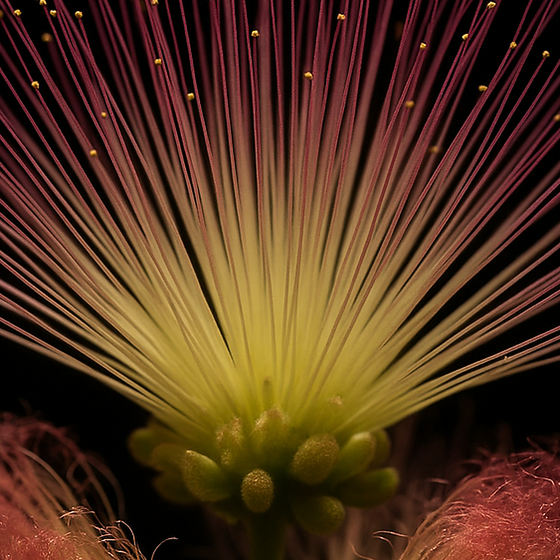
Cvet albicije

AkordCVETOVIcvetni · puderast · sladak
Srednje notePiramida
—Jačina
—Trajnost
—Poreklo
Uzorak
Cvet albicije kao sirovina za parfeme
Srednje note
Albizia julibrissin
Fantazijska/konceptualna
Definicija

The Persian silk tree, Albizia julibrissin, is a species of tree in the Fabaceae family, and its showy flowers are fragrant and pink. The tree is native to southwestern and eastern Asia.

CVETNI SLADAK PUDERAST TOPAO SVEŽ KREMAST
Pink silk tree, mimosa tree, pink siris, Lankaran acacia
Type
Akord
Olfactive family
Cvetni
Source
Flower of Albizia julibrissin
Instrumenti
Piramida
GGornje note
SSrednje note
BBazne note

Miris

The flowers are fragrant.

Detaljno

Each flower has a small calyx and corolla, except the central ones, and a dense tuft of conspicuous stamens 2-3 cm long, white or pink with a white base. The flowers bloom throughout the summer in dense inflorescences, which resemble starbursts of pink silky threads. They have been observed to attract bees, butterflies and hummingbirds.

The Tree

Albizia julibrissin is a small deciduous tree with a broad crown of level or arching branches, growing to 5-16 m (16-52 ft) tall. The leaves are large and frond-like, divided into 6-12 pairs of pinnae, each with 20-30 pairs of leaflets. Its fruit is a flat brown pod 10-20 cm (4-8 in) long that contains several seeds. Original habitats of the tree include regions from Iran (Persia) and the Republic of Azerbaijan to China and Korea. The native range also includes Japan, Nepal and Taiwan, and the tree has been introduced to Greece and the United States.

Varieties and Forms

The typical variety is Albizia julibrissin var. julibrissin, while var. mollis differs in having densely hairy shoots. The flower colour varies from white in the form alba to rich red-tipped flowers. The form rosea, the pink silk tree, is a smaller tree of 5-7 m with always pink flowers, native to Korea and northern China, and it survives temperatures down to at least -25 °C.

Names

The specific epithet julibrissin is a corruption of the Persian word gul-i abrisham, which means "silk flower". It is also called Lankaran acacia or bastard tamarind, though it is not too closely related to either genus. In the United States the species is called Chinese silk tree, silk tree or mimosa, which is misleading. Several species of Acacia, notably Acacia baileyana and Acacia dealbata, are also called mimosa, especially in floristry.

Uses of the Tree

The tree is widely planted as an ornamental plant in parks and gardens. The flowers provide nectar and pollen for bees. Silk tree wood may be used to make furniture. The dried stem bark is used medicinally in China to prepare tonics and sedatives. The flowers are also used to make teas, and in Chinese medicine the plant is considered an antidepressant. In Japan the name nemunoki is a kigo, a seasonal word of haiku, representing summer.

Spread

The tree has become an invasive species in the United States. There it has spread from southern New York, New Jersey and Connecticut west to Missouri and Illinois, and south to Florida and Texas.

Explore all seven extraits in the Discovery Set.

Zanimljivosti

The leaves of the tree slowly close during the night and during periods of rain. In Japan its common names nemunoki, nemurinoki and nenenoki all mean "sleeping tree".

Dobijanje i hemija

Način dobijanja

The scent of the silk tree flower can in principle be captured by solvent extraction, which gives an absolute, or by steam distillation, which gives an essential oil. Both methods apply high heat and are lengthy, so the result may differ considerably from the scent of the living flower. The volatiles of the living flower have instead been analysed by solid-phase microextraction, which uses no solvent and needs no pretreatment.

Botanički naziv
Albizia julibrissin
Izgled
Pink, puff-ball shaped, feathery and silky flowers
Sinonimi
Pink silk tree, mimosa tree, pink siris, Lankaran acacia
Status prema standardima IFRA
Pogledajte napomenu

No IFRA Standard for the material itself (51st Amendment)

U parfemima

Mimosa is among the absolutes in demand, an absolute being produced by solvent extraction.

Uloga u formuli
01pojačivač difuzije
02modifikator
03nota potpisa
04sirovina za stapanje
05graditelj volumena
06svežina
Oblici na tržištu
sintetički akord fantazijska nota

Pogledajte i

8 nota