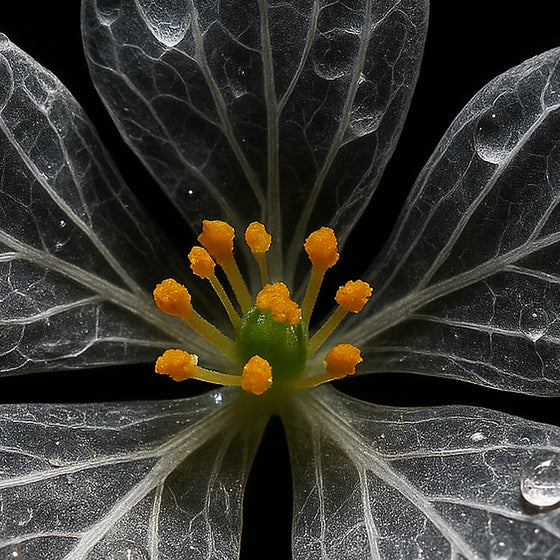
The skeleton flower belongs to the genus Diphylleia in the order Ranunculales. It is native to northern and central Japan. It grows in slightly moist places in the woods of high mountains. Its petals become transparent in contact with water and return to white when they dry.
Explore all seven extraits in the Discovery Set.
Plant
The plant grows up to 0.4 m. The flowers are white, with six obovate petals, and bloom from May to July. After flowering it bears dark blue/purple fruit with a white powdery coating from June to August. Its stems grow 30-60 cm long, and its rhizomes are stout and knotty. The leaves are broad and umbrella-like. The rhizomes grow slowly and can last for decades, forming small colonies under the tree canopy.
Distribution
The plant is distributed from north to central Honshu, Hokkaido, Mount Daisen, and Sakhalin. The skeleton flower has very specific habitat requirements and is found in only three habitats in the world. Its leaves cover the cool forest understory of Japan, China and Sakhalin Island, which belongs to Russia. Botanists think that its present range in East Asia and the Appalachian Mountains of the United States reflects an ancient forest that once spanned the Northern Hemisphere. As glaciers advanced and retreated, that forest broke up and left relict species such as Diphylleia in scattered mountain refuges.
Family and relatives
Berberidaceae is the barberry family, with 18 genera and about 700 known species, most of them in the genus Berberis. Mayapple and barberry belong to the same family. The genus Diphylleia also occurs in the southern Appalachian Mountains, where the umbrella leaf, Diphylleia cymosa, grows in deciduous forests.
The transparent petals
The whiteness of the petals comes from structure, not pigment. When dry, the petals are filled with air pockets, and light bounces through these spaces and reflects back as white. When water fills the gaps, the scattering stops. Light then passes straight through, and the petals turn transparent except for the tougher veins, which remain visible. Scientists call this phenomenon hydrochromism. The effect is fully reversible: once the petals dry, air returns and the flowers become opaque white again. It is not clear why the plant evolved this trait. Some scientists suggest that it helps the blooms stand out to pollinators on dark, rainy days, while others think it may be a side effect of the delicate petal structure.
Research and conservation
Smart windows based on the same mechanism could switch from a light-scattering, translucent state to a fully transparent one in response to humidity or water, which would give a low-energy way to control light and heat in buildings. The IUCN has not formally assessed Diphylleia grayi, so its conservation status is Not Evaluated.