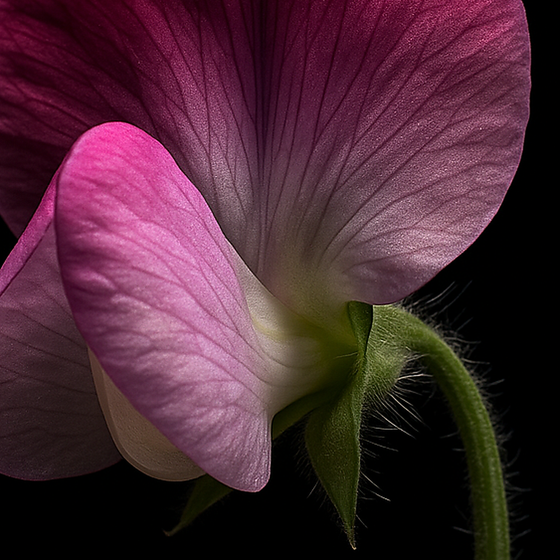
Mirisni grašak

AkordCVETOVIcvetni · sladak
Srednje notePiramida
—Jačina
—Trajnost
—Poreklo
Uzorak
Mirisni grašak kao sirovina za parfeme
Srednje note
Lathyrus odoratus
Fantazijska/konceptualna
Definicija

Sweet pea (Lathyrus odoratus) is an annual climbing plant in the legume family Fabaceae. Its blooms are usually strongly scented.

CVETNI ZELEN SLADAK TOPAO SVEŽ
Type
Akord
Olfactive family
Cvetni
Source
Flowers of Lathyrus odoratus
Instrumenti
Piramida
GGornje note
SSrednje note
BBazne note

Miris

Sweet peas are grown for their intense unique fragrance. Cupani's early sweet peas were sweetly scented. Pre-1914 varieties with smaller flowers, known as Old Fashioned, have a very strong perfume. Other species of Lathyrus do not have the scent of the sweet pea.

Detaljno

Sweet pea (Lathyrus odoratus) is an annual climbing plant native to Sicily, southern Italy and the Aegean Islands. It grows to a height of 1-2 metres when suitable support is available. The leaves are pinnate with two leaflets and a terminal tendril that twines around supporting structures and helps the plant to climb. In the wild plant the flowers are purple and 2-3.5 cm broad; in cultivars they are larger and highly variable in colour. Sweet peas are grown for their flower colour, usually in pastel shades of blue, pink, purple and white, including bi-colours.

In one analysis of fresh flowers, 71 compounds were isolated. The main volatile compounds in quantifiable amounts (>2%) were α-trans-bergamotene, (E)-β-ocimene, linalool, (E,E)-α-farnesene, 7-epi-sesquithujene and β-sesquiphellandrene. Phenyl ethyl alcohol was a major constituent of the flowers, with values of 24.67%, 7.58% and 7.16%. In an earlier study of the floral volatiles, the major components were (E)-β-ocimene (22.9-46.5%), linalool (16.6-26.2%), geraniol (4.5-6.5%) and nerol (3.3-10.1%). In the enantioselective analysis of the flowers, linalool was found to be a racemic mixture. Linalool is a naturally occurring terpene alcohol and, together with geraniol, nerol and citronellol, one of the rose alcohols.

Francesco Cupani, an Italian Franciscan friar, is credited with discovering and first cultivating the wild sweet pea. Sweet peas have been cultivated since the 17th century. The Scottish nurseryman Henry Eckford cross-bred and developed the sweet pea, turning it from a rather insignificant if sweetly scented flower into a floral sensation of the 19th century. By 1901, Eckford had introduced a total of 115 of the 264 cultivars grown at the time. The first of the tall, large-flowered, frilly sweet peas, named 'Countess Spencer', was introduced in 1901, and all later varieties of this form are known as Spencers.

Explore all seven extraits in the Discovery Set.

—

Related: Abelia · Almond Blossom · Alpha Terpineol · Alstroemeria · Alumroot · Amarillys · Amazon Moonflower · Amethyst Flower

Dobijanje i hemija

Način dobijanja

The floral scent of fresh flowers was collected over different months by headspace solid-phase microextraction and analysed by gas chromatography coupled with mass spectrometry, the system most used to analyse floral scent samples. An earlier study of the floral volatiles used thermal desorption followed by gas chromatography-mass spectrometry.

Formula
Complex natural mixture (key constituents: linalool C₁₀H₁₈O; phenyl ethyl alcohol C₈H₁₀O; α-trans-bergamotene)
Botanički naziv
Lathyrus odoratus
Status prema standardima IFRA
Pogledajte napomenu

No IFRA Standard for the material itself (51st Amendment)

U parfemima

Linalool, one of the main volatile compounds of sweet pea flowers, has uses in the manufacture of fragrances. It is used as a scent in perfumed hygiene products and cleaning agents, including soaps, detergents, shampoos and lotions.

Uloga u formuli
01pojačivač difuzije
02nota potpisa
03sredstvo za podizanje
04sirovina za stapanje
05graditelj volumena
06svežina
Oblici na tržištu
rekonstitucija

Pogledajte i

8 nota