


Vratić
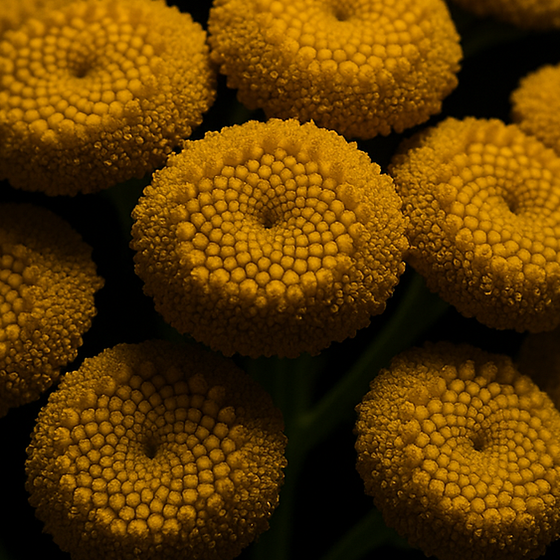
Bitter, camphoraceous, and faintly toxic-smelling. Tansy oil is herbal sharpness at its most aggressive — closer to wormwood or mugwort than to chamomile, despite being a botanical relative.
- Type
- Sirovina
- Olfactive family
- Aromatični
- Source
- leaves and flowering tops
- Chemical class
- complex natural (essential oil)
Miris
Teroar i prerada
Detaljno
Zanimljivosti
Tansy was historically used in embalming — packed around corpses to repel insects and slow decomposition. In medieval England, tansy cakes were eaten at Easter, supposedly to commemorate the bitter herbs of Passover. The practice was eventually abandoned, likely because tansy oil is acutely toxic: ingestion of as little as 10 drops has caused death in adults.
Dobijanje i hemija
Način dobijanja
Steam distillation of the flowering tops and aerial parts of Tanacetum vulgare. The resulting oil is yellowish-orange. Chemical composition varies enormously by chemotype: camphor-dominant (up to 31%), thujone-dominant (up to 34.5%), or chrysanthenyl acetate-dominant (up to 76%). The extreme variability means perfumers must test each batch. Yield is approximately 0.1-0.3% from fresh plant material.
- Formula
- Complex mixture (beta-thujone C₁₀H₁₆O, camphor C₁₀H₁₆O, 1,8-cineole C₁₀H₁₈O)
- CAS
- 84961-64-8
- Botanički naziv
- Tanacetum vulgare
- Izgled
- yellow clear liquid
- Jačina mirisa
- Visok
- Trajnost
- 12 hours at 100.00%
- Sinonimi
- BITTER BUTTONS GOLDEN BUTTONS COW BITTER
Restricted (contains thujone — regulated by IFRA and EU)
- Relativna gustina
- 0.92500 to 0.93500 @ 15.00 °C.
- Indeks prelamanja
- 1.45700 to 1.46200 @ 20.00 °C.
U parfemima
Tansy (Tanacetum vulgare) oil is a specialist ingredient, used sparingly for its bitter-camphoraceous bite in herbal and aromatic compositions. It functions as a modifier in fougère and chypre structures, adding a sharp, almost medicinal green that separates an accord from softer herbal notes like lavender or clary sage. Its chemical profile centers on thujone (both alpha and beta isomers) and camphor, with trans-chrysanthenyl acetate as a secondary component. The thujone content varies dramatically by chemotype — from under 3% to over 34% — making batch-to-batch consistency a challenge. Blue tansy (Tanacetum annuum), a separate species from Morocco, is rich in chamazulene and has a completely different, sweeter profile. In leather accords, common tansy can add a bitter-green harshness alongside birch tar or castoreum. Always used at very low doses due to thujone neurotoxicity.
Pogledajte i
7 nota