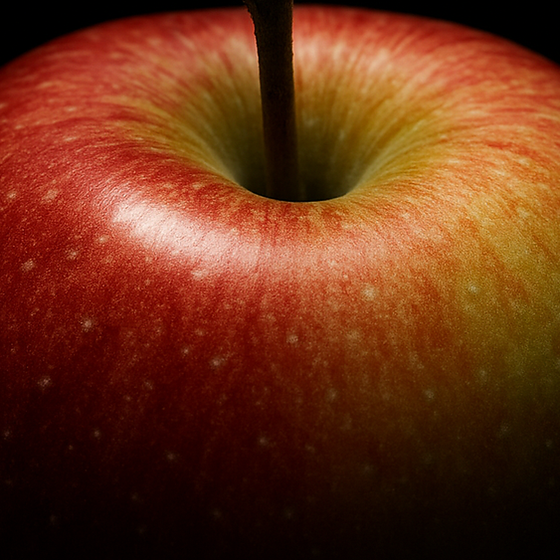
The domestic apple, Malus domestica, is the most widely grown in the genus and is cultivated worldwide. The tree originated in Central Asia, where its wild ancestor, Malus sieversii, is still found. The apple as a species has more than 100 alternative scientific names, and Malus pumila and Malus domestica are the two main names in use. The size of the fruit varies widely between cultivars, but generally has a diameter between 2.5 and 12 cm. Ripe apples have a yellow, green, yellow-green or whitish yellow ground colour. The skin is covered in a protective layer of epicuticular wax. World production of apples in 2024 was 98 million tonnes. Apple seeds contain small amounts of amygdalin, a cyanogenic glycoside.
More than 300 volatile compounds have been identified in apples, but only a subset of 20-30 of them contributes significantly to the typical apple aroma. The esters, especially those with even-numbered carbon chains that combine acetic, butanoic and hexanoic acids with ethyl, butyl and hexyl alcohols, are the major contributors to apple volatiles. Butyl acetate, hexyl acetate, 2-methylbutyl acetate and ethyl 2-methylbutanoate are the crucial esters because of their high content and their impact on the aroma of several apple varieties. Alcohols come second after esters in their effect on the aroma of ripe apples, the most abundant being 2-methyl-1-butanol, 1-butanol, 1-hexanol and 1-propanol. More than 25 aldehydes, mostly hexanal, trans-2-hexenal and butanal, have been identified in apples. Aldehydes are abundant in pre-climacteric apples, but after ripening some of them become almost imperceptible. During ripening, the volatile compounds are converted from aldehydes to esters.
Aroma is cultivar-specific. 2-Methylbutyl acetate is the main ester in apples such as Fuji, whereas butyl acetate is the main ester in Golden Delicious and Royal Gala. Ethyl 2-methylbutanoate, 2-methylbutyl acetate and hexyl acetate contribute most to the characteristic aroma of Fuji apples. Ethyl butanoate and ethyl 2-methylbutanoate are the active odour compounds in Elstar apples. Granny Smith apples have low volatile emission compared with other apple varieties. Epidermal tissue produces a greater amount of volatiles than internal tissues. The peels of 40 apple cultivars together hold 78 identified volatile compounds, among them 47 esters, 12 aldehydes, 5 alcohols, 3 ketones and 1 acid. Eight of these compounds, including hexyl acetate and hexanal, are present in the peels of all the cultivars.
Hexyl acetate is an ester with the molecular formula C₈H₁₆O₂. It is naturally present in many fruits, such as apples and plums. Hexanal is an alkyl aldehyde, also called hexanaldehyde or caproaldehyde. The first synthesis of hexanal was published in 1907 by P. Bagard.
Damascones are a series of closely related chemical compounds that are components of a variety of essential oils. They belong to the rose ketones, a family that also includes damascenones and ionones.
Fructone is also known as apple ketal and applinal. Ethyl acetoacetate is the ethyl ester of acetoacetic acid and is a colorless liquid.