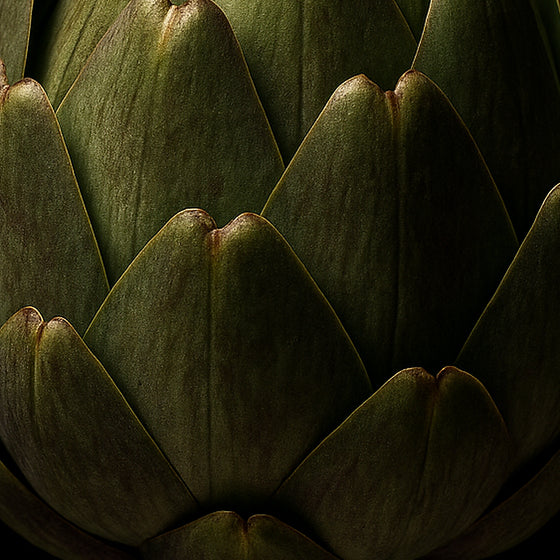
The artichoke is a domesticated variety of the wild cardoon, which is native to the Mediterranean area. It belongs to the family Asteraceae. The globe artichoke differs from Cynara cardunculus in that the leaf lobes and inner bracts of the involucre are less spiny.
Classification and Relatives
The artichoke belongs to Cynara, a genus of thistle-like perennial plants native to the Mediterranean region, the Middle East, northwestern Africa and the Canary Islands. The genus name comes from the Greek kynara, which means artichoke. The cardoon, Cynara cardunculus, is also called the artichoke thistle, and it was domesticated in ancient times and still occurs as a wild plant. Two main cultivar groups derive from the wild cardoon: the cultivated cardoon, selected for edible leaf stems, and the artichoke, selected for larger edible flower buds. Both differ from the wild plant in being larger, much less spiny, and with thicker leaf stems and larger flowers. Wild and cultivated cardoons and artichokes are very similar genetically and are fully interfertile.
Botany
The plant has arching, deeply lobed, silvery, glaucous-green leaves 50-83 cm long. The edible portions of the buds consist primarily of the fleshy lower portions of the involucral bracts and the base, known as the heart. The mass of immature florets in the center of the bud is called the choke or beard. Once the buds bloom, the structure changes to a coarse, barely edible form. The plant grows to 1.4-2 m tall. The budding flower-head is a cluster of many small buds together with many bracts, on an edible base.
Cultivars
Large green cultivars include 'Vert de Laon' from France, and medium green ones include 'Verde Palermo' from Sicily and 'Blanca de Tudela' from Spain. Purple cultivars include the large 'Romanesco' and 'C3', and the medium-size 'Violet de Provence' from France and 'Baladi' from Egypt. Spined cultivars include 'Spinoso Sardo e Ingauno' from Sardinia and 'Criolla' from Peru.
Ecology and Genome
Artichokes are affected by fungal pathogens including Verticillium dahliae and Rhizoctonia solani. The artichoke plume moth, Platyptilia carduidactyla, is a pest of artichoke crops. The globe artichoke genome has been sequenced.
Chemistry
Cynaropicrin is a sesquiterpene lactone of the guaianolide type found mainly in leaves of artichoke plants. It is one of the compounds that gives the artichoke its characteristic bitterness. Cynaropicrin has a 5-7-5 fused tricyclic skeleton. It is found in artichoke leaves with an abundance of approximately 87 g/kg, but can hardly be found in other parts of the plant. Cynaropicrin makes up about 0.7% of leaf extracts of the artichoke. Cynaropicrin is synthesized in the leaves of the artichoke plant and was found to accumulate in the trichomes. The γ-butyrolactone ring of cynaropicrin is involved in most of its biological functions. Cynaropicrin is soluble in water. It can be toxic in higher doses, although no toxicological effects have been proven in humans at normal intake.
Production
In 2024, world production of artichokes was 1.7 million tonnes , led by Egypt with 601,272 tonnes and Italy with 373,960 tonnes.
Culinary Use
A recipe well known in Rome is Jewish-style artichokes , which are deep-fried whole. The softer parts of artichokes are also eaten raw, one leaf at a time dipped in vinegar and olive oil, or thinly sliced and dressed with lemon and olive oil. In Italy, artichoke hearts in oil are the usual vegetable for the spring section of the four seasons pizza. A common Italian stuffing mixes bread crumbs, garlic, oregano, parsley, grated cheese, prosciutto and sausage, and a bit of it is pushed into the spaces at the base of each leaf and into the center before boiling or steaming. In Spain, younger, smaller and more tender artichokes are used. Artichokes also may be made into a herbal tea. The infusion is consumed particularly among the Vietnamese, and an artichoke-based herbal tea called Ceai de Anghinare is made in Romania. The flower portion is put into water and consumed as a herbal tea in Mexico. The tea has a slightly bitter, woody taste.
Aperitif
An Italian aperitif with 16.5% alcohol by volume has artichoke as its primary botanical ingredient.