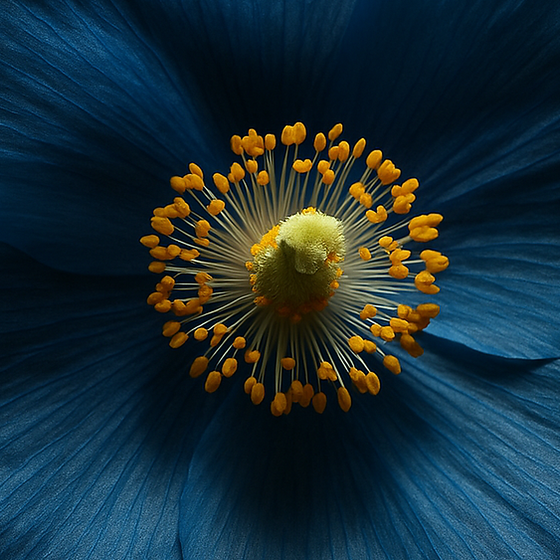
Meconopsis betonicifolia is a herbaceous perennial that is often short-lived. Its life cycle spans two to three years, and flowering occurs in the second or third year after the seed germinates. The hermaphroditic flowers bloom from late spring to early summer. The flowers attract pollinators such as bees and butterflies.
Origin and Habitat
The plant is rare and grows in the Himalayan regions of Nepal, Tibet and Myanmar, at elevations of 2,000 to 5,000 meters (6,600 to 16,400 ft). It thrives in slightly alkaline to acidic soils in cool, moist environments. Gardeners have introduced blue poppies for their beauty, and overexploitation is making them scarce in the wild. The plant is hardy in most of the United Kingdom.
Taxonomy and Related Species
Meconopsis betonicifolia is now treated as a synonym of Cathcartia betonicifolia. It belongs to the poppy family, Papaveraceae, and the name Meconopsis baileyi refers to the same species. Meconopsis is a genus of flowering plants in the poppy family, and its name means poppy-like. All species now placed in the genus are native to the Himalayas and surrounding regions, and they usually have blue flowers. A large proportion of the species are monocarpic and notoriously difficult to maintain in cultivation. Species of Meconopsis do not produce opium. The taxonomy of Meconopsis remains unsettled, since many sources recognise the genus while others sink it into Papaver. Many species hybridise readily and produce viable seed, so some named species may in fact be one species with an under-appreciated range of form. Meconopsis grandis, which is also called the Himalayan blue poppy, is native to China (Yunnan), Bhutan, northeast India and Nepal.
Cultivation
Himalayan varieties have a reputation for being difficult to grow from seed, and fresh seed helps when raising new plants.
Other Blue Poppies
Meconopsis grandis grows to 1 m (3.3 ft) tall and broad as a hardy herbaceous perennial with a basal rosette of toothed leaves. Its large, pure blue flowers reach 15 cm (5.9 in) across, have a prominent yellow central boss and open in late spring. It is difficult to grow in normal garden conditions and can be short-lived, preferring an evenly cool temperature, shade, and somewhat acid soil that stays moist.
Meconopsis gakyidiana is a blue poppy native to eastern Bhutan, western Arunachal Pradesh and southern Tibet, at 3,700 to 4,300 m in elevation. It forms loose tufts with short rhizomes and tall stems, and its leaves are yellowish-green. It grows in open shrubberies, lush pastures and beside rubble walls in grazing grounds, and rarely on the sunny edge of sub-alpine forests. Its name comes from gakyi, a Dzongkha word for happiness, and honours the Bhutanese philosophy of Gross National Happiness.