Борнеол

Натуральний і синтетичнийЗЕЛЕНІ НОТИ, ТРАВИ Й ФУЖЕРНІ АКОРДИсвіжий · ароматичний · деревний

Сім ароматівОдин із них дивиться на вас

Ноти серцяПіраміда
3/5Сила
—Стійкість
3Походження
Зразок
Борнеол як парфумерна сировина
Ноти серця
Визначення

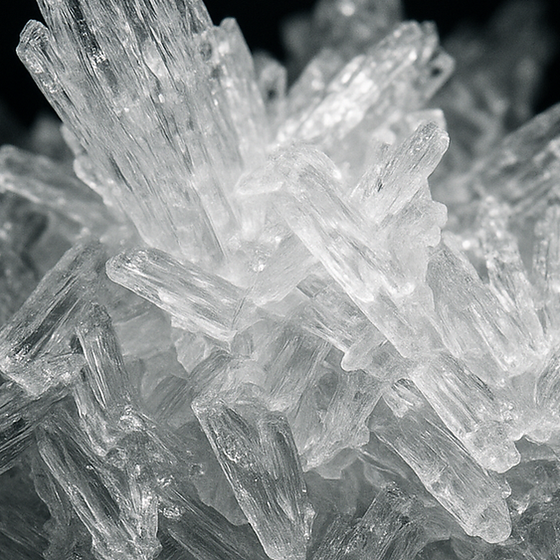
Borneol is a bornane monoterpenoid with a hydroxy group at position 2. It appears as a white lump-solid with a sharp, camphor-like odour.

КАМФОРНИЙ ДЕРЕВНИЙ ЗЕЛЕНИЙ ТРАВ’ЯНИЙ ПРОХОЛОДНИЙ
Borneo camphor, Sumatra camphor, bornyl alcohol, endo-2-bornanol, endo-2-camphanol, endo-borneol
Type
Складник
Olfactive family
Ароматичні
Source
Resin and essential oil of woody plants for (+)-borneol; Blumea balsamifera for (−)-borneol; chemical synthesis from camphor
Chemical class
Bornane monoterpenoid
Інструменти
Піраміда
ВВерхні ноти
СНоти серця
ББазові ноти
3/5Сила
Середня
інтенсивність запаху
Стійкість на блотері
Moderate
Країни-виробники
Суматра півострівна Малайзія Борнео

Запах

Borneol has a sharp, camphor-like odour. It is also described as piney and pungent. D-borneol has been described as having a peculiar peppery odour. The odour is dry camphoraceous with pine-like and woody undertones. It is slightly peppery and minty, with subtle balsamic nuances. It is drier and less penetrating than camphor itself. Laevo-borneol has a balsamic odour type with pine, woody and camphoraceous facets. l-(−)-Borneol is cleaner and less harsh, with more pronounced balsamic undertones, while d-(+)-borneol is slightly sharper, with more pronounced woody-pine aspects.

Теруар і переробка

Докладно

What it is

Borneol is a bicyclic organic compound and a terpene derivative. The hydroxyl group in this compound is placed in an endo position. The exo diastereomer is called isoborneol. Its molecular formula is C₁₀H₁₈O. Its IUPAC name is 1,7,7-trimethylbicyclo[2.2.1]heptan-2-ol. Some sources use the term borneol for the entire category of 2-bornanols, while others use it only for the compounds with an endo hydroxyl.

Occurrence

Borneol is a component of many essential oils. It can be found in several species of Heterotheca and Artemisia, and in rosemary, Dryobalanops aromatica, Blumea balsamifera and Kaempferia galanga. It is also found in castoreum, where it is gathered from the beaver's plant food.

Enantiomers

Being chiral, borneol exists as two enantiomers, both of which are found in nature. They are d-borneol, also written (+)-borneol, and l-borneol, also written (−)-borneol. The d-form used to be the most readily available commercially, but the more commercially available enantiomer now is l-borneol. The 2020 edition of the Chinese Pharmacopoeia contains three commercial borneol products: D-borneol, L-borneol and synthetic borneol.

Properties

Borneol is oxidized to the ketone camphor. Bornyl acetate is the acetate ester of borneol. D-borneol sublimes but is less volatile than camphor. Racemic borneol is insoluble in water and very soluble in ethanol, ether and benzene. It is slightly soluble in propylene glycol. Borneol has a burning taste somewhat reminiscent of mint. Borneol generates a TRPM8-mediated cooling sensation similar to, but weaker than, menthol. It is more effective at activating TRPM8 at lower temperatures. Borneol is also a natural insect repellent.

Medical use and market

Dextro-borneol (dexborneol) is used in edaravone/dexborneol, a drug approved in China for stroke. In Traditional Chinese Medicine theory, borneol is an upper ushering drug that guides herbs to their target organs, especially in the upper part of the body, including the brain. The price of natural (+)-borneol is the highest among all borneol isomers. Chemically synthesized borneol is the major form currently used in traditional Chinese medicine because it has the lowest selling price.

Цікавий факт

Marco Polo reported that the finest camphor came from Fansuri, which referred to Barus in present-day Sumatra. In the Chinese market in 1848, first-quality Barus camphor sold wholesale at 2000 dollars a picul, against 20 dollars for first-quality ordinary Chinese camphor.

Отримання й хімія

Спосіб отримання

Natural D-borneol is extracted from fresh branches and leaves of Cinnamomum camphora or Dryobalanops aromatica. L-borneol is processed from the sublimation of Blumea balsamifera. Synthetic borneol is a racemic borneol prepared by chemical synthesis from turpentine and camphor. Borneol can be synthesized by reduction of camphor by the Meerwein-Ponndorf-Verley reduction, which is a reversible process. For flavour use, a racemic mixture of camphor is the starting material, which gives a racemic mixture of borneol and isoborneol. Reduction of camphor with sodium borohydride, which is fast and irreversible, gives instead the diastereomer isoborneol. The chirality can be controlled by changing the chirality of camphor: (+)-camphor gives (−)-isoborneol and (+)-borneol. Chemically synthesized borneol is not optically pure and contains four stereoisomers: (+)-isoborneol, (−)-isoborneol, (−)-borneol and (+)-borneol.

Формула
C₁₀H₁₈O
CAS
507-70-0
Зовнішній вигляд
White to off-white crystals
Сила запаху
Середня
Стійкість
Moderate
Синоніми
Borneo camphor, Sumatra camphor, bornyl alcohol, endo-2-bornanol, endo-2-camphanol, endo-borneol
Статус IFRA
Див. примітку

No IFRA Standard for the material itself (51st Amendment)

Фізичні властивості
Температура кипіння
213 °C
Температура плавлення
208 °C
Температура спалаху
150 °F (60 °C), closed cup
Відносна густина
1.011 g/cm³ at 20 °C

У парфумерії

Borneol is used to make perfumes. Laevo-borneol is used in perfumery.

Роль у формулі
01модифікатор
02фірмова нота
03сполучний компонент
04формувач об’єму
05свіжість
Форми випуску
кристалічна речовина порошок натуральний ізолят

Див. також

5 ноти