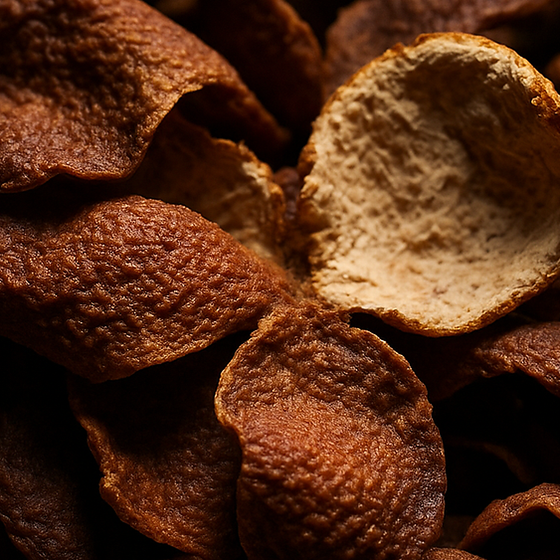
Chen pi (陈皮) is the dried ripe pericarp of Citrus reticulata Blanco or its cultivars. The standard for traditional Chinese medicine in Guangdong Province requires Xinhui chenpi to be aged for a minimum of 3 years.
Chemistry
Chenpi contains volatile oils which include the compounds nobiletin, hesperidin, neohesperidin, tangeretin and citromitin. D-Limonene and gamma-terpinene are the major components of these oils, and the alkaloid methyl 2-(methylamino)benzoate is present at a higher level than most of the minor components. D-limonene, a prominent aromatic compound of citrus fruits, had the highest content in both freshly harvested and 3-year-stored Xinhui chenpi, ranging from 42.62 to 78.36 mg/g. Over 3 years of storage, Xinhui chenpi lost volatile compounds and synephrine and gained total flavonoids, phenolic acids, flavonoids and antioxidant activity. In Chachi peel stored for 1 to 11 years, hesperidin decreased significantly with storage time, while nobiletin, 3,5,6,7,8,3′,4′-heptamethoxyflavone and tangeretin increased. Chachi peel aged 10 years had the highest flavonoid content, especially polymethoxyflavones, compared with fresh peel and peel aged 1, 3 and 5 years. A study of nine-processed tangerine peel (Jiuzhi Chenpi) by gas chromatography–ion mobility spectrometry detected 110 flavor compounds across its production stages, including terpenes, alcohols, aldehydes and ketones. In that study the terpenes limonene, gamma-terpinene, alpha-pinene and myrcene were reduced at the later stage of production, while the final product contained more aldehydes and ketones. The Chinese Pharmacopoeia designates hesperidin, nobiletin and tangeretin as quality markers of dried tangerine peel. Aging lowers hesperidin and raises hesperetin, and the polymethoxyflavones keep accumulating throughout aging.
Cultivars and aging
Besides Citrus reticulata itself, the Chinese Pharmacopoeia names the cultivars Chachi (Guangchenpi), Dahongpao, Unshiu (Satsuma mandarin) and Tangerina (Fuju) among the main cultivated varieties of chenpi. Traditional Chinese medicine holds that aging reduces the pungent and hot odor of the fresh peel and mellows its properties. After the peel is sun-dried to a moisture content of 12 to 15%, it is stored in warehouses with low humidity, adequate ventilation and cool temperatures, and turned regularly to prevent microbial contamination and insect infestation. Over 1 to 7 years of aging, the share of 4-vinylguaiacol in the volatile oil rises progressively.
Provenance
Xinhui is an urban district of Jiangmen in Guangdong, China, and is best known in China for its chenpi. It lies at the confluence of the Tan and West Rivers in the southwestern area of the Pearl River Delta. Where two rivers converge and fresh and saltwater meet, the district forms an alluvial plain with fertile soil that suits the growth of Xinhui tangerines. The total planting area for tangerines in Xinhui reaches about 66.67 square kilometers. In 2022 the total output value of the entire chenpi supply chain in Xinhui reached 19 billion yuan ($2.67 billion).
Medicinal use
Chenpi is a common ingredient in Chinese folk medicine, where it is believed to regulate qi, fortify the spleen, eliminate dampness, improve abdominal distension, enhance digestion and reduce phlegm. It is also used as a traditional medicine to treat indigestion and respiratory diseases. According to Chinese herbology, its attribute is warm.
Culinary use
Some tong sui desserts, such as red bean soup, use chenpi, and it is used to make the dish orange chicken. It can also go into porridge, duck, pigeon, mooncakes, green bean soup, jam and wine, and chenpi-infused tea can be prepared. In Japanese cuisine, chenpi is a common ingredient in shichimi tōgarashi, a traditional spice mix. The peel of the mandarin, dried as chenpi, can serve as a spice for cooking, baking, drinks or candy.
Preparation
Before use, chenpi is soaked and rinsed with cold water until it becomes soft; soaking for no longer than half an hour keeps its flavor.
Nine-processed tangerine peel
Nine-processed tangerine peel (Jiuzhi Chenpi) is a traditional snack that originated in the Chaoshan region of Guangdong Province. Its name refers to a production process of picking, soaking, keeping fresh, peeling, pickling, draining, seasoning, repeated drying and storage. With licorice, salt and sugar added, the preserved peel tastes sweet, salty, aromatic and pungent.