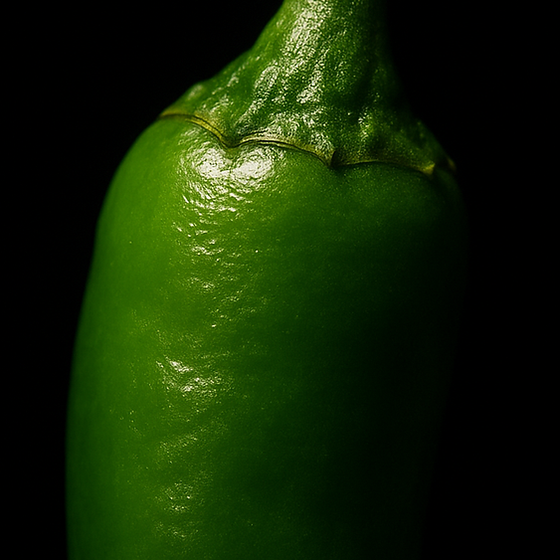
Зелений перець чилі

АкордЗЕЛЕНІ НОТИ, ТРАВИ Й ФУЖЕРНІ АКОРДИзелений · пряний · свіжий
Верхні нотиПіраміда
5/5Сила
—Стійкість
5Походження
Зразок
Зелений перець чилі як парфумерна сировина
Верхні ноти
Capsicum annuum
Фантазійний/концептуальний
Визначення

In 2024, world production of green chillies and peppers, counted as any Capsicum or Pimenta fruits, was 45 million tonnes. The smell of peppers comes from 3-isobutyl-2-methoxypyrazine, which is mainly contained in the flesh of the pepper.

ЗЕЛЕНИЙ ПРЯНИЙ ТЕПЛИЙ СВІЖИЙ
Type
Акорд
Olfactive family
Ароматичні
Chemical class
Methoxypyrazine
Інструменти
Піраміда
ВВерхні ноти
СНоти серця
ББазові ноти
5/5Сила
Дуже висока
інтенсивність запаху
Країни-виробники
Китай Індія Туреччина Мексика Індонезія

Запах

2-Methoxy-3-isobutylpyrazine smells of green pepper in fermented chili pepper. It introduces a green and peppery undertone.

Докладно

Capsicum annuum is a flowering plant in the family Solanaceae (nightshades), native to the northern regions of South America and to southwestern North America. The genus Capsicum has over 30 species, but Capsicum annuum is the primary species in its genus. In 2024, world production of green chillies and peppers, counted as any Capsicum or Pimenta fruits, was 45 million tonnes.

The key odorant

The molecule 3-isobutyl-2-methoxypyrazine, also written 2-isobutyl-3-methoxypyrazine, has the formula C₉H₁₄N₂O and the CAS number 24683-00-9. It is also known as IBMP, galbazine and galbanum pyrazine. It is most frequently found in members of the genus Capsicum. The molecule is produced by some plants and is a contributor to the aroma of several plant-based foods. The human nose can detect it below the part per trillion level, which makes it one of the most odor-intensive compounds on earth. Methoxypyrazines in general are a class of compounds that produce odors, and their detection thresholds are typically near 2 parts per trillion (1 ng/L). In Sauvignon blanc wines, this molecule and 3-isopropyl-2-methoxypyrazine are considered important determinants of green flavours, meaning herbal, grassy or vegetal ones.

Capsaicin and pungency

Capsaicin is the main active component of chili peppers and gives them their distinct pungent taste. It is a potent irritant for mammals, producing a sensation of burning in any tissue with which it comes into contact. Capsaicin is extracted from peppers as oleoresin capsicum: the capsicum is finely ground, an organic solvent such as ethanol extracts the capsaicin, and when the solvent is evaporated the remaining waxlike resin is the oleoresin. The bell pepper, a variant of Capsicum annuum, does not contain high concentrations of capsaicin and is rated a 0 on the Scoville heat scale. The primary substances responsible for pungency are capsaicin in chilis, piperine in peppercorns and allyl isothiocyanate in radishes, mustard and wasabi. Pungency is sensed via chemesthesis, the sensitivity of the skin and mucous membranes to chemical substances. Substances such as piperine, capsaicin and thiosulfinates can cause a burning or tingling sensation by inducing trigeminal nerve stimulation. The nasal cavity, which has exposed membranes without taste receptors, produces a similar sensation of heat when exposed to pungent agents.

Aroma of fermented chilli pepper

Analysis of fermented chili pepper detected a total of 19 aroma-active compounds. Omission experiments confirmed methyl salicylate, linalool, 2-methoxy-3-isobutylpyrazine and phenylethyl alcohol as the key aroma-active compounds of fermented chili pepper. Methyl salicylate masked the floral aroma, while phenylethyl alcohol had an additive effect on the aroma of linalool and 2-methoxy-3-isobutylpyrazine.

What does green chilli smell like

Dried pepper flakes and other spices derived from the seeds and placenta of peppers lack the aroma that is thought of as a fresh pepper smell.

Explore all seven extraits in the Discovery Set.

Цікавий факт

TRPV1, the capsaicin receptor, is an ion channel activated by capsaicin and by temperatures greater than 43 °C, and its activation leads to a painful, burning sensation. Birds do not feel pungency because they lack TRP channels, and pepper seeds are not destroyed when birds eat and digest them.

Отримання й хімія

Спосіб отримання

The volatile oil of green bell peppers is recovered by chopping the fruit and distilling it with steam under vacuum, which yields about 1 part of oil per 1,000,000 parts of peppers. The oil is then fractionated by gas chromatography, and its major component is identical to synthetic 2-methoxy-3-isobutylpyrazine. In the laboratory, leucine amide is reacted with glyoxal to give 2-hydroxy-3-isobutylpyrazine, and this intermediate is methylated to give 2-methoxy-3-isobutylpyrazine. An essential oil extract of capsicum that holds capsaicinoids and terpenes is made from capsicum powder with the seeds and stems removed.

Формула
Complex natural mixture (key constituents: 2-isobutyl-3-methoxypyrazine C₉H₁₄N₂O)
Ботанічна назва
Capsicum annuum
Сила запаху
Very strong (methoxypyrazine detectable below one part per trillion)
Статус IFRA
Див. примітку

No IFRA Standard for the material itself (51st Amendment)

Фізичні властивості
Температура спалаху
80 °C

У парфумерії

3-Isobutyl-2-methoxypyrazine has such a powerful scent that it is often used in fragrances and cleaners. Although it is not very volatile, it is often considered a top note in perfumery because the fragrance can be detected at such low levels. Chemically it behaves like a base note, since it has a low volatility. Its pungency allows it to be identified with the other top notes in the fragrance even if its relative concentration in the air is much lower. It poses little threat to children or pets, and it is used in detergents, candles, deodorants, gums and candies.

Роль у формулі
01модифікатор
02фірмова нота
03компонент піднесення
04сполучний компонент
05натуралізатор
06формувач об’єму
Форми випуску
синтетичний акорд фантазійна нота

Див. також

8 ноти