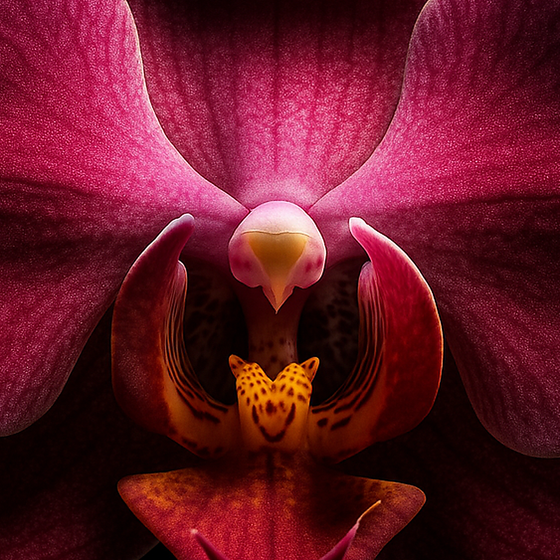
Orchids are cosmopolitan plants, living in diverse habitats on every continent except Antarctica. The world's richest diversity of orchid genera and species is in the tropics. Many species are epiphytes, living on trees. Orchids have very small seeds, relying on fungal partners for germination. Some orchids have no leaves, either photosynthesizing with their roots or relying entirely on fungal partners for food.
Scent Chemistry
Terpenoids are dominant in floral volatiles, including those emitted by orchids. Phenylpropanoids and benzenoids are the second most dominant group of volatile compounds. The main volatile constituent of the orchid Oncidium Rosy Sunset is linalool, at 52.8%. It is followed by benzaldehyde at 9.25%, β-myrcene at 4.15% and tiglaldehyde at 3.65%. The odor of this orchid is strongest around noon three days after full flowering, and the main source of its aroma is the petals and sepals. In flowering plants, scent glands are called osmophores. In orchids, the osmophores are found on the sepals, petals, or parts of the lip, mainly at the base of the lip.
Pollination by Scent
The flowers and their pollination mechanisms are highly specialized, attracting insect pollinators by colour, pattern, scent, pheromones, and sometimes by mimicking female insects. Approximately one-third of all orchid species are pollinated through food deception, in which the flowers contain no nectar or other rewards but mimic the floral signals of rewarding plants. Some orchids produce the aroma of nectar without providing the actual food reward. Others attract nematoceran gnats that feed on decaying fungi with the aroma of mushrooms. In the Dracula orchid, Dracula lafleurii, the labellum acts as both a visual and an olfactory mimic of mushrooms that often grow alongside these orchids. Some Bulbophyllum species attract male fruit flies solely via a floral chemical, such as methyl eugenol, raspberry ketone or zingerone, which also acts as a floral reward.
Orchids of the genus Ophrys use sexual deception to attract pollinators to their flowers. In sexual deception, an orchid attracts male pollinators by producing the sex pheromone of virgin female pollinators in addition to providing visual and tactile cues. The allomone produced by an orchid is specific to its pollinator, of which it usually only has one. The allomone of an Ophrys orchid is a mixture of alkenes and alkanes. Pollinators and orchids use the same chemical compounds in the same absolute amounts in their pheromones and allomones, respectively. In Ophrys speculum, the attractants are instead a mixture of hydroxy- and keto acids, together with aldehydes and esters. Only about 10% of an Ophrys population gets pollinated. This is enough to preserve the population, since each Ophrys orchid produces about 12,000 minute seeds.
The Vanilla Connection
Vanilla is a spice derived from orchids of the genus Vanilla, primarily obtained from the seed pods of the flat-leaved Mexican and Central American vanilla. Vanilla planifolia is a species of vanilla orchid native to Mexico, Central America, Colombia, and Brazil. It is one of the primary sources for vanilla flavouring, due to its high vanillin content. Vanillin makes up 80% of the total aromatic compounds found in the pods of Vanilla planifolia, against 50% in the pods of Vanilla × tahitensis. Natural vanilla extract is a mixture of several hundred different compounds in addition to vanillin. Cured vanilla pods contain about 2% by dry weight vanillin. The flowers of Vanilla planifolia are greenish-yellow, with a diameter of 5 cm. Each flower lasts only one day, yet the flowering of Vanilla planifolia takes place over a period of two months once a year. In the wild, there is only around a 1% chance that any given vanilla flower will be successfully pollinated. Measured by weight, vanilla is the world's second-most expensive spice after saffron, because growing the vanilla seed pods is labor-intensive.
Other Uses of Orchids
Many orchid species and hybrids are cultivated for their flowers. Orchids currently account for a prominent share of the world's flower trade, with annual sales of more than $4 billion (USD). The tubers of terrestrial orchids, mainly the early purple orchid, are ground to a powder and used in cooking, for example in the hot beverage salep and in ice cream. Gastrodia elata is one of three orchids listed in the earliest known Chinese Materia Medica.
Explore all seven extraits in the Discovery Set.