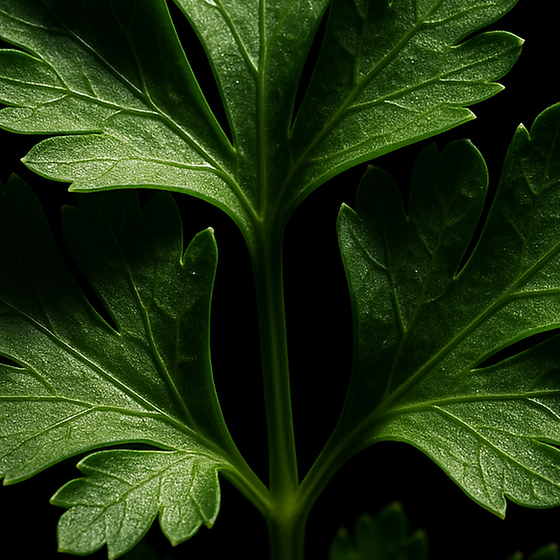
Петрушка

НатуральнийЗЕЛЕНІ НОТИ, ТРАВИ Й ФУЖЕРНІ АКОРДИсвіжий · зелений · пряний
Ноти серцяПіраміда
3/5Сила
—Стійкість
5Походження
Зразок
Петрушка як парфумерна сировина
Ноти серця
Petroselinum crispum
Визначення

Warm, subterranean, faintly narcotic. Parsley seed oil has nothing in common with the garnish on your plate — it smells of root cellars, dried spice, and damp earth, with a nutmeg-like haze from its high myristicin content.

ЗЕЛЕНИЙ ЗЕМЛИСТИЙ СОЛОДКИЙ ТРАВ’ЯНИЙ СВІЖИЙ ПЕРЦЕВИЙ
GARDEN PARSLEY CURLY PARSLEY FLAT-LEAF PARSLEY
Type
Складник
Olfactive family
Ароматичні
Source
leaves, seeds
Chemical class
complex natural (essential oil)
Інструменти
Піраміда
ВВерхні ноти
СНоти серця
ББазові ноти
3/5Сила
Середня
інтенсивність запаху
Країни-виробники
Єгипет Франція Німеччина Угорщина Індія

Запах

Opens with a brief herbaceous-green flash that vanishes within minutes. What follows is warm, spicy, and heavy: a nutmeg-like woodiness from the myristicin, underlaid by the denser, almost medicinal phenolic quality of apiol. The overall impression sits between celery seed and angelica root — earthy, faintly sweet, with a persistent mineral undertone.

Compared to celery seed oil, parsley seed is spicier and less aqueous. Compared to carrot seed oil, it is warmer and heavier. Compared to lovage root, it lacks the yeast-like pungency. The dry-down is quiet, rooty, and long-lasting — a warm trace on cloth that lingers for days.

Докладно

Parsley seed oil is steam-distilled from the ripe fruits (botanically, schizocarps) of Petroselinum crispum. The leaf oil exists but yields under 0.1% and is commercially irrelevant in perfumery. The seed oil is a different material entirely: where the leaf is bright, grassy, almost watery, the seed is warm, heavy, and spicy — closer to angelica root or celery seed than to anything green.

Chemistry

Two phenylpropanoids dominate the composition. Apiol (C₁₂H₁₄O₄, CAS 523-80-8) is the primary constituent at 30–50% of the oil, contributing a heavy, phenolic, slightly medicinal warmth. Myristicin (C₁₁H₁₂O₃, CAS 607-91-0) follows at 9–30%, providing the characteristic nutmeg-like, woody-spicy quality. The same molecule occurs in nutmeg oil, where it accounts for much of that spice's narcotic warmth. Minor constituents include 1-allyl-2,3,4,5-tetramethoxybenzene (4–13%), α-pinene, and β-phellandrene.

Terroir and Production

France, Hungary, India, Egypt, Germany, and the Netherlands are the main producing countries. Yield from steam distillation runs approximately 0.7–1.0% of dry seed weight — modest but sufficient for commercial production. The oil is pale yellow to amber, sometimes depositing crystals of apiol when stored at low temperatures. Composition varies significantly by cultivar and growing conditions: Indian and Egyptian oils tend toward higher apiol content, while certain European cultivars produce more balanced myristicin-to-apiol ratios.

Perfumery Use

Parsley seed oil occupies a niche role, valued precisely because it reads as unidentifiable. At low dosage in aromatic and fougère compositions, it adds an earthy, root-like depth that does not register as a culinary herb. The warmth is subterranean rather than Mediterranean — root cellar, not herb garden. It bridges spice accords to woody bases and pairs naturally with angelica, vetiver, and nutmeg — materials that share its phenylpropanoid chemistry.

Explore all seven extraits in the Discovery Set.

Цікавий факт

Myristicin — the secondary major compound in parsley seed oil — is the same molecule responsible for nutmeg's reputation as a folk hallucinogen. In the 1960s, pharmacologist Alexander Shulgin proposed that myristicin could be metabolised in vivo into MMDA (3-methoxy-4,5-methylenedioxyamphetamine), a psychoactive amphetamine derivative. A 1997 study using isolated rat liver confirmed the biotransformation is chemically possible. The concentrations in parsley seed oil are far too low to produce any such effect, but the shared chemistry explains why the oil smells more like a spice rack than a salad.

Отримання й хімія

Спосіб отримання

Steam distillation of ripe, dried seeds (schizocarps) of Petroselinum crispum. Yield: approximately 0.7–1.0% of dry seed weight, varying by cultivar, harvest maturity, and distillation parameters. A CO2 extract also exists, preserving a broader range of heavier molecules and yielding a richer, more root-like profile. The oil is pale yellow to amber; at low temperatures, crystals of apiol may precipitate from the solution. Parsley leaf oil (from the aerial parts) is a separate product — much lower yielding (under 0.1%) and olfactively different, greener and milder. Major producing countries: France, Hungary, India, Egypt, Germany, Netherlands.

Формула
Complex mixture; key compounds: myristicin (C₁₁H₁₂O₃), apiol (C₁₂H₁₄O₄), β-phellandrene (C₁₀H₁₆)
CAS
8000-68-8
Ботанічна назва
Petroselinum crispum
Зовнішній вигляд
pale yellow to amber liquid
Сила запаху
Середня
Синоніми
GARDEN PARSLEY CURLY PARSLEY FLAT-LEAF PARSLEY
Статус IFRA
Див. примітку

No IFRA Standard for the material itself (51st Amendment)

Фізичні властивості
Температура кипіння
~290°C @ 760 mmHg
Температура спалаху
50°C (TCC)
Відносна густина
0.920–0.930 @ 20°C
Показник заломлення
1.485–1.490 @ 20°C

У парфумерії

Parsley seed oil functions as a heart-to-base modifier in aromatic, fougère, and spicy compositions. Its earthy-spicy warmth provides depth without sweetness, making it useful where a subterranean quality is needed without identifiable culinary associations. The high apiol and myristicin content links it chemically to nutmeg, and the two materials work in concert in spice accords. At low dosage (typically 0.5–2% of a formula), parsley seed oil adds root-like complexity to chypre and green compositions without dominating. It blends naturally with angelica, celery seed, vetiver, cedarwood, and citrus oils. The phenylpropanoid-heavy composition gives it moderate fixative power — the heavier molecules (apiol MW 222, myristicin MW 192) persist well into the base. No direct synthetic replacement exists for the full oil, though individual qualities can be approximated: elemicin and methyl eugenol reproduce some of the spicy warmth. Parsley seed oil is not featured in any current PREMIEREPEAU fragrance.

Роль у формулі
01модифікатор
02кістяк
03фірмова нота
04компонент піднесення
05сполучний компонент
06свіжість
Форми випуску
ефірна олія (трава) ефірна олія (насіння)

Див. також

7 ноти