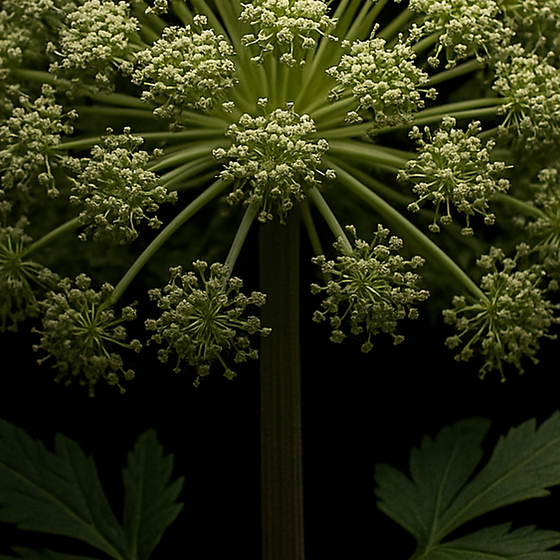
Дягель

НатуральнийЗЕЛЕНІ НОТИ, ТРАВИ Й ФУЖЕРНІ АКОРДИзелений · землистий · свіжий
Ноти серця·Базові нотиПіраміда
—Сила
—Стійкість
3Походження
Зразок
Дягель як парфумерна сировина
Від нот серця до базових нот
Angelica archangelica
Визначення

Angelica oil is prepared from the roots or seeds of Angelica archangelica. Among the Umbelliferae, angelica is unique for a pervading aromatic odor, a pleasant perfume unlike that of fennel, parsley, anise, caraway or chervil.

Herbacé
92
Vert
74
Frais
75
Aromatique
41
Boisé
49
Terreux
20
garden angelica, wild celery, Norwegian angelica
Type
Складник
Olfactive family
Ароматичні
Source
roots and seeds
Chemical class
essential oil (terpenoids and sesquiterpenoids)
Інструменти
Піраміда
ВВерхні ноти
СНоти серця
ББазові ноти
Країни-виробники
Франція Угорщина Індія

Запах

The root oil has a warm, pungent odor with musky or earthy notes. Cyclopentadecanolide gives angelica root a distinctive musky aroma. Angelica has been compared to musk and to juniper. The seed oil has a sweeter and more delicate aroma than the root oil. Its odor type is classed as amber. Another description of the oil gives a strong aromatic odor.

Теруар і переробка

Докладно

Angelica archangelica is a biennial plant of the family Apiaceae. During its first year it grows only leaves, but during its second year its fluted stem can reach a height of 2.5 meters. Angelica grows only in damp soil, preferably near rivers or deposits of water. The leaves are made of numerous small leaflets divided into three principal groups, each subdivided again into three lesser groups, and the leaflet edges are finely toothed. The yellowish or greenish flowers open in July and are grouped in large globular umbels that bear pale yellow, oblong fruits. Like several other Apiaceae, angelica looks similar to poisonous species such as Conium and Heracleum and should not be eaten unless it has been identified with absolute certainty.

Angelica archangelica grows wild in Russia, Finland, Sweden, Norway, Denmark, Greenland, the Faroe Islands and Iceland, mostly in the northern parts of the countries. It is cultivated in France, mainly in the Marais Poitevin, a marsh region close to Niort in the department Deux-Sèvres. Commercially available angelica is often sourced from Hungary, Romania, Bulgaria, Germany and Poland.

Angelica root oil contains about 90% terpenoids and sesquiterpenoids. α-Pinene, 3-carene, limonene and β-phellandrene are the major components, together about 60%. In one analysis of the root oil, 87 compounds were reported, of which 43 were hydrocarbons and 22 alcohols. The macrolides 15-pentadecanolide and 13-tridecanolide are essential odor components of the root oil. Reported ranges for the terpenic hydrocarbons are 4.4 to 24% for α-pinene, 7.5 to 20% for α-phellandrene and 16 to 24% for β-phellandrene. The macrocyclic lactone is reported at 0.8 to 2.4% of the oil. The seed oil contains α-pinene, camphene, β-pinene, myrcene, β-phellandrene, limonene, γ-terpinene, caryophyllene, p-cymene, 1,8-cineole, borneol and carvone. Both the seeds and roots contain coumarins and furocoumarins. The seed oil contains 0.1% bergapten, one of two linear furanocoumarins that are invariably found in plants associated with phytophotodermatitis. In a study of supercritical CO2 extracts of the root, 76 components were identified, and the major volatile components included sabinene, myrcene, chrysanthenyl acetate, α-copaene and 15-pentadecanolide.

Cyclopentadecanolide is a macrolide lactone, a colorless solid with the formula C₁₅H₂₈O₂. It occurs in small quantities in angelica root essential oil. Its content is less than 1% in roots and less than 0.5% in seeds.

The roots are among the most common botanicals in gin distillation, often used together with juniper berries and coriander, and they are also used in absinthes, aquavits and bitters. Angelica also flavors liqueurs or aquavits, omelettes and trout, and is made into jam. The hollow stems may be eaten: they are picked clean of their leaves, crystallized in sugar syrup and colored green as cake decoration or candy.

Explore all seven extraits in the Discovery Set.

—

Related: Alpha Pinene · Angelica Root · Angelica Root Oil · Artemisia · Barrenwort · Beachheather · Behini Tree · Beta Pinene

Цікавий факт

The name angelica is a Latin feminine name implying "angel-like" from the mid-16th century, probably given to the plant because of its scent. Cyclopentadecanolide, found in angelica root oil, is also called angelica lactone. The species name archangelica comes either from an Old French term of the late 12th century for an angel of the highest order, or from the Greek arkhangelos, "chief angel".

Отримання й хімія

Спосіб отримання

Angelica root oil is obtained by steam distillation of the roots. The yield from the roots is fairly low even though they may be steam distilled for up to 24 hours. Seed oil is obtained by steam distillation of the fresh seed of Angelica archangelica. The yield of seed oil is 0.6 to 1.5% from seeds harvested in mid-July in Germany. Supercritical CO2 extraction at 40°C and pressures from 80 to 400 bar has also been used to isolate flavor compounds from angelica root. The total yield of volatiles by supercritical CO2 extraction ranged from 0.13 to 0.55%.

Формула
Complex natural mixture (key constituents: α-pinene; 3-carene; limonene; β-phellandrene; cyclopentadecanolide C₁₅H₂₈O₂; 13-tridecanolide)
CAS
8015-64-3
Ботанічна назва
Angelica archangelica
Зовнішній вигляд
Root oil: pale-yellow to deep-amber liquid
Синоніми
garden angelica, wild celery, Norwegian angelica
Статус IFRA
Обмежено

Restricted — IFRA Standard « Angelica root oil » (Amendment 49)

Фізичні властивості
Температура спалаху
43 °C
Відносна густина
0.86
Показник заломлення
1.48
Нота
Soluble in most fixed oils, slightly soluble in mineral oil, but relatively insoluble in glycerin and in propylene glycol.

У парфумерії

Angelica oils are used mainly in the alcoholic beverage industry and, in very low dosages, also in fine fragrances. Perfumers and aroma chemists take particular interest in the cyclopentadecanolide of angelica root. The roots are generally preferred for culinary and aroma uses. Cosmetic functions recorded for the oil are fragrance, skin conditioning, tonic and perfuming.

Роль у формулі
01модифікатор
02фірмова нота
03компонент піднесення
04сполучний компонент
05натуралізатор
06формувач об’єму
Форми випуску
ефірна олія

Див. також

6 ноти