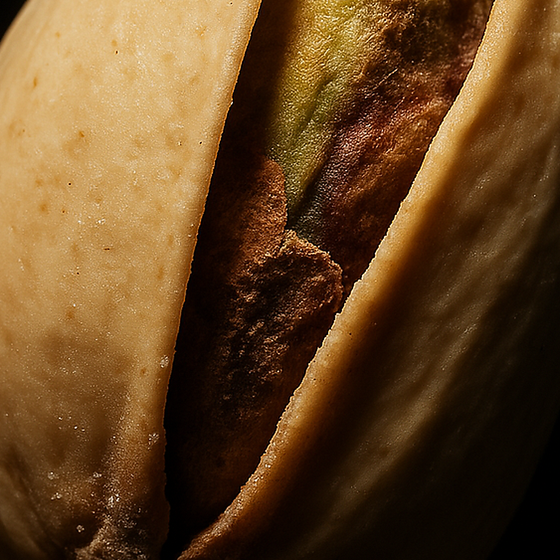
Фісташка

НатуральнийФРУКТИ, ОВОЧІ Й ГОРІХИвершковий · горіховий · насичений
Ноти серцяПіраміда
—Сила
—Стійкість
5Походження
Зразок
Фісташка як парфумерна сировина
Ноти серця
Pistacia vera
Визначення

Pistachio is the edible seed of Pistacia vera, a small to medium-sized tree of the cashew family. The seed has light green flesh and a distinctive flavor.

ЗЕЛЕНИЙ СОЛОДКИЙ ТРАВ’ЯНИЙ ТЕПЛИЙ ВЕРШКОВИЙ ГОРІХОВИЙ ОБСМАЖЕНИЙ
Pistacia vera, pistachio nut
Type
Складник
Olfactive family
Фруктові
Source
Edible seed (kernel) of the fruit of Pistacia vera
Інструменти
Піраміда
ВВерхні ноти
СНоти серця
ББазові ноти
Країни-виробники
Сполучені Штати Туреччина Іран Сирія Китай

Запах

α-Pinene, the most important volatile compound in pistachio samples, has an odor like pine and turpentine. Octane and decane, two major volatiles of pistachio oil, release an alkane odor.

Докладно

Pistacia vera belongs to the family Anacardiaceae and is a small to medium-sized tree. The species is dioecious, with separate male and female trees. The tree grows up to 10 metres tall. The pistachio tree is native to Iran and Central Asia. The fruit is a drupe with a hard, cream-colored shell, and the seed inside has a mauve-colored skin and light green flesh. The fruit contains an elongated seed, which is the edible portion; the seed, commonly thought of as a nut, is a culinary nut and not a botanical nut. The leaves are deciduous and pinnate, 10 to 20 centimetres long, and the flowers are apetalous and unisexual, borne in panicles. The genus Pistacia belongs to the cashew family and contains at least eleven species, of which Pistacia vera is the only edible commercial one. Pistachio is a desert plant and is highly tolerant of saline soil.

Chemistry

The essential oil of the whole unripe fruits of Pistacia vera from Greece is very rich in α-pinene (54.6%) and terpinolene (31.2%). Twenty-one constituents were identified in it, and only three others exceeded 1%: limonene, 3-carene and β-pinene. In the fruit oil the (+)/(−)-α-pinene ratio is 99.5:0.5, that of limonene is 80:20 and that of β-pinene is 96:4, while α-terpineol was found only as the (−) form. The leaf essential oil has α-pinene (30.0%), terpinolene (17.6%) and bornyl acetate (11.3%) as major components, and thirty-three compounds were identified in it. In pistachio oils analysed by HS-SPME and GC-MS, d-limonene, α-pinene, 3-carene, β-myrcene, nonanal and α-terpinolene had the highest content. The major ones were α-pinene, octane and decane in samples from ultrasound-assisted extraction, and decane, nonanal and (E)-2-decenal in samples from Soxhlet extraction. Terpene concentrations were lower in the Soxhlet samples, while hydrocarbons and aldehydes were significantly higher. Long processing at high temperature is a key parameter in the formation of roasted compounds. The fruit oils of four related species (P. terebinthus, P. atlantica, P. lentiscus and P. palaestina) also contain α-pinene (3.8 to 15.6%) and terpinolene (0.1 to 6.9%), but in much lower concentrations than P. vera. α-Pinene and terpinolene have antibacterial and antifungal properties, and terpinolene has also been identified as an antioxidant.

Raw pistachios are 4% water, 45% fat, 28% carbohydrates and 20% protein. Oleic acid, at 52% of total fat, is the most common monounsaturated fatty acid, and linoleic acid makes up 30%. Palmitic acid makes up 10% of total fat and stearic acid 2%. A 100-gram reference amount provides 2,351 kilojoules (562 kcal) of food energy. Compared with other tree nuts, pistachios have less fat and food energy but more potassium, vitamin K, γ-tocopherol, carotenoids and phytosterols.

Production

In 2024 world production of pistachios in shells was 1.4 million tonnes, with the United States, Turkey and Iran together accounting for 87% of the total. In that year the United States produced 498,950 tonnes, Turkey 383,000, Iran 316,142, Syria 83,796 and China 78,986. In 2023, California produced 99% of the pistachios grown in the United States, with more than 428,000 acres devoted to the crop in 2022. Each mature tree averages around 50 kilograms of seeds, or around 50,000 seeds, every two years. Greece is one of the important pistachio-producing countries. Several years of severe drought in Iran from about 2008 to 2015 caused significant declines in production, and in 2011 anthracnose fungus caused a sudden 50% loss in the Australian harvest.

Uses

The kernels are often eaten whole, either fresh or roasted and salted. They are also used in Turkish delight candy, pistachio ice cream, traditional Persian ice cream, kulfi, spumoni, pistachio butter, pistachio paste, baklava, pistachio chocolate, pistachio halva, lokum, biscotti and cold cuts such as mortadella. Americans make pistachio salad, which includes fresh pistachios or pistachio pudding, whipped cream and canned fruit. Indian cooking uses pounded pistachios with grilled meats and in pulao rice dishes. In Greece the unripe whole fruits are used to prepare traditional spoon sweets. As a tree nut, the pistachio is considered a priority allergen that may induce allergic reactions in susceptible people.

Цікавий факт

When the fruit ripens, the shell abruptly splits partly open with an audible pop. The word pistachio ultimately derives from Middle Persian pistakē, meaning pestle. The shell is naturally beige, but it may be dyed red or green in commercial pistachios; the dye was first applied to hide stains left when the nuts were picked by hand. The oil of P. vera could potentially be used to adulterate mastic gum oil, and the adulteration could be identified by an increased percentage of terpinolene.

Отримання й хімія

Спосіб отримання

Hydrodistillation for three hours of fresh unripe whole fruits gave 0.5% essential oil, leaves gave 0.1%, and fresh ripe nuts without hull and shell gave an insignificant quantity. The distillation used a modified Clevenger-type apparatus, and the oil was dried over anhydrous sodium sulphate and stored at 4 °C. Essential oil is found only in the unripe whole fruit, at the maturation stage used for sweets. Distillation of unroasted ripe nuts without hull and shell failed to give a measurable quantity of essential oil, even directly after their collection. In a comparison of two pressing systems for pistachio oil, a screw press reached an oil yield of 34.8% and a hydraulic press 31.0%. Soxhlet extraction (6 hours at 70 °C) and ultrasound-assisted extraction (15 minutes at 25 °C, three times) were compared on the 'Aegina' cultivar, and the ultrasound-assisted extraction gave the lower yield. Of three techniques compared for extracting volatiles from pistachio nuts, solid-phase microextraction was recommended as the most appropriate. The three techniques were liquid-liquid solvent extraction with ethanol and hexane (85 °C, 6 hours), headspace extraction (100 °C, 1 hour) and solid-phase microextraction (100 °C, 1 hour); they extracted 34, 41 and 25 volatiles, of which 67.36%, 72.04% and 92.91% were identified.

Формула
Complex natural mixture (key constituents: α-pinene; terpinolene)
Ботанічна назва
Pistacia vera
Зовнішній вигляд
Seed with mauve-colored skin and light green flesh
Синоніми
Pistacia vera, pistachio nut
Статус IFRA
Див. примітку

No IFRA Standard for the material itself (51st Amendment)

У парфумерії

In nuts generally, hot air roasting heats the samples to 130-200 °C for 5 to 60 minutes, and the Maillard reaction, caramelization, fatty acid autoxidation and the breakdown of sulfur-containing amino acids then change the volatile profile. In one study of pistachios, limonene marked the unroasted nuts, while α-pinene and 3-carene were linked to the roasted ones, with or without salt.

Роль у формулі
01модифікатор
02фірмова нота
03формувач об’єму
Форми випуску
essential oil pressed oil kernel

Див. також

6 ноти