Олія ши

НатуральнийФРУКТИ, ОВОЧІ Й ГОРІХИрослинний жир · без запаху або зі слабким запахом
Базові нотиПіраміда
—Сила
—Стійкість
4Походження
Зразок
Олія ши як парфумерна сировина
Базові ноти
Vitellaria paradoxa
Визначення

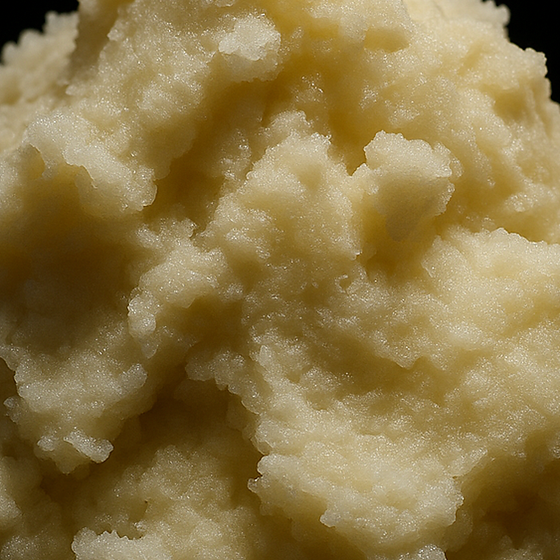
Shea butter is a fat, mainly triglycerides of oleic and stearic acid, extracted from the nut of the African shea tree, Vitellaria paradoxa. It is ivory in colour when raw and solid at ambient temperature.

БЕЗ ЗАПАХУ НІЖНИЙ
Karité
Type
Складник
Olfactive family
Землисті
Source
nut (seed kernel)
Chemical class
complex natural fat (triglycerides)
Інструменти
Піраміда
ВВерхні ноти
СНоти серця
ББазові ноти
Країни-виробники
Буркіна-Фасо Малі Того Уганда

Запах

Shea butter from fresh seeds is odourless. Refined shea butter has a mild characteristic odour.

Докладно

The shea fruit has a thin, tart pulp around a relatively large, oil-rich seed from which the butter is extracted. The kernel of the seed, often incorrectly called 'nut', contains a vegetable fat known as shea butter. The shea tree is a tree of the family Sapotaceae and is the only species in the genus Vitellaria.

Origin and Production

The shea tree grows naturally in the wild in the dry savannah belt of West Africa from Senegal in the west to Sudan in the east, and onto the foothills of the Ethiopian highlands. Two subspecies are recognised: Vitellaria paradoxa subsp. paradoxa, roughly from the Nigeria-Cameroon border westward, and subsp. nilotica, roughly from that border eastward. The tree starts bearing its first fruit when it is 10 to 15 years old; full production is attained when the tree is about 20 to 30 years old. The fruits resemble large plums 4 to 8 centimetres long weighing between 10 and 57 grams each. Each kilogram of fruit gives approximately 400 grams of dry seeds. Fruits are gathered in the wet season, usually in June-August depending on latitude. Harvesting continues for about 2.5 months and is done mostly by women and children.

Chemistry and Properties

Shea butter is composed of five principal fatty acids: palmitic, stearic, oleic, linoleic, and arachidic. About 85 to 90% of the fatty acid composition is stearic and oleic acids. The stearic acid gives it a solid consistency, while the oleic acid influences how soft or hard the shea butter is, depending on ambient temperature. Ugandan shea butter has consistently high oleic acid content, and is liquid at warm ambient temperatures. Shea butter from the Mossi Plateau region of Burkina Faso has a higher average stearic acid content so is usually harder than shea butter from other West African regions. Shea butter is a complex fat that also contains many nonsaponifiable components. Butter from fresh seeds is white and of high quality, while butter from stale seeds is dark and tastes bitter. A 2014 review identified 10 phenolic compounds in shea butter, eight of which are catechins.

Uses

Shea butter is mainly used in the cosmetics industry for skin- and hair-related products. In some African countries such as Benin, shea butter is used as cooking oil, as a waterproofing wax, for hairdressing, for candle-making, and as an ingredient in medicinal ointments. It is occasionally mixed with other oils as a substitute for cocoa butter, although the taste is noticeably different. Shea stearin is used in chocolate products as a cocoa butter equivalent.

History and Names

A testa found at the site of the medieval village of Saouga is evidence of shea butter production by the 14th century. The butter was being imported into Britain by 1846. The English word 'shea' comes from sǐ, the tree's name in Bambara. The tree is called ghariti in the Wolof language of Senegal, which is the origin of the French name of the tree and the butter, karité.

Отримання й хімія

Спосіб отримання

Fat is traditionally extracted from the kernels by roasting and pressing them. The resulting liquid is boiled, sieved and cooled. In rural areas, seeds are traditionally processed by hot water extraction, usually the job of women. The seeds are then boiled and later sun- or kiln-dried. The kernels are removed by trampling and redried before being crushed, ground and kneaded to form a paste. The paste is put in water, heated or boiled and the boiling mass is churned until a grey, oily fat separates from the emulsion. The fat is skimmed off from the surface and washed to remove impurities. The congealed fat may subsequently undergo further refining before being moulded into various forms. Industrially, the kernels are ground and the fat is extracted with the solvent hexane. In simple cold pressing, the temperature does not exceed 80 °C.

Формула
Complex natural mixture (key constituents: stearic acid; oleic acid)
CAS
91080-23-8
Ботанічна назва
Vitellaria paradoxa
Зовнішній вигляд
Ivory when raw, commonly dyed yellow; solid at ambient temperature
Синоніми
Karité
Статус IFRA
Див. примітку

No IFRA Standard for the material itself (51st Amendment)

Фізичні властивості
Температура плавлення
32 to 45 °C
Показник заломлення
1.462 to 1.485 at 44 °C

У парфумерії

In the West shea butter is most commonly used as an emollient in cosmetics and is less commonly used in food. Many cosmetic products, especially moisturizers, lotions and lipsticks, have shea butter as a base because its high unsaponifiable matter content imparts excellent moisturizing characteristics.

Роль у формулі
01емолент
02косметична основа
Форми випуску
неочищене масло рафіноване масло стеарин олеїн

Див. також

5 ноти