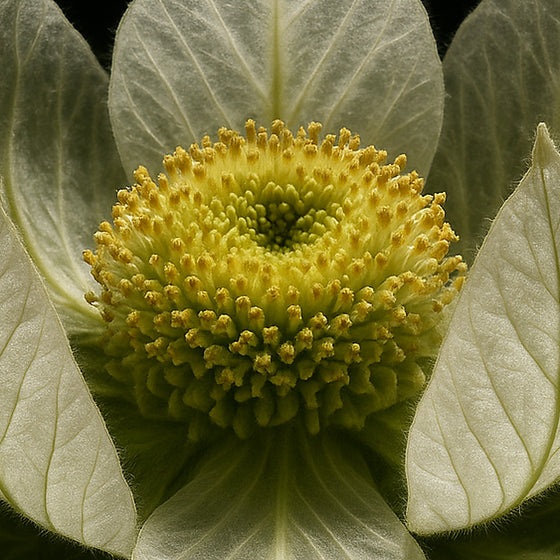
Saussurea is a genus of about 300 species of flowering plants in the family Asteraceae. The genus is native to cool temperate and arctic regions of East Asia, Europe, and North America, with the highest diversity in alpine habitats in the Himalayas and East Asia.
Botany and Habitat
The flowers of the genus form in a dense head of small capitula, often surrounded by dense white to purple woolly hairs. The wool is densest in the high-altitude species. It helps regulate the temperature of the flowers, limits frost damage at night and shields them from ultraviolet light. A number of the high alpine Himalayan species are grown as ornamental plants for their decorative dense woolly flowerheads. Saussurea involucrata is a perennial alpine species mainly distributed in the Tianshan Mountains. Saussurea involucrata can be found at 4,000 m elevation in the western part of the Tianshan Mountains in Xinjiang, China. It occurs in the Tianshan and Altai Mountains at about 2400-4100 m, and its seeds carry long hairs that let the wind spread them. Saussurea laniceps, the cotton-headed snow lotus, is a rare snow lotus found only in the Himalayas, including Nepal and southwest China (Sikkim in India, and Sichuan, Tibet and Yunnan in China). It grows above about 3,200 m altitude on alpine scree slopes. Saussurea laniceps is a perennial herb 15-45 cm tall that grows slowly for 7-10 years or more and dies after flowering. It is pollinated by two bumblebee species.
Chemistry
The major bioactive components of the herb were reported to be acacetin, hispidulin and rutin.
Traditional Use
Several varieties of snow lotus are used in traditional Tibetan medicine. The flowers and stems of Saussurea laniceps, Saussurea involucrata and Saussurea medusa have long been used in traditional Chinese medicine for the treatment of rheumatoid arthritis, cough with cold, stomachache, dysmenorrhea, and altitude sickness. Saussureae Involucratae Herba is the dried ground part of Saussurea involucrata and is used in traditional Uyghur and/or Chinese medicine. In the China Pharmacopoeia (2015), the major pharmaceutical values of snow lotus are alleviating rheumatoid arthritis, accelerating blood circulation and mitigating other "cold" syndromes.
Conservation and Cultivation
The plant takes over 8 years to mature before the harvest. Over-harvesting in China is destroying the growing environment and damaging the quality of Saussurea involucrata. Saussurea involucrata has become endangered due to over-exploitation. The whole plant of Saussurea laniceps is used medicinally, and the species is threatened in many regions by over-exploitation. The cultivation of snow lotus has been tried by the Xinjiang Technical Institute of Physics & Chemistry in China. The harvest period could be shortened from 8 years to 2 years, and the major chemical contents were not decreased.
Explore all seven extraits in the Discovery Set.