


Triplal
Keywords: green · herbal · fresh
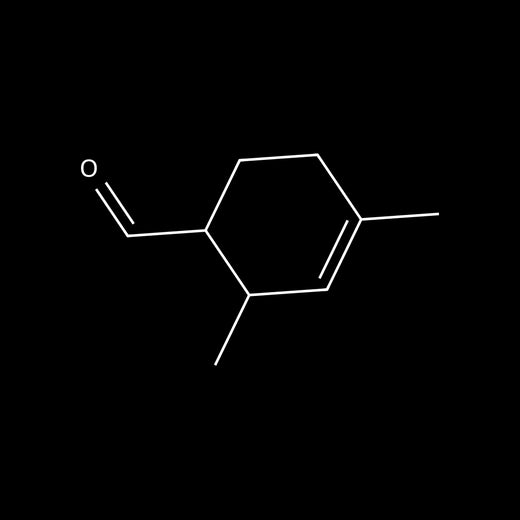
Triplal is the synthetic aldehyde 2,4-dimethylcyclohex-3-ene-1-carbaldehyde, with a green, aldehydic, leafy and tart odour. Its odour is described as green, aldehydic, leafy and tart.
- Olfactive family
- Aromatic · 510 entries of the glossary in this family Subfamily: Green notes · 93 entries in this subfamily Cluster: Green-herbal notes · 155 entries in this cluster
- Material
- Synthetic
- IFRA status
- Restricted
- Pyramid
- Top · Volatility: Top Note
- Strength
- High Step 4 of 5 · shared by 498 of 2,156 graded entries Graded entries at each step, from 1 to 5: 4, 119, 1,473, 498, 39. 23 more sit between two steps.
- Also called
- Ligustral, Cyclal C, Vertocitral, Hivertal, Tricyclal, Zestover, Lantral
Family, subfamily and cluster: PREMIEREPEAU house classification, version 2026‑11.
Triplal · Facets
Entries of the glossary that carry each facet, of 3,979:
- green 1,442
- aldehydic 84
- leafy 82
- tart 21
- metallic 100
- herbal 757
- fresh 1,387
Editorial note We own no rights to this material, its name or its trademark. This entry is independent editorial journalism, published under freedom of expression.
Triplal · Scent
Its odour at 10% in dipropylene glycol is described as green, aldehydic, leafy, tart, floral and peely. Other descriptions give powerful, green and grass notes, or green, citrus, herbal and aldehydic notes. One supplier describes a powerful green odour with fresh cucumber and citrus. Another describes it as powerful, green and citrus, recalling the tartness of lemon and bergamot peels. The liquid is also described as having a strongly green, slightly herbaceous, citrus note. Further descriptions read green, leafy, floral and powerful; green, citric and fresh; or fresh bergamot and lavender. A ranking of odour descriptors for the fragrance puts green first, followed by herbal, aldehydic, floral, leafy, fresh, citrus, cortex, woody and ozone. The odour strength is high, and smelling in a solution of 10% or less is recommended.
Evolution over time
Triplal: scent over time.
- Immediately
Green and aldehydic, tart and peely, with a citrus freshness.
Scent words: citrus · green
- Tenacity
- 8 hours at 100%
Triplal · In Perfumery
Triplal is used for perfuming cosmetic preparations as well as household products. In cosmetics it serves as a tonic, perfuming and fragrance ingredient. Its stability is good in soap and in body lotion, very good in an APC liquid cleaner, and poor in bleach and in a citric acid cleaner. It is used in a method for improving the performance of a fragrance or its mixture.
Pyramid
Triplal: Top. Entries of the glossary stored at each place of the pyramid, of 4,006 (42 store no place):
- Top 718
- Top · Heart 497
- Heart 1,641
- Heart · Base 514
- Base 594
Role in the formula
Triplal: roles in the formula. Entries of the glossary that share each role, of 4,006:
- Signature note 897
- Lifting agent 567
- Green accord anchor fewer than 40 entries
- Modifier 1,167
- Freshness amplifier fewer than 40 entries
Triplal · Extraction & Chemistry
Triplal is synthetic: it is prepared as a mixture of its cis- and trans-isomers by a Diels-Alder reaction of 2-methyl-1,3-pentadiene and acrolein. The reaction is carried out under high pressure. The diene is made from bisacetone alcohol, which is first hydrogenated to methylpentanediol and then dehydrated to methylpentadiene. Its listed raw materials are acrolein, diacetone alcohol and trans-2-methyl-1,3-pentadiene.
- Appearance
- Colorless to pale yellow clear liquid (est)
Triplal · Did You Know?
Acrolein, one of the two starting materials of this aldehyde, is the simplest unsaturated aldehyde. Acrolein itself is a colorless liquid with a foul and acrid aroma. The IFRA Standard lists nine commercial names for the material, among them Agrumen Aldehyde, Cyclovertal and Aldehyde AA.
Triplal · In Depth
Identity
2,4-Dimethylcyclohex-3-ene-1-carbaldehyde is an alicyclic aldehyde of the formula C₉H₁₄O. FEMA number 4505 is assigned to (Z,E)-2,4-dimethyl-3-cyclohexenecarboxaldehyde. Its molecular weight is 138.21 g/mol, and its structure is written CC1C=C(CCC1C=O)C in SMILES notation. It is registered under EINECS number 268-264-1 and is TSCA listed.
The IFRA Standard on the mixed dimethylcyclohex-3-ene-1-carbaldehyde isomers was published in January 2020 as Amendment 49. It covers the 2,4-isomer, listed under CAS 68039-49-6, together with other dimethylcyclohex-3-ene-1-carbaldehyde isomers such as the 3,5- and 3,6-isomers.
Manufacture
The aldehyde is a raw material produced industrially by a Diels-Alder reaction of acrolein with 2-methylpentadiene, and it is available on a large scale. A Diels-Alder reaction joins a conjugated diene and a substituted alkene to form a substituted cyclohexene derivative, and it reliably builds six-membered rings with good control of regiochemistry and stereochemistry.
Under standard conditions the product is a racemic mixture of cis and trans diastereomers in a ratio of 80:20, with a small amount of the regioisomer 2,4-dimethylcyclohex-2-ene carboxaldehyde. Lewis acid or transition metal catalysts can be used to improve the stereoselectivity.
After cooling, the unreacted diene and acrolein are distilled off at 80–85 °C and returned to the reactor.
Derivatives
Oxidation gives the corresponding acid, which can be esterified, and a Wittig reaction with phosphoranes gives compounds with a functionalized unsaturated side chain. Some of the esters are hesperidic and fruity with grapefruit notes, and one has typical ester notes with an aldehydic tonality and a watermelon odour. The aldehyde has also been chosen as a route to analogues of natural and synthetic odorants such as α-ionone and β-irone.
Safety and regulation
European hazard information classes it as an irritant and dangerous for the environment, irritating to skin and eyes and possibly sensitising by skin contact. The FDA listing for the (2,4)-, (3,5)- and (3,6)-dimethyl-3-cyclohexenylcarbaldehydes notes that the FDA no longer provides for the use of these seven synthetic flavoring substances. The material is not listed in the Food Chemicals Codex. It is assigned WGK 2 in Germany.
The IFRA Standard sets maximum acceptable concentrations in the finished product by product category, and dermal sensitization is the endpoint that drives them. The limits apply to the isomers used individually or in combination, and their summed concentration must not exceed them. Because small amounts may be ingested from products in Categories 1 and 6, the material must also be recognized as safe as a flavoring ingredient under the IOFI Code of Practice.
Supply and storage
The aldehyde is soluble in alcohol and dipropylene glycol, and its solubility in water is estimated at 311.5 mg/L at 25 °C. Shelf life is 12 months or longer if stored properly. It should be stored in a cool, dry place in tightly sealed containers, protected from heat and light and under nitrogen.
Triplal · Technical Sheet
Molecular weight
138.21 g/mol Heavier than 439 of the 536 other entries at the same place of the pyramid that store a weight.
2,515 entries store a molecular weight. By place in the pyramid: Top 537, Top · Heart 403, Heart 861, Heart · Base 452, Base 262.
Identity
- Botanical
- N/A (synthetic — 2,4-dimethyl-3-cyclohexene-1-carboxaldehyde)
- Source
- Synthetic molecule
- Type
- Ingredient
- Category
- Greens, herbs and fougeres
- Producing countries
- Manufactured globally
Classification
- Chemical class
- Aldehyde
Chemical data
- Formula
- C9H14O
- CAS
- 68039-49-6
- PubChem CID
- 93375, compound record on PubChem
- InChIKey
- MZZRKEIUNOYYDF-UHFFFAOYSA-N
- Wikidata
- Triplal: Q27258798, item on Wikidata
Physical properties
- Boiling point
- 196 °C at 760 mmHg
- Flash point
- 151 °F (66 °C) TCC
- Specific gravity
- 0.932–0.940 at 25 °C
- Refractive index
- 1.469–1.475 at 20 °C
- Vapour pressure
- 0.578 mmHg at 25 °C (est)
- Log P
- 2.34
- Acid value
- 5.0 max KOH/g
- Assay
- 97–100% sum of isomers
Performance and rules
- Available as
- synthetic
- IFRA status
- Restricted — IFRA Standard “Dimethylcyclohex-3-ene-1-carbaldehyde (mixed isomers)” (Amendment 49)
Triplal · See Also
Entries related to Triplal, by their place in the pyramid. “shared” marks a scent word Triplal has too.
Top notes

Beta-Pinene
piney · woody · green (shared) Aromatic / Same cluster / Natural & Synthetic / 136.24 g/mol
Myrcene
herbal (shared) · spicy · peppery Aromatic / Same cluster / Semi-synthetic / 136.23 g/mol
Alpha-Pinene
piney · fresh (shared) · herbal (shared) Aromatic / Same cluster / Natural / 136.23 g/mol
3,6-Dimethylcyclohex-3-ene-1-carbaldehyde
aldehydic (shared) · citrus · green (shared) Aromatic / Top · Heart / Same cluster / Synthetic / 138.21 g/mol
Acrolein
alliaceous · herbal (shared) · pungent Aromatic / Same cluster / Synthetic / 56.06 g/mol
3,5,5-Trimethylhexanal
green (shared) · aldehydic (shared) · gassy Aromatic / Top · Heart / Same cluster / Synthetic / 142.24 g/mol
Shishito Pepper
green (shared) · spicy · vegetal Aromatic / Same subfamily / Natural & Synthetic
Basil
aromatic · green (shared) · herbal (shared) Aromatic / Top · Heart / Same subfamily / Natural
Ivy carbaldehyde
green (shared) · citrus · floral Green / Top · Heart / Synthetic / 138.21 g/mol
3,5-Dimethylcyclohex-3-ene-1-carbaldehyde
leafy (shared) · aldehydic (shared) · green (shared) Green / Top · Heart / Synthetic / 138.21 g/mol
Melonal
fresh (shared) · fruity · sweet Green / Synthetic / 140.22 g/mol
Methyl 2-Octynoate (Violet Leaf)
green (shared) · violet · fresh (shared) Green / Top · Heart / Synthetic / 154.21 g/mol


Heart notes

Sage
aromatic · herbal (shared) · amber Aromatic / Natural
Tea
green (shared) · aromatic · dry Aromatic / Heart · Base / Natural
3-(4-Methyl-3-cyclohexenyl)
butanal
citrus · floral · fruity Florals / 166.26 g/mol
1-Methyl-4-(4-methylpentyl)
cyclohex-3-ene-1-carbaldehyde
metallic (shared) · aldehydic (shared) · fresh (shared) Green / Heart · Base / Synthetic / 208.34 g/mol
3-Propylbicyclo
[2.2.1] hept-5-ene-2-carbaldehyde
aldehydic (shared) · green (shared) · sweaty Green / Synthetic / 164.24 g/mol


Triplal · Sources
Cite as PREMIEREPEAU Glossary, “Triplal”, https://premierepeau.com/
