


Coconut Blossom
Keywords: floral · tropical · nutty
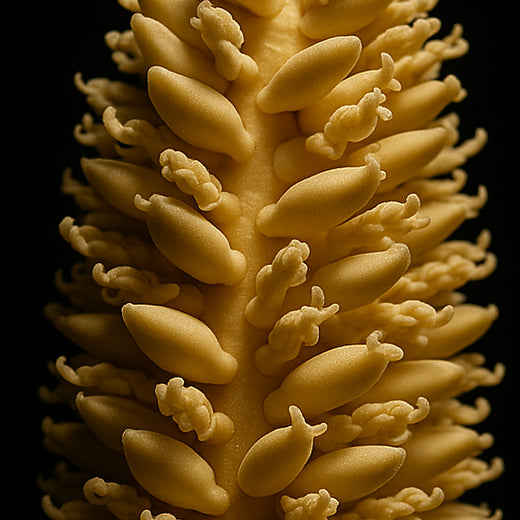
Coconut Blossom: Sap from the coconut palm’s flower bud stem is boiled into coconut sugar or fermented into palm wine.
- Olfactive family
- Florals · 779 entries of the glossary in this family Subfamily: Fresh florals · 104 entries in this subfamily Cluster: Classic florals · 245 entries in this cluster
- Material
- Natural Flower
- Pyramid
- Heart · Volatility: Heart Note
- Strength
- Medium Step 3 of 5 · shared by 1,473 of 2,156 graded entries Graded entries at each step, from 1 to 5: 4, 119, 1,473, 498, 39. 23 more sit between two steps.
- Also called
- Coconut flower · Cocos nucifera flower
Family, subfamily and cluster: PREMIEREPEAU house classification, version 2026‑11.
Coconut Blossom · Facets
Entries of the glossary that carry each facet, of 3,979:
- floral 1,546
- sweet 1,988
- warm 1,108
- fresh 1,387
- creamy 401
- tropical 189
Coconut Blossom · Scent
Coconut sugar’s sweet, roasted, burnt, nutty, smoky and caramel notes come mostly from pyrazine, furan and pyran derivatives. Acetoin, 2,3-pentanedione and 2,3-butanedione give coconut sugar buttery, cheesy and creamy aromas. Gula jawa, the Indonesian sugar made from coconut sap, has an earthy aroma.
Evolution over time
Coconut Blossom: scent over time.
- Immediately
Sweet, with buttery and creamy aspects.
Scent words: sweet · creamy - After a few hours
Nutty and caramel notes come forward.
Scent words: nutty - After a few days
Roasted, smoky and burnt notes remain.
Scent words: roasted · smoky
Coconut Blossom · In Perfumery
Pyramid
Coconut Blossom: Heart. Entries of the glossary stored at each place of the pyramid, of 4,006 (42 store no place):
- Top 718
- Top · Heart 497
- Heart 1,641
- Heart · Base 514
- Base 594
Role in the formula
Coconut Blossom: roles in the formula. Entries of the glossary that share each role, of 4,006:
- Diffusion enhancer 248
- Signature note 897
- Freshness 720
PREMIEREPEAU collection: Extrait de parfum
Coconut Blossom · Terroir & Origins
- Producing countries
- Thailand, Indonesia, Philippines
No origin card: Indonesia, Philippines.
Thai Coconut Blossom
Samut Songkhram — Thailand
Coconut sugar is made in Thailand, for example in Samut Songkhram, and Thailand is named among the main producing countries of palm sap sugar.
Coconut Blossom · Extraction & Chemistry
Farmers make a cut on the spadix, and the sap starts to flow from the cut into bamboo containers. For coconut sugar the sap is then placed over moderate heat in large woks to evaporate its moisture.
Available as
Coconut Blossom: available as.
- synthetic accord
- fantasy note
- sap
- syrup
- sugar
- Appearance
- Cream to yellow flowers (no commercial extract)
Coconut Blossom · Did You Know?
Palm sap begins fermenting immediately after collection, due to natural yeasts in the air. Within two hours, fermentation yields an aromatic, sweet wine with up to 4% alcohol and mildly intoxicating effects.
Coconut Blossom · In Depth
The inflorescence
The coconut palm is monoecious, with male and female flowers growing on the same tree and in the same inflorescence. The female flower is much larger than the male flower. Botanically the inflorescence is a spadix inside a sheathing spathe, and it takes some 14 months for each flower primordium to develop into one. A healthy tree can produce up to 15 inflorescences per year, staggered so that there is always a mature one with others in different stages of development.
Sap and sugar
Coconut sugar, also called coconut blossom sugar, is a palm sugar made from the sap of the flower bud stem of the coconut palm. The fresh sap is translucent and about 80% water. A container is fastened to the flower stump to collect it, and the white liquid that first collects is usually very sweet and non-alcoholic.
As the water evaporates the sap turns into a thick syrup. Coconut sap, fresh or fermented, is drunk as toddy or tubâ in the Philippines. When left to ferment on its own, it becomes palm wine.
The plant
The accepted botanical name of the coconut palm is Cocos nucifera L., a species of the palm family Arecaceae. Mature trees bloom all year round, bearing leaves, flowers and fruit at the same time. Eleven months pass between the opening of the female flowers and the harvest of the fruit. Coconut palms are largely cross-pollinated, though most dwarf varieties pollinate themselves.
Composition and products of the sap
Sap tapped from the unopened spadix in a chilled collecting box is called Kalparasa; one analysis of it gave total sugars of 15.96 g per 100 g, free amino acids of 901 mg per 100 g and vitamin C of 13.45 mg per 100 g. The fresh sap has different local names, including neera or nira in Indonesia, tinamís in the Philippines, coconut toddy in Sri Lanka and namwan maphrao in Thailand.
The main carbohydrates of coconut sugar are sucrose at 70–79%, with glucose and fructose at 3–9% each. The brown colour that develops as the sap is reduced comes mostly from caramelization. A young, well-maintained tree can give around 300 liters of toddy a year.
Related: Pineapple Blossom
Coconut Blossom · History
Gula melaka, a palm sugar made from coconut flower bud sap, probably took its name from the state of Malacca in Malaysia, where it originated.
Coconut Blossom · Technical Sheet
Identity
- Botanical
- Cocos nucifera
- Taxonomy
- Arecales order › Arecaceae family › Cocos genus · GBIF
- Botanical records
- Cocos nucifera: POWO, Cocos nucifera · IPNI, Cocos nucifera · GBIF, Cocos nucifera · Wikidata, Cocos nucifera · Wikipedia, Cocos nucifera
- IPNI
- Cocos nucifera L., Sp. Pl. 2: 1188 (1753) — Carl Linnaeus (1707–1778)
- Type
- Ingredient
- Category
- Flowers
- Note
- N/A – no commercial extract
In Nature
- Growth form
- Tree · POWO
- Native range
- Malesia · Papuasia · Australia · Southwestern Pacific · POWO
- Introduced to
- 102 regions · Africa 27 · Southern America 26 · Tropical Asia 21 · Pacific 20 · Temperate Asia 5 · Northern America 3
- Flowering
- peak in August · north of the equator · iNaturalist
- Recorded altitude
- 0–250 m · 2,680 records with an altitude · GBIF
- Wild or cultivated
- 51 native · 252 introduced · 470 cultivated among 64,209 records (the rest carry no such mark) · GBIF
- Recorded in
- 151 of 512 squares of the world grid; a brighter dot holds more records · GBIF
- Also from this genus
- Cocos: Coconut · Coconut Water
- Also from this botanical family
- Arecaceae: Acai Berry · Buriti · Coco De Mer · Dates · Dragon Blood Resin · Saw Palmetto · 1 more entry
In Print
- Timeline
- first described 1753 · earliest aroma paper in Europe PMC, 2011
- In English books
- most mentioned in the 1980s · Google Books Ngram
Classification
- Chemical class
- Fantasy note
Chemical data
- Formula
- N/A – natural blossom
- Most reported compounds
- Menthol (1 paper; one: J Agric Food Chem 1993, Menthol) · Butyroin (1 paper; one: J Agric Food Chem 1993, Butyroin) · L-Lysine (1 paper; one: Biochemical Systematics and Ecology 1986, L-Lysine) · L-Valine (1 paper; one: Biochemical Systematics and Ecology 1986, L-Valine) · 2-Heptanol (1 paper; one: J Agric Food Chem 1993, 2-Heptanol) · LOTUS
- INCI names (CosIng)
- COCOS NUCIFERA OIL (HAIR CONDITIONING, FRAGRANCE, SKIN CONDITIONING, PERFUMING)COCOS NUCIFERA FLOWER EXTRACT (HUMECTANT, SKIN CONDITIONING)COCOS NUCIFERA FLOWER NECTAR EXTRACT (ANTIMICROBIAL, ANTIOXIDANT, pH ADJUSTERS)COCOS NUCIFERA FRUIT EXTRACT (SKIN CONDITIONING – EMOLLIENT, HAIR CONDITIONING, SKIN CONDITIONING)COCOS NUCIFERA OIL EXTRACT (SKIN CONDITIONING – MISCELLANEOUS)COCOS NUCIFERA PULP EXTRACT (SKIN CONDITIONING – EMOLLIENT, SKIN CONDITIONING – HUMECTANT)COCOS NUCIFERA FRUIT WATER (HAIR CONDITIONING, SKIN CONDITIONING)COCOS NUCIFERA WATER (FRAGRANCE)
- Compound classes reported
- Monoterpenoids 10 % · Amino acids and peptides 55 % · Fatty acids and conjugates 13 % · of 31 compounds reported, 3 % of them esters · LOTUS
Labelling
- Forms in the EU cosmetic inventory
- Coconut Blossom: COCOS NUCIFERA FRUIT · COCOS NUCIFERA FRUIT JUICE · COCOS NUCIFERA FRUIT POWDER · COCOS NUCIFERA FRUIT/FRUIT JUICE EXTRACT · COCOS NUCIFERA SEED BUTTER · COCOS NUCIFERA SHELL POWDER
Performance and rules
- IFRA status
- No IFRA Standard for the material itself (51st Amendment)
Coconut Blossom · See Also
Entries related to Coconut Blossom, by their place in the pyramid. “shared” marks a scent word Coconut Blossom has too.
Top notes

Coconut Water
tropical (shared) · nutty (shared) · fresh (shared) Fruity / Top · Heart / Fantasy/Concept

Heart notes

Coffee Blossom
floral (shared) · gourmand · roasted Florals / Same cluster / Natural
Michelia
floral (shared) · fruity · sweet (shared) Florals / Same cluster / Natural
Cananga
floral (shared) · woody · sweet (shared) Florals / Same cluster / Natural
Mandarin Orange Blossom
floral (shared) · citrus · fresh (shared) Florals / Same cluster / Natural
Orange Blossom
floral (shared) · honeyed · citrus Florals / Natural
Tuberose
floral (shared) · narcotic · creamy (shared) Florals / Natural
Jasmine
floral (shared) Florals / Natural
Rose
floral (shared) · honeyed · waxy Florals / Natural
Palm Leaf
fresh (shared) · green · tropical (shared) Aromatic / Fantasy/Concept


Base notes

Iris
powdery · earthy · violet Florals / Natural
Vanilla Bahiana
gourmand · creamy (shared) · sweet (shared) Gourmand / Natural


Coconut Blossom · Sources
- GBIF Cocos nucifera
- International Plant Names Index (IPNI) Cocos nucifera L.
- International Journal of Environmental Research and Public Health (2023) Coconut Sugar: Chemical Analysis and Nutritional Profile; Health Impacts; Safety and Quality Control; Food Industry Applications
- Journal of Food Science and Technology (2021) Reaction kinetics of physico-chemical attributes in coconut inflorescence sap during fermentation
- IFRA Standards, 51st Amendment
- Wikipedia Coconut
- Wikipedia Coconut sugar
- Wikipedia Palm sugar
- Wikipedia Palm wine
Cite as PREMIEREPEAU Glossary, “Coconut Blossom”, https://premierepeau.com/
