


Finger Lime
Keywords: citrus · floral
Finger lime (Citrus australasica) is a thorny understorey shrub or small tree of lowland subtropical rainforest in Queensland and New South Wales, Australia, with edible fruits. The peel is frequently defined as having an intense floral lime aroma.
Not to be confused with Kaffir Lime (Citrus hystrix)
- Olfactive family
- Citrus · 152 entries of the glossary in this family Subfamily: Zesty citrus · 110 entries in this subfamily Cluster: Lemon-lime sharp citrus · 78 entries in this cluster
- Material
- Natural Fruit peel
- Pyramid
- Top · Volatility: Top Note
- Strength
- High Step 4 of 5 · shared by 498 of 2,156 graded entries Graded entries at each step, from 1 to 5: 4, 119, 1,473, 498, 39. 23 more sit between two steps.
- Also called
- Caviar lime, lemon caviar, Australian finger lime, Microcitrus australasica
Family, subfamily and cluster: PREMIEREPEAU house classification, version 2026‑11.
Finger Lime · Facets
Entries of the glossary that carry each facet, of 3,979:
- floral 1,546
- citrus 487
- green 1,442
- herbal 757
- fresh 1,387
- dry 159
- creamy 401
- sour 45
- pungent 90
Finger Lime · Scent
The juice is described as sour and relatively strongly pungent. Different varieties and hybrids have more or less acidulous or floral odorous notes.
Evolution over time
Finger Lime: scent over time.
- After a few hours
An intense floral lime aroma.
Scent words: floral
- Tenacity
- 24 hours
Finger Lime · In Perfumery
Pyramid
Finger Lime: Top. Entries of the glossary stored at each place of the pyramid, of 4,006 (42 store no place):
- Top 718
- Top · Heart 497
- Heart 1,641
- Heart · Base 514
- Base 594
Role in the formula
Finger Lime: roles in the formula. Entries of the glossary that share each role, of 4,006:
- Modifier 1,167
- Signature note 897
- Lifting agent 567
- Blender 1,040
- Volume builder 780
- Freshness 720
PREMIEREPEAU collection: Extrait de parfum
Finger Lime · Terroir & Origins
- Producing countries
- Australia
Finger Lime · Extraction & Chemistry
The oil of the Faustrime hybrid has been obtained by cold-pressing the peel.
- Appearance
- Cylindrical, slightly curved fruit with rough, greenish yellow to pink skin
Finger Lime · Did You Know?
The finger lime is thought to have the widest range of colour variation within any Citrus species. It is not a host to the Queensland fruit fly, saving Australian growers the extra burden of treatment before export.
Finger Lime · In Depth
The shrub and its fruit
Finger lime, Citrus australasica, is a thorny understorey shrub or small tree of lowland subtropical rainforest in the coastal border region of Queensland and New South Wales, Australia. It has edible fruits which are grown as a commercial crop. The fruit is a botanical berry, cylindrical and tapered at both ends, slightly curved and about 8 cm long.
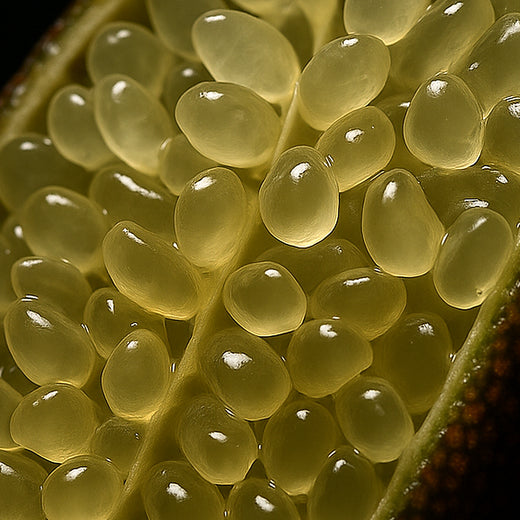
The skin is rough with numerous oil glands, and greenish yellow to pink. Like many other plants in the genus, the leaves contain numerous oil glands and are aromatic when crushed. Finger lime is also called caviar lime because its spherical pulp sacs give the pulp a caviar-like appearance.
Origin and Production
The finger lime is native to the southeastern corner of Queensland and the northeastern corner of New South Wales, from the area around Brisbane to the Clarence River. It grows in coastal rainforest and extends into neighbouring open forest, often on soils derived from basalt. There is an increasing range of genetic selections which are budded onto citrus rootstock. As of December 2024 the species is assessed as of least concern by the International Union for Conservation of Nature.
Chemistry
In three cultivars grown in Sicily, 84 volatile compounds were identified in the peel and the juice. The cultivars Pink Pearl, Sanguinea and Faustrime have distinct chemotypes, with limonene, sabinene and bicyclogermacrene in Pink Pearl, limonene, γ-terpinene and bicyclogermacrene in Sanguinea, and limonene, β-phellandrene and γ-terpinene in Faustrime.
In five Australian cultivars, the predominant volatile compounds in the peel were limonene, γ-terpinene, β-citronellol and citronellal. Limonene was the most abundant monoterpene hydrocarbon in all the samples of peel oil, accounting for up to 73.6% in the Red variety. Bicyclogermacrene was the sesquiterpene hydrocarbon with the highest relative abundance in all the peel oils. In the varieties examined, the peel oils were characterised mainly by monoterpenes, while the pulp oils were rich in sesquiterpenes.
Oils and nutrients
The cold-pressed oil of Faustrime, a hybrid of Microcitrus australasica, Fortunella and Citrus aurantifolia cultivated in Italy, was dominated by limonene (43.2%), citronellal (16.3%), γ-terpinene (4.5%) and α-phellandrene (4.5%). The leaf oil of C. australasica is a different mixture, with bicyclogermacrene (19–28%), germacrene-D (2–8%), delta-elemene (0.5–11%) and limonene (12–24%) as its principal components.
The fruits contain the nutrients vitamin C, folate and potassium, as well as the antioxidants vitamin E and polyphenols. Finger limes show promise for commercial development as a functional food.
Culinary Use
The finger lime has become a gourmet bushfood. Its globular juice vesicles, also called pearls, serve as a garnish or go into various recipes, and they give a burst of effervescent, tangy flavour as they are chewed. The juice is acidic and resembles lime juice. Marmalade and pickles are made from the fruit, and the peel can be dried and used as a spice.
Finger Lime · History
First Peoples living along the east coast of Australia used finger limes for hydration and to treat skin infections and cuts. Early settlers consumed the fruit and retained the trees when clearing for agriculture. Colonial botanists suggested that they should be cultivated, due to the lack of citrus alternatives.
Ferdinand von Mueller first described the species, which was published in 1858. In 1915 Walter Tennyson Swingle placed all four Australian species in a new genus, Microcitrus, and in 1998 David Mabberley restored the finger lime to Citrus. Commercial use of the fruit started in the mid-1990s with boutique marmalades made from wild harvested fruit. By 2000 it was being sold in restaurants and exported fresh.
Finger Lime · Technical Sheet
Identity
- Botanical
- Citrus australasica
- Taxonomy
- Sapindales order › Rutaceae family · GBIF
- Botanical records
- Citrus australasica: POWO, Citrus australasica · IPNI, Citrus australasica · GBIF, Citrus australasica · Wikidata, Citrus australasica · Wikipedia, Citrus australasica · IUCN Least concern (LC), Citrus australasica
- IPNI
- Citrus australasica F.Muell., Fragm. (Mueller) 1(2): 26 (1858) — Ferdinand Jacob Heinrich von Mueller (1825–1896)
- Type
- Ingredient
- Category
- Citrus smells
- Note
- N/A — limited commercial availability
In Nature
- Native range
- Australia · POWO
- Introduced to
- 1 region · Southern America 1
- Sample origins in GC-MS studies
- Italy (1 paper; one: Nat Prod Res 2023)
- Wild or cultivated
- 26 native · 5 introduced · 8 cultivated among 541 records (the rest carry no such mark) · GBIF
- Recorded in
- 12 of 512 squares of the world grid; a brighter dot holds more records · GBIF
- Also from this genus
- Citrus: Bergamot · Bergamot Blossom · Bitter Orange · Blood Orange · Buddha’s Hand · Calamansi · Candied Lemon · Chen Pi · 44 more entries
- Also from this botanical family
- Rutaceae: Acronychia pedunculata · Amyris · Boronia · Boronia Absolute · Buchu or Agathosma · Curry Tree · 9 more entries
In Print
- Timeline
- first described 1858 · earliest aroma paper in Europe PMC, 2015
- In English books
- most mentioned in the 1910s · Google Books Ngram
Classification
- Chemical class
- Complex natural mixture (monoterpene-rich peel oil)
Chemical data
- Formula
- Complex natural mixture (key constituents: limonene; γ-terpinene; bicyclogermacrene)
- GC-MS study
- Molecules 2022, Comparative Volatilomic Profile of Three Finger Lime (Citrus australasica) Cultivars Based on Chemometrics Analysis of HS-SPME/GC-MS Data
- Structure
- Limonene, Gamma-Terpinene:
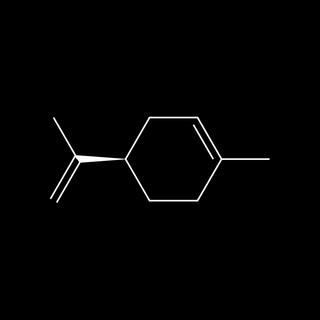
Limonene
PubChem, Limonene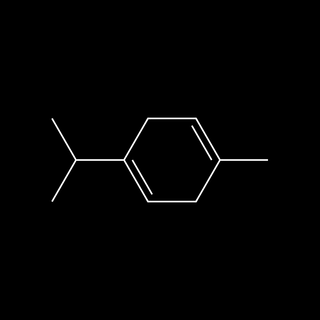
Gamma-Terpinene
PubChem, Gamma-Terpinene - INCI names (CosIng)
- CITRUS AUSTRALASICA SEED OIL (ANTIOXIDANT, HAIR CONDITIONING, HUMECTANT, SKIN CONDITIONING)CITRUS AUSTRALASICA FRUIT EXTRACT (ANTIOXIDANT, HUMECTANT, SKIN CONDITIONING)
Labelling
- Forms in the EU cosmetic inventory
- Finger Lime: CITRUS AUSTRALASICA FRUIT POWDER
Performance and rules
- Available as
- expressed oil
- IFRA status
- No IFRA Standard for the material itself (51st Amendment)
Finger Lime · See Also
Entries related to Finger Lime, by their place in the pyramid. “shared” marks a scent word Finger Lime has too.
Top notes

Kaffir Lime
citrus (shared) · fresh (shared) · green (shared) Citrus / Same cluster / Natural
Lemon Verbena
citrus (shared) · fresh (shared) · green (shared) Citrus / Same cluster / Natural
Lime
citrus (shared) · fresh (shared) · green (shared) Citrus / Same cluster / Natural
Lemon Tree
citrus (shared) · fresh (shared) · green (shared) Citrus / Same cluster / Natural
Lemon Zest
citrus (shared) · fresh (shared) · green (shared) Citrus / Same cluster / Natural
Calamansi
citrus (shared) · fresh (shared) · fruity Citrus / Same subfamily / Natural
Bergamot
citrus (shared) · aromatic · bitter · tea-like Citrus / Same subfamily / Natural
Buddha’s Hand
citrus (shared) Citrus / Same subfamily / Natural
Palestinian Sweet Lime
citrus (shared) · sweet · fresh (shared) Citrus / Same subfamily / Natural
Lemon
citrus (shared) · fresh (shared) · fruity Citrus / Same subfamily / Natural
Blood Orange
citrus (shared) · fresh (shared) · fruity Citrus / Natural
Neroli
floral (shared) · honeyed · green (shared) Florals / Top · Heart / Natural


Finger Lime · Sources
Read the science
- Phytochemistry (2015) Comparative analysis of three Australian finger lime (Citrus australasica) cultivars: identification of unique citrus chemotypes and new volatile molecules
- Nat Prod Res (2023) Volatile organic compounds from Citrus australasica growing in Basilicata (Southern Italy)
- International Plant Names Index (IPNI) Citrus australasica F.Muell.
- Antioxidants (2022) Comparing Metabolomic and Essential Oil Fingerprints of Citrus australasica F. Muell (Finger Lime) Varieties and Their In Vitro Antioxidant Activity
- Molecules (2022) Comparative Volatilomic Profile of Three Finger Lime (Citrus australasica) Cultivars Based on Chemometrics Analysis of HS-SPME/GC-MS Data
- Citrus Variety Collection, University of California, Riverside Microcitrus australasica
- FAO AGRIS Volatile compounds, phenolic acid profiles and phytochemical content of five Australian finger lime (Citrus australasica) cultivars
- FAO AGRIS The leaf oils of the Australian species of Citrus (Rutaceae)
- IFRA Standards, 51st Amendment
- Wikipedia Citrus australasica
Cite as PREMIEREPEAU Glossary, “Finger Lime”, https://premierepeau.com/

