


Mimosa Leaves
Keywords: green · fresh · floral
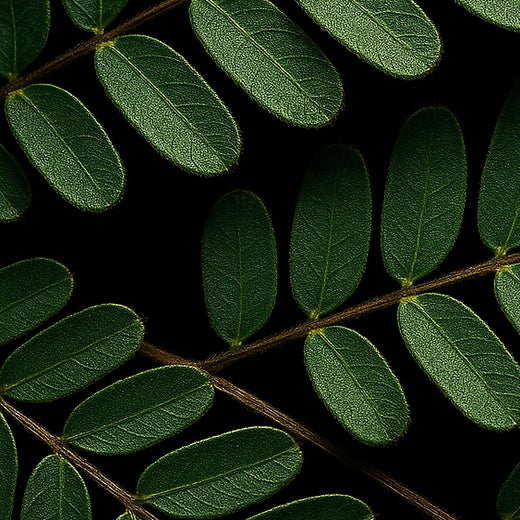
Mimosa leaves are the leaves of Acacia dealbata, the silver wattle, which is also called mimosa. The essence of the flowers of this tree, called mimosa, is used in perfumes.
- Olfactive family
- Aromatic · 510 entries of the glossary in this family Subfamily: Green notes · 93 entries in this subfamily Cluster: Green leafy notes · 420 entries in this cluster
- Material
- Natural Leaves and flowering tops
- Pyramid
- Top · Heart · Volatility: Top · Heart Note
- Strength
- Medium Step 3 of 5 · shared by 1,473 of 2,156 graded entries Graded entries at each step, from 1 to 5: 4, 119, 1,473, 498, 39. 23 more sit between two steps.
- Also called
- silver wattle, blue wattle, mimosa
Family, subfamily and cluster: PREMIEREPEAU house classification, version 2026‑11.
Mimosa Leaves · Facets
Entries of the glossary that carry each facet, of 3,979:
- green 1,442
- sweet 1,988
- powdery 197
- fresh 1,387
Mimosa Leaves · In Perfumery
In one fragrance, the leaf extract features in the top note and the bloom plays a major part in the heart.
Pyramid
Mimosa Leaves: Top · Heart. Entries of the glossary stored at each place of the pyramid, of 4,006 (42 store no place):
- Top 718
- Top · Heart 497
- Heart 1,641
- Heart · Base 514
- Base 594
Role in the formula
Mimosa Leaves: roles in the formula. Entries of the glossary that share each role, of 4,006:
- Diffusion enhancer 248
- Modifier 1,167
- Signature note 897
- Lifting agent 567
- Volume builder 780
- Freshness 720
Mimosa Leaves · Terroir & Origins
- Producing countries
- France, India, Morocco
Mimosa Leaves · Extraction & Chemistry
The leaves were extracted with dichloromethane and the extract was analysed by gas chromatography–mass spectrometry.
Available as
Mimosa Leaves: available as.
- essential oil
- concrete
- absolute
- Appearance
- Bluish grey or silvery, glaucous bipinnate leaves
Mimosa Leaves · Did You Know?
In Italy, Albania, Russia and Georgia the flowers are frequently given to women on International Women’s Day. Acacia dealbata is also allegedly the first plant to bloom in the aftermath of the Hiroshima atomic bomb in August 1945.
Mimosa Leaves · In Depth
The plant
Acacia dealbata, commonly known as silver wattle, blue wattle or mimosa, is a species of flowering plant in the legume family, Fabaceae. It is endemic to south-eastern mainland Australia but can be found as an introduced or invasive species elsewhere. The leaves are bipinnate and bluish grey or silvery. Each leaf has 6 to 30 pairs of pinnae, and each pinna carries 10 to 68 pairs of narrow pinnules 0.7 to 5 mm long. The leaves are sometimes used in Indian chutney.
Mimosa as a name
Florists use the name mimosa for its cut flowers and tip shoots, and this name is not to be confused with the genus of plants called Mimosa.
Leaf chemistry
The dichloromethane extract of the leaves showed the highest content of lipophilic compounds of the three parts studied, with lupenone as the major compound. Lupenone accounts for 32.5% of the total lipophilic extract of the leaves. The identified compounds in the leaf extract total 21,394.5 mg per kg of dry weight.
Terpenic compounds make up 68.4% of the identified compounds in the leaf extract. Lupenone is the most abundant of them, followed by α-amyrin and squalene. Lupeol has also been reported in the leaves. Fatty acids, long-chain aliphatic alcohols, monoglycerides and aromatic compounds were also detected in the extracts. In an allelopathy study, GC-MS analysis found resorcinol, maculosin and moretenone predominantly in the leaves. Methyl p-anisate, p-anisyl alcohol, stigmasterol and anisal were identified in the flowers.
The mimosa of perfumery
Acacia dealbata, better known as mimosa, reveals powdery, honeyed and green floral facets in the perfumer’s palette. It is not to be confused with Vachellia farnesiana (formerly Acacia farnesiana), which offers a more balmy and dried fruit profile.
Harvest and history
The mimosa tree arrived in France from Australia in the mid-19th century as a decorative plant for gardens. The first plantations of mimosa trees for the perfumery industry were established in 1865. The harvest season lasts for about four weeks, from February to early March, and is subject to climatic conditions.
In 1929 Provence experienced one of its worst winters, and most of the trees died. The winter of 1956 brought a savage frost that destroyed the majority of the mimosa plantations in southern France. The heady fragrance of mimosa enjoyed a heyday from the 1950s through the 1970s and is used in tiny amounts today.
Explore all seven extraits in the Discovery Set.
Related: Violet Leaf · Yellow Flowers · Violet Leaf Absolute · Carnation Leaves · Cassie Absolute · Black Currant Leaf
Mimosa Leaves · Technical Sheet
Identity
- Botanical
- Acacia dealbata
- Taxonomy
- Fabales order › Fabaceae family › Acacia genus · GBIF
- Botanical records
- Acacia dealbata: POWO, Acacia dealbata · IPNI, Acacia dealbata · GBIF, Acacia dealbata · Wikidata, Acacia dealbata · Wikipedia, Acacia dealbata · IUCN Least concern (LC), Acacia dealbata
- IPNI
- Acacia dealbata Link, Enum. Hort. Berol. Alt. 2: 445 (1822) — Johann Heinrich Friedrich Link (1767–1851)
- Type
- Ingredient
- Category
- Greens, herbs and fougeres
- Note
- Mimosa leaf absolute — green, hay-like facet distinct from flower absolute
In Nature
- Native range
- Australia · POWO
- Introduced to
- 59 regions · Africa 18 · Southern America 12 · Europe 9 · Tropical Asia 7 · Temperate Asia 5 · Australasia 4 · Northern America 2 · Pacific 1 · Antarctic 1
- Flowering
- peak in January–March · north of the equator · iNaturalist
- Recorded altitude
- 0–550 m · median 100 m · 14,368 records with an altitude · GBIF
- Wild or cultivated
- 776 native · 3,251 introduced · 119 cultivated among 74,592 records (the rest carry no such mark) · GBIF
- Recorded in
- 73 of 512 squares of the world grid; a brighter dot holds more records · GBIF
- Also from this genus
- Acacia: Mimosa · Mimosa Absolute · Wattleseed
- Also from this botanical family
- Fabaceae: Acacia · Albizia · Amburana Bark · Amburana Wood · Ashoka Flower · Astragalus · 47 more entries
In Print
- Timeline
- first described 1822 · earliest aroma paper in Europe PMC, 2014
- In English books
- most mentioned in the 1890s · Google Books Ngram
Classification
- Chemical class
- Lipophilic leaf extract, mainly terpenic compounds
Chemical data
- Formula
- Complex natural mixture (key constituents: lupenone; α-amyrin; squalene)
- Most reported compounds
- Robinetinidol (5 papers; one: J Nat Prod 2011, Robinetinidol) · Catechin (2 papers; one: Phytochemistry 1969, Catechin) · Epigallocatechin (2 papers; one: J Nat Prod 2011, Epigallocatechin) · (−)-Butin (1 paper; one: Phytochemistry 1969, (−)-Butin) · Butein (1 paper; one: Phytochemistry 1969, Butein) · LOTUS
- Structure
- Squalene:

Squalene
PubChem, Squalene - CAS
- 165800-52-2 (Acacia dealbata leaf extract)
- INCI names (CosIng)
- ACACIA DEALBATA FLOWER EXTRACT (SKIN CONDITIONING)ACACIA DEALBATA LEAF EXTRACT (SKIN CONDITIONING, SKIN PROTECTING)ACACIA DEALBATA SEED EXTRACT (SKIN CONDITIONING)ACACIA DEALBATA FLOWER CERA (SKIN CONDITIONING – EMOLLIENT, SKIN CONDITIONING)ACACIA DEALBATA FLOWER WAX (SKIN CONDITIONING – EMOLLIENT, SKIN CONDITIONING)
Labelling
- Forms in the EU cosmetic inventory
- Mimosa Leaves: ACACIA DEALBATA FLOWER/STEM EXTRACT
Performance and rules
- IFRA status
- No IFRA Standard for the material itself (51st Amendment)
Mimosa Leaves · See Also
Entries related to Mimosa Leaves, by their place in the pyramid. “shared” marks a scent word Mimosa Leaves has too.
Top notes

Basil
aromatic · green (shared) · herbal Aromatic / Top · Heart / Same subfamily / Natural
Mint
fresh (shared) · sweet (shared) · green (shared) Aromatic / Same subfamily / Natural
Black Pepper
spicy · warm · aromatic Aromatic / Natural
Rosemary
aromatic · herbal · camphorous Aromatic / Top · Heart / Natural
Resorcinol
musty · vanilla · nutty Gourmand / Synthetic


Heart notes

Strawberry Leaf
fruity · green (shared) · fresh (shared) Aromatic / Same cluster / Natural
Melilot or Sweet Clover
green (shared) · sweet (shared) · floral (shared) Aromatic / Same cluster / Natural
Sage
aromatic · herbal · amber Aromatic / Natural-
Mimosa Absolute
floral (shared) · powdery (shared) Florals / Heart · Base / Natural


Base notes

Sedge
woody · earthy · dry Woods / Natural

Mimosa Leaves · Sources
Read the science
- J Chem Ecol (2014) Ambient has become strained. Identification of Acacia dealbata Link volatiles interfering with germination and early growth of native species
- GBIF Acacia farnesiana (L.) Willd., name record of the World Checklist of Vascular Plants (Kew)
- International Plant Names Index (IPNI) Acacia dealbata Link
- International Journal of Molecular Sciences (2020) Characterization and Cytotoxicity Assessment of the Lipophilic Fractions of Different Morphological Parts of Acacia dealbata
- FAO AGRIS Effects and identification of chemical compounds released from the invasive Acacia dealbata Link
- IFRA Standards, 51st Amendment
- Wikipedia Acacia dealbata
Cite as PREMIEREPEAU Glossary, “Mimosa Leaves”, https://premierepeau.com/
