


Sulphur
Keywords: chemical element · odorless
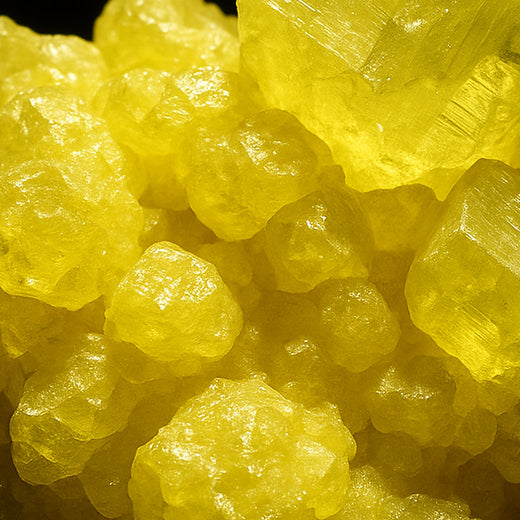
Sulphur, also spelled sulfur, is a chemical element with symbol S and atomic number 16. Elemental sulfur is a bright yellow, crystalline solid at room temperature, and pure sulfur is odorless.
- Olfactive family
- Fruity · 696 entries of the glossary in this family Subfamily: Tropical fruits · 120 entries in this subfamily Cluster: Mixed fruit notes · 346 entries in this cluster
- Material
- Fantasy/Concept Element found as sulfide and sulfate minerals and sometimes in native form; mostly produced as a byproduct of natural gas and petroleum processing
- Pyramid
- Base · Volatility: Base Note
- Strength
- Medium Step 3 of 5 · shared by 1,473 of 2,156 graded entries Graded entries at each step, from 1 to 5: 4, 119, 1,473, 498, 39. 23 more sit between two steps.
- Also called
- Sulfur, brimstone
Family, subfamily and cluster: PREMIEREPEAU house classification, version 2026‑11.
Sulphur · Facets
Entries of the glossary that carry each facet, of 3,979:
- floral 1,546
- smoky 166
- gourmand 91
- tropical 189
- roasted 132
Sulphur · Scent
Pure sulfur is odorless, but traces of hydrocarbon impurity may impart an oily and/or rotten egg odor.
Evolution over time
Sulphur: scent over time.
- Immediately
Pure sulfur has no smell on the blotter; any scent is a faint rotten-egg note from impurities.
- After a few hours
Where traces of hydrocarbon are present, an oily note appears beside the rotten-egg note.
The element has no odour of its own; every scent described here comes from impurities.
- Tenacity
- > 200 hours
Sulphur · In Perfumery
Grapefruit mercaptan, a sulfur compound, is sometimes used pure, or as citrus oils rich in it, to give citrus aromas and flavours. Buchu mercaptan, another sulfur aroma chemical, can be used in tiny traces to add realism to fruity accords, especially blackcurrant, peach and tropical fruits. Dimethyl sulfide is available as a food additive that gives a savory flavour, and its concentration in such use is low. Asafoetida, a resin whose odour comes mainly from organosulfur compounds, is used in perfumery mainly as a fixative.
Pyramid
Sulphur: Base. Entries of the glossary stored at each place of the pyramid, of 4,006 (42 store no place):
- Top 718
- Top · Heart 497
- Heart 1,641
- Heart · Base 514
- Base 594
Role in the formula
Sulphur: roles in the formula. Entries of the glossary that share each role, of 4,006:
- Signature note 897
- Lifting agent 567
- Naturalizer 162
- No perfumery function (odorless element) fewer than 40 entries
Sulphur · Where It Is Made
- Producing countries
- Indonesia, Chile, Japan, Mexico, Ukraine, Poland
Sulphur · Extraction & Chemistry
Almost all elemental sulfur is produced as a byproduct of removing sulfur-containing contaminants from natural gas and petroleum. In petroleum refineries, hydrogen sulfide is converted to elemental sulfur by partial combustion in the Claus process. In the Frasch process, superheated water is pumped into the sulfur deposit; the sulfur melts and is extracted. The Frasch process can be used for deposits 50–800 meters deep.
Available as
Sulphur: available as.
- standard form
- crystals
- powder
- molten liquid
- Appearance
- Bright yellow crystalline solid
Sulphur · Did You Know?
The odor threshold for hydrogen sulfide is 0.47 parts per billion, the point at which 50% of a human panel can detect the presence of an odor without being able to identify it. Hydrogen sulfide is very pungent at first, but it quickly deadens the sense of smell, creating temporary anosmia.
Sulphur · In Depth
What sulfur is
Under normal conditions, sulfur atoms form cyclic octatomic molecules with the chemical formula S₈. The best-known allotrope is octasulfur, cyclo-S₈, a soft, bright-yellow solid. It melts at 115.21 °C and boils at 444.6 °C. Sulfur is the tenth most abundant element by mass in the universe and the fifth most common on Earth. It is insoluble in water but soluble in carbon disulfide.
Occurrence
Elemental sulfur can be found near hot springs and volcanic regions in many parts of the world, especially along the Pacific Ring of Fire. In July 2024, elemental sulfur was found on Mars when the Curiosity rover crushed a rock and revealed sulfur crystals inside it. Sulfur is an essential element for all life, almost always in the form of organosulfur compounds or metal sulfides.
Sulfurous notes and organosulfur compounds
Organosulfur compounds are organic compounds that contain sulfur. Many sulfur compounds are odoriferous, and the smells of odorized natural gas, skunk scent, bad breath, grapefruit, and garlic are due to organosulfur compounds. Thiols are used as odorants to assist in the detection of natural gas, which in pure form is odorless.
Grapefruit mercaptan is a monoterpenoid that contains a thiol functional group. Furan-2-ylmethanethiol is a key component of the aroma of roasted coffee. Allicin is an organosulfur compound obtained from garlic and leeks. Dimethyl sulfide is the simplest thioether and contributes to the characteristic odor of sea air.
Detection
Volatile thiols typically have very strong, often unpleasant odors that can be detected by humans in very low concentrations. The detection threshold for the (+)-(R) enantiomer of grapefruit mercaptan is 3.4×10⁻⁵ ppb, or equivalently a concentration of 0.000034 nanograms per litre of air, the lowest detection threshold recorded.
Uses
The greatest commercial use of the element is the production of sulfuric acid for sulfate and phosphate fertilizers, and other chemical processes. Sulfur is used in matches, insecticides, and fungicides.
History
Sulfur was known in ancient times, being mentioned for its uses in ancient India, ancient Greece, China, and ancient Egypt. Historically, Sicily was a major source of sulfur in the Industrial Revolution. In 1894 the German-born American chemist Herman Frasch devised his Frasch method of sulfur removal using pipes to bypass the quicksand.
Explore all seven extraits in the Discovery Set.
Related: Gunpowder
Sulphur · Technical Sheet
Molecular weight
32.07 g/mol Heavier than 1 of the 261 other entries at the same place of the pyramid that store a weight.
2,515 entries store a molecular weight. By place in the pyramid: Top 537, Top · Heart 403, Heart 861, Heart · Base 452, Base 262.
Identity
- Botanical
- N/A — chemical element (S)
- Type
- Ingredient
- Category
- Accords and curiosities
Classification
- Chemical class
- Chemical element (nonmetal)
Chemical data
- Formula
- S
- Structure
- Sulphur:
 PubChem
- CAS
- 7704-34-9
- PubChem CID
- 5362487, compound record on PubChem
- InChIKey
- NINIDFKCEFEMDL-UHFFFAOYSA-N
- Wikidata · Wikipedia
- Sulphur: Q682, item on Wikidata · Wikipedia, English article
Physical properties
- Boiling point
- 444.6 °C
- Melting point
- 115.21 °C
- Flash point
- 207 °C (closed cup)
Performance and rules
- IFRA status
- No IFRA Standard for the material itself (51st Amendment)
Sulphur · See Also
Entries related to Sulphur, by their place in the pyramid. “shared” marks a scent word Sulphur has too.
Top notes

Lychee
fruity · floral (shared) · rosy Fruity / Same cluster / Natural
1-p-Menthene-8-thiol
grapefruit · fruity · tropical (shared) Citrus / 170.32 g/mol


Heart notes

Tucumã
nutty · creamy · warm Fruity / Same cluster / Natural
Genipapo
acidic · pungent · fruity Fruity / Same cluster / Natural
SugarLoaf Pineapple
fruity · tropical (shared) · sweet Fruity / Same subfamily / Natural
Fig
green · fruity · woody Fruity / Natural & Synthetic


Sulphur · Sources
- PubChem Sulfur
- IFRA Standards, 51st Amendment
- Perflavory Buchu mercaptan
- Wikipedia Sulfur
- Wikipedia Frasch process
- Wikipedia Grapefruit mercaptan
- Wikipedia Dimethyl sulfide
- Wikipedia Hydrogen sulfide
- Wikipedia Organosulfur chemistry
- Wikipedia Thiol
- Wikipedia Furfurylthiol
- Wikipedia Allicin
- Wikipedia Asafoetida
Cite as PREMIEREPEAU Glossary, “Sulphur”, https://premierepeau.com/
