Botany
Clovers are small annual, biennial or short-lived perennial herbaceous plants, typically growing up to 30 cm tall. The leaves are usually trifoliate, and the small flowers are reddish to white or yellow. Related genera with similar common names include Melilotus (sweet clover) and Medicago (burclover).
Red clover (Trifolium pratense) is a short-lived perennial that grows 20-80 cm tall, with dark pink flowers that have a paler base. Its species name comes from the Latin prātum, meaning meadow. It is native to Europe, Western Asia and northwest Africa, and has been naturalised in other continents, such as North and South America.
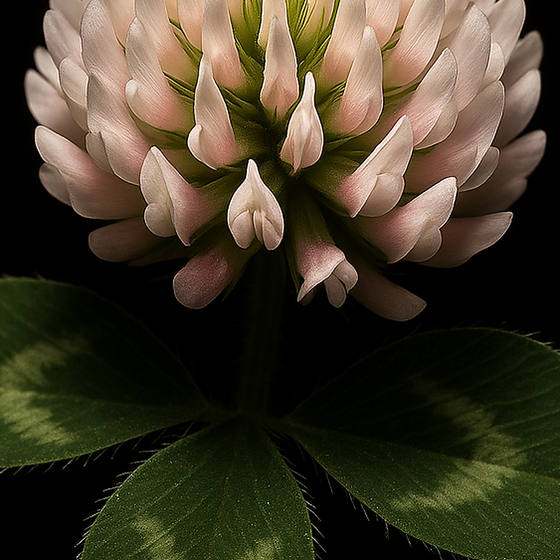
White clover (Trifolium repens) is a herbaceous perennial plant in the bean family. Its stems creep and root at the nodes, so it often forms mats. Its flowering heads hold whitish florets, often with a tinge of pink or cream. It is native to Europe and Central Asia and has been introduced to North America, South Africa, Australia, New Zealand and Japan.
Originating in Europe, the genus is found worldwide, with its highest diversity in the temperate Northern Hemisphere. Many species also occur in South America and Africa.
Cultivation
White clover has been described as the most important forage legume of the temperate zones. Clover fixes nitrogen using symbiotic bacteria in its root nodules, which reduces the need for synthetic fertilizers. Red clover has a deep taproot that makes it tolerant to drought. The flowers of both red and white clover are mostly visited by bumblebees. White clover is often added to lawn seed mixes, because it grows and gives green cover in poorer soils where turfgrasses do not perform well.
Constituents and uses
Phytochemicals in red clover include carbohydrates, isoflavones and other flavonoids, and saponins. The principal isoflavones are formononetin, biochanin A, daidzein and genistein. Isoflavone content varies markedly with plant part, phenological stage, cultivar and post-harvest processing. Red clover contains coumarin and flavonoid derivatives, so it should be used with caution by people with coagulation disorders or on anticoagulation therapy.
Clover is edible by humans. Tea can be made from the blossoms, and the seeds from the blossoms are used to make bread. In the United States, clover (Trifolium spp.) is on the list of substances generally recognized as safe as a spice, natural seasoning and flavoring, but that listing does not cover isoflavone supplement preparations.
Sweet clover and coumarin
Sweet clover, the genus Melilotus, takes its name from its sweet smell, not its bitter taste. Melilotus officinalis, known as sweet yellow clover, yellow melilot, ribbed melilot and common melilot, is a species of legume native to Eurasia. It can be an annual or biennial plant, 120-180 centimetres high at maturity, with three leaflets and yellow flowers.
—
Related: Abelia · Almond Blossom · Alpha Terpineol · Alstroemeria · Alumroot · Amarillys · Amazon Moonflower · Amethyst Flower