Gurjun balzam

PrirodnaSMOLE I BALZAMIbalzamski · drvenast · sladak
Bazne notePiramida
—Jačina
—Trajnost
5Poreklo
Uzorak
Gurjun balzam kao sirovina za parfeme
Bazne note
Dipterocarpus turbinatus
Definicija

Gurjun balsam is an oleoresin exuding from Dipterocarpus turbinatus and other species of Dipterocarpus.

Résineux
97
Balsamique
80
Doux
49
Boisé
65
Fumé
41
Chaleureux
25
East Indian copaiba balsam
Type
Sirovina
Olfactive family
Smolasti
Source
resin
Chemical class
sesquiterpene hydrocarbons (essential oil)
Instrumenti
Piramida
GGornje note
SSrednje note
BBazne note
Zemlje proizvođači
Indija Malezija Laos Vijetnam Filipini

Miris

The essential oil brings discreet woody notes at the beginning, then evolves on balsam tones, slightly sweet licorice, then spicy and guaiac wood. The essential oil of Dipterocarpus kerrii has a pleasantly balsamic odour. The oleoresin has a copaiba-like odour.

Klase i odležavanje

Detaljno

The essential oil obtained from the oleoresin is called gurjun balsam. The oleoresin obtained from the sapwood of Dipterocarpus is known as minyak keruing, damar minyak, minyak lagan or balau. Dipterocarpus turbinatus, commonly known as gurjan or gurjun, is a species of tree native to north-eastern India and mainland Southeast Asia. The trees of D. turbinatus are lofty, growing 30-45 m tall. The resin of the tree is used in India, where it is the source of kanyin oil and gurjun oil. Dipterocarpus tuberculatus, from Bangladesh, Burma (Myanmar), Indo-China and Thailand, is another important species yielding gurjun balsam. Dipterocarpus turbinatus is an important source of the wood known as keruing, and is often used in the plywood industry. The conservation status of Dipterocarpus turbinatus is Vulnerable, and the major threat for the species is habitat loss.

The essential oil is not a balsam in the strict sense, as it does not contain any cinnamic or benzoic acid. The essential oils from Dipterocarpus are composed almost exclusively of sesquiterpene hydrocarbons. As such they resemble copaiva balsam from South American Copaifera species and have also been known as East Indian copaiva balsam. The essential oil of Dipterocarpus kerrii oleoresin harvested by bark chipping contains 79% α-gurjunene, 5.3% allo-aromadendrene, 1.1% β-caryophyllene and 0.8% β-gurjunene. The essential oil from traditionally harvested oleoresin contains 58% α-gurjunene and 4.1% allo-aromadendrene. The essential oil of Dipterocarpus grandiflorus is soluble in common solvents except ethanol. The oil of Dipterocarpus grandiflorus contains 50-95% allo-aromadendrene and 3-20% α-gurjunene. The essential oil of Dipterocarpus gracilis is composed of 75% β-caryophyllene and 25% α-humulene. The balsam contains 40 to 70 per cent of a volatile oil that is similar to oil of copaiba in composition. Besides the volatile oil, the balsam contains crystalline gurjunic acid, resin and a bitter principle. The resinous fraction of the oleoresin contains 10-40% dipterocarpol, a triterpenoid. Alpha-gurjunene has the molecular formula C₁₅H₂₄ and a molecular weight of 204.35. The compounds α-gurjunene, allo-aromadendrene, humulene and caryophyllene have termiticidal properties.

The oleoresin is still traditionally used for illumination, to caulk boats, to make baskets watertight and to treat timber which is exposed to the weather. It is now used for interior varnishing, and in medicine as disinfectant, laxative, diuretic, mild stimulant, and in analgesic liniments. As a natural varnish it produces a brilliant, tough, and durable coating, but it is slow-drying and becomes brittle over time. In Cambodia, the almost solid resin is especially used to prepare torches. In herbal medicine, the plant has been traditionally used for treating gonorrhea, leprosy, psoriasis, and other skin diseases.

—

Related: Amberwood · Andiroba · Bakhoor · Balsamic Notes · Benzoin Resinoid · Benzyl Benzoate · Benzyl Salicylate · Birch Tar

Zanimljivosti

The annual production of Dipterocarpus alatus trees in Laos is estimated at 22.5-31 litres per tree. Laotian tappers claim that Dipterocarpus alatus trees are productive for 50-80 years.

Dobijanje i hemija

Način dobijanja

Tapping involves cutting a hole in the stem, with its base sloping down towards the centre of the stem, a process known as boxing. The hole is usually triangular and may extend halfway through the stem. Generally, the oleoresin starts to flow within an hour and collects inside the hole, and it is removed once every 7-8 days. After collection, the remaining hardened coat of oleoresin is set on fire to prevent clogging and to stimulate further flow. In Peninsular Malaysia a refined technique has been developed which gives a somewhat better product with a higher essential oil content. The bark chipping method involves removing the outer bark, after which a strip of inner bark 2.5 cm wide is removed to expose the wood. In Peninsular Malaysia the harvested oleoresin of Dipterocarpus is filtered by means of gunny sacks and flour sacks, which are firmly fixed to wooden frames. Distillation with water gives a higher essential oil yield. When freshly collected oleoresin from Dipterocarpus grandiflorus is distilled with water, it yields 38-40% of a yellowish essential oil. Direct distillation at 255°C of the oleoresin of Dipterocarpus alatus yields 70% reddish essential oil and 30% resin. Water distillation of the oleoresin of Dipterocarpus kerrii yields 80% essential oil.

Formula
Complex natural mixture (key constituents: alpha-gurjunene C₁₅H₂₄; allo-aromadendrene; beta-caryophyllene; beta-gurjunene)
CAS
8030-55-5
Botanički naziv
Dipterocarpus turbinatus
Izgled
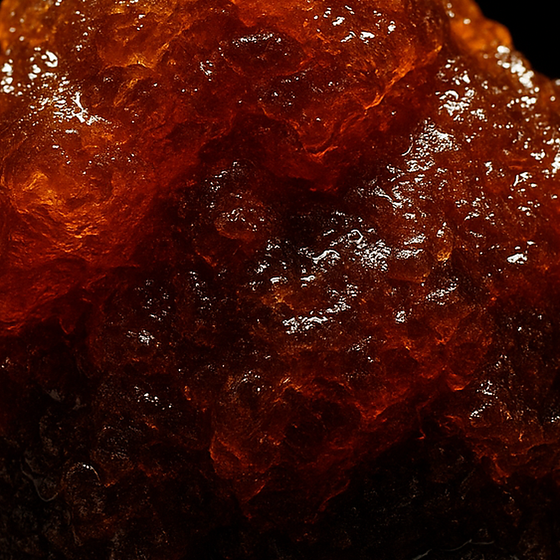
Thick, viscid balsam, grayish, greenish or brownish in reflected light, reddish-brown or brown in transmitted light; oil yellowish (D. grandiflorus) or reddish (D. alatus)
Sinonimi
East Indian copaiba balsam
Status prema standardima IFRA
Pogledajte napomenu

No IFRA Standard for the material itself (51st Amendment)

Fizička svojstva
Relativna gustina
0.9228 (d 30/30, essential oil of Dipterocarpus grandiflorus)
Indeks prelamanja
1.493 (n 30 D, essential oil of Dipterocarpus grandiflorus)

U parfemima

Gurjun balsam is used as a fixative in perfumery, particularly in soap perfumes. It is a cheaper substitute for patchouli oil obtained from Pogostemon cablin. The demand for and the value of Dipterocarpus oleoresins fluctuate with the availability and price of the preferred patchouli oil.

Uloga u formuli
01fiksativ
02modifikator
03sirovina za stapanje
04graditelj volumena
Oblici na tržištu
eterično ulje

Pogledajte i

6 nota