Mleko

AkordGURMANSKI I JESTIVI MIRISIkremast · topao · sladak
Srednje notePiramida
—Jačina
—Trajnost
1Poreklo
Uzorak
Mleko kao sirovina za parfeme
Srednje note
Fantazijska/konceptualna
Definicija

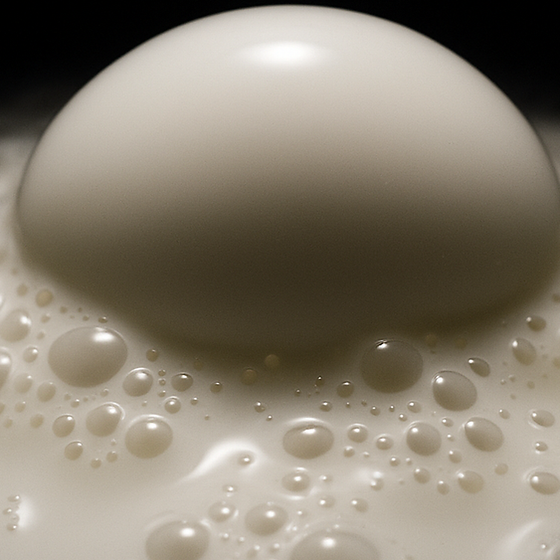
Milk is an emulsion or colloid of butterfat globules within a water-based fluid that contains dissolved carbohydrates and protein aggregates with minerals. Diacetyl, or butane-2,3-dione, contributes to the buttery sensory character of dairy products.

SLADAK GURMANSKI KREMAST MLEČAN PUTERAST KOKOSOV
Type
Akord
Olfactive family
Gurmanski
Instrumenti
Piramida
GGornje note
SSrednje note
BBazne note
Zemlje proizvođači
Indija (najveći proizvođač kravljeg mleka and bivoljeg mleka)

Miris

The lactone δ-decalactone smells intensely coconut-like, with creamy, sweet, milky and buttery nuances.

Detaljno

Butterfat is a triglyceride formed from fatty acids such as myristic, palmitic and oleic acids. Milk contains several different carbohydrates, including lactose, glucose, galactose and other oligosaccharides. The lactose gives milk its sweet taste and contributes approximately 40% of the calories in whole cow's milk.

Lactones are internally formed cyclic esters of γ- and δ-hydroxy acids. Two macrocyclic lactones, cyclopentadecanolide and 15-pentadec-11/12-enolide, have odors similar to those of the macrocyclic ketones of animal origin muscone and civetone.

Diacetyl is a yellow liquid with an intensely buttery flavor. Diacetyl occurs naturally in alcoholic beverages and some cheeses. It arises naturally as a byproduct of fermentation.

Across the 15 types of milk analysed, the four substances with the highest flavor contribution in all species were 2,3-butanedione, trimethylamine, isophorone and acetaldehyde. In the same analysis, human milk contained high levels of esters, particularly fatty acid ethyl esters, which contribute to its unique flavor.

Pasteurized cow's milk eventually spoils and assumes an unpleasant odor. In raw milk, the presence of lactic acid-producing bacteria, under suitable conditions, ferments the lactose present to lactic acid.

Lactic acid takes its name from its original isolation from soured milk (Latin: lac, lactis). The name lactone was coined in 1844 by the French chemist Théophile-Jules Pelouze, who first obtained it as a derivative of lactic acid. Thousands of years ago, a chance mutation spread in human populations in northwestern Europe that enabled the production of lactase in adulthood.

—

Related: Aldron · Ambretone · Ambrette Musk Mallow · Ambrettolide Natural Musk · Ambrinol · Coral Reef · Cyclopentadecanolide · Exaltolide

Dobijanje i hemija

Način dobijanja

δ-Decalactone can be obtained from both chemical and biological sources. Chemically, it is produced from Baeyer-Villiger oxidation of delfone. Diacetyl is produced industrially by dehydrogenation of 2,3-butanediol.

Formula
Complex natural mixture (key constituents: 2,3-butanedione C₄H₆O₂; trimethylamine; isophorone; acetaldehyde)
Status prema standardima IFRA
Pogledajte napomenu

No IFRA Standard for the material itself (51st Amendment)

Fizička svojstva
Nota
The pH of cow's milk ranges from 6.7 to 6.9.

U parfemima

Lactones contribute significantly to the flavor of fruit and of unfermented and fermented dairy products, and are therefore used as flavors and fragrances. δ-Decalactone is used as a dairy and fruit flavour. Diacetyl is a butter-flavoured vicinal diketone and is used for the simulation of butter-like and other milky flavours.

Uloga u formuli
01modifikator
02nota potpisa
03sirovina za stapanje
04graditelj volumena
Oblici na tržištu
sintetički akord fantazijska nota

Pogledajte i

7 nota