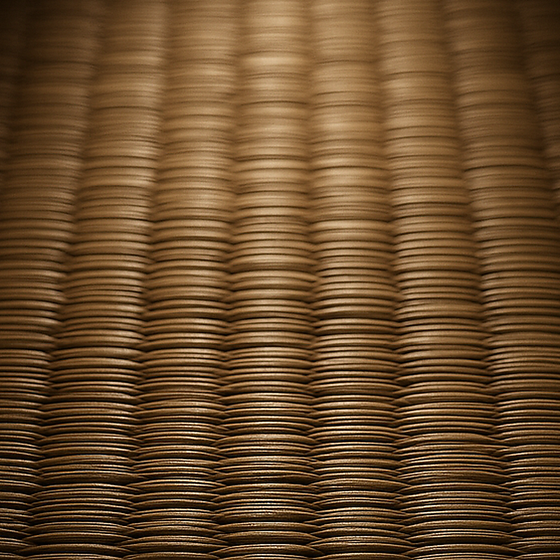
Tatami

AkordDRVA I MAHOVINEzemljan · drvenast · zelen
Bazne notePiramida
—Jačina
—Trajnost
1Poreklo
Uzorak
Tatami kao sirovina za parfeme
Bazne note
Juncus effusus L. var. decipiens Buchen.
Fantazijska/konceptualna
Definicija

Tatami is a soft mat used as flooring in traditional Japanese-style rooms. The unique smell of the washitsu comes from the tatami.

DRVENAST ZELEN ZEMLJAN TOPAO SVEŽ SUV
Type
Akord
Olfactive family
Drvenasti
Source
Soft rush (igusa), with a core traditionally of rice straw
Instrumenti
Piramida
GGornje note
SSrednje note
BBazne note
Zemlje proizvođači
Japan

Miris

Hexanal, the main volatile component of the rush, is associated with a green, grassy scent.

Detaljno

Tatami are made in standard sizes, twice as long as wide, about 0.9 by 1.8 metres, depending on the region. The mat is covered with a weft-faced weave of soft rush (igusa) on a warp of hemp or weaker cotton. The core, called the doko, is traditionally made from sewn-together rice straw. Contemporary tatami sometimes have compressed wood chip boards or extruded polystyrene foam in their cores instead or as well. The long sides are usually edged with brocade or plain cloth, although some tatami have no edging. In martial arts, tatami are used for training in a dojo and for competition. Tatami have also traditionally been used for tameshigiri, the Japanese art of target test cutting.

In Japan the soft rush Juncus effusus is called igusa and is grown to be woven into the covering of tatami mats. The white cotton-like structure inside the soft rush forms a dense honeycomb structure with excellent humidity adjusting and harmful substance adsorption properties. Kumamoto Prefecture is regarded as a representative region of Japan for soft rush.

An aroma extract dilution analysis of mat rush revealed 51 odor-active peaks. Twelve peaks with the higher FD factors proved to be the most important components of the characteristic aroma of mat rush. Eleven odorants were identified or tentatively identified from these peaks, among them methional, isovaleric acid and vanillin. The odor-active peaks in dried mat rush had much higher FD factors than those in raw mat rush. This suggests that the drying process during manufacture is one of the most important factors in forming the characteristic aroma.

Tatami can be categorized by their size, correlated to their place of origin. Kyōma tatami, which originated in Kyoto, measure 1.91 by 0.955 m, Chūkyōma tatami, which originated in Nagoya, 1.82 by 0.91 m, and Edoma tatami, which originated in Tokyo, 1.76 by 0.88 m. In Japan, the size of a room is usually measured in relation to the size of tatami mats. One tsubo is the area of two tatami mats.

—

Related: Alder · Alpha Humulene · Amaranth · Amberever · Amburana Bark · Antillone · Apple Tree

Zanimljivosti

Over 90% of igusa grown in Japan comes from a single region: Yatsushiro City in Kumamoto Prefecture on the island of Kyushu. In a study with 17 volunteers, those who used igusa mats reported reduced tension and anxiety afterward.

Dobijanje i hemija

Način dobijanja

After igusa is cultivated, it is dried and woven into mats. These mats are then sewn onto the tatami's base. In the traditional mud dyeing method, soft rush immediately after harvesting is immersed in a solution of natural soil in water. The mud coating prevents the chlorophyll and the internal structure of the rush from getting damaged.

Botanički naziv
Juncus effusus L. var. decipiens Buchen.
Status prema standardima IFRA
Pogledajte napomenu

No IFRA Standard for the material itself (51st Amendment)

U parfemima

Tatami's smell comes from the igusa rush that forms the mat surface.

Uloga u formuli
01modifikator
02nota potpisa
03sirovina za stapanje
04naturalizator
05graditelj volumena
06svežina
Oblici na tržištu
sintetički akord fantazijska nota

Pogledajte i

8 nota