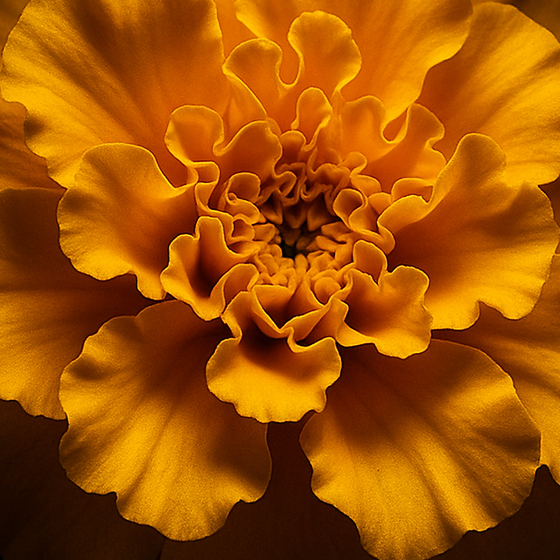
Tagetes is a genus of annual or perennial, mostly herbaceous plants in the family Asteraceae, and Tagetes erecta is one of its species. Tagetes plants are among several groups known in English as marigolds. The name African marigold usually refers to cultivars and hybrids of Tagetes erecta. Some authorities regard Tagetes patula, the French marigold, as a synonym of Tagetes erecta.
Botany and Cultivation
It is a herbaceous annual or perennial plant whose height ranges from 30 to 110 cm. The resin channels in the bark of its stem are aromatic when squeezed. It has a long flowering period extending throughout the summer and fall, and it reproduces easily by seeds. In Mexico the wild plant is found in the states of México, Michoacán, Puebla, Veracruz and Guerrero. In the wild it lives in diverse types of ecosystems, such as tropical deciduous forests, thorny forests, cloud forests and pine-oak forests. It is widely cultivated commercially, with many cultivars in use as ornamental plants and for the cut-flower trade. The cultivar Inca Orange has gained the Royal Horticultural Society's Award of Garden Merit. Due to antibacterial thiophenes exuded by the roots, Tagetes should not be planted near any legume crop. Across the genus, the foliage of some species smells musky and pungent, although some varieties have been bred to have no scent.
Pigments and Dye Uses
The pigments of the plant are due to carotenoids, of which the main one is lutein. The most intense orange tones of the flowers are related to a higher content of carotenoids, especially xanthophyll. The florets are rich in the orange-yellow carotenoid lutein and are used as a food colour in the European Union. In the United States, however, the powders and extracts are only approved as colorants in animal feed. The dried flower petals, ground to a powder, are used in poultry feed to ensure a good colouration of egg yolks and broiler skin. It is also used to enhance colouring in crustaceans such as the Pacific white shrimp. It is used as a natural dye on textiles.
Chemistry of the Oil
The essential oil of the flower contains antioxidants. Generally speaking, Tagetes oils are rich in monoterpene hydrocarbons such as ocimenes, limonene, terpinene and myrcene, and in acyclic monoterpene ketones (tagetone, dihydrotagetone and tagetenone), which are the primary odorants. They also hold lower amounts of sesquiterpene hydrocarbons and oxygenated compounds. The oils of Tagetes lucida and Tagetes filifolia differ, being dominated by phenylpropanoids such as methyleugenol, methylchavicol and anethole. Tagetes flower extracts and flower oils are mixtures of many substances. Tagetes minuta, which comes originally from South America, supplies an essential oil called tagette or marigold oil for the perfume industry, and the plant also serves as a flavouring in food and tobacco. Fresh Tagetes minuta has green and yellow-orange notes, and its taste and smell resemble a blend of sweet basil, tarragon, mint and citrus. The major components of Tagetes minuta oils from Madagascar vary considerably, since both the ocimenes and dihydrotagetone can range from 0.1% to 99%. The major constituents of a commercial Tagetes minuta oil from Madagascar include α-pinene (2.0%), limonene (7.4%), dihydrotagetone (11.6%) and tagetone (14.1%).
Safety and Regulation
Tagetes belong to the Composite family, of which several members are known to be phototoxic. Alpha-terthienyl, also called terthiophene, a phototoxic compound responsible for the phototoxicity of Tagetes extracts and oils, was found from below the detection level to 2.45%. On the 21st of June 2005 the Scientific Committee on Consumer Products adopted the opinion that Tagetes extracts and oils are phototoxic and that no safe limit of use in cosmetic products had been demonstrated. For Tagetes minuta and Tagetes patula, IFRA limits oils and absolutes to 0.01% in the consumer product on areas of skin exposed to sunshine, excluding bath preparations, soaps and other products that are washed off the skin. The SCCS concluded that a maximum level of 0.01% Tagetes minuta and Tagetes patula extracts and essential oils in leave-on products (except sunscreen cosmetic products) is safe, provided that the alpha terthienyl content of the extracts and oils does not exceed 0.35%. Because the effect of the phototoxic chemical is unpredictable in cosmetics with a sunscreen effect, Tagetes extracts and oils should not be used as components in this type of cosmetic product.
History and Names
The Aztecs gathered the wild plant as well as cultivating it for medicinal, ceremonial and decorative purposes. It was introduced to Europe after the Spanish conquest of the Aztec Empire and colonization. The Spanish name cempazúchitl, or cempasúchil, comes from the Nahuatl cempohualxochitl. The English name marigold comes from the arrangement of the petals, which resembles Calendula officinalis, also called Mary's gold. With the arrival of the Spaniards in Mexico, the documentary record of the ceremonial and medicinal use of Tagetes erecta increased. Bernardino de Sahagún described the flowers called Cempoalxóchitl as yellow and of good smell. Sahagún also described a role for the plant in the rituals of the Mexica festival in the month of Teculhuitontli. The physician Francisco Hernández described that at least seven types of flowers received the name cempoalxóchitl. Since prehispanic times, this plant has been used for medicinal purposes. The Cherokee used it as a skin wash and for yellow dye. In Mexico it is used in the festivities of the Day of the Dead to decorate altars and tombs, and it is also called the flor de muertos.