Гіпсофіла

АкордКВІТИквітковий · свіжий · пудровий
Ноти серцяПіраміда
—Сила
—Стійкість
3Походження
Зразок
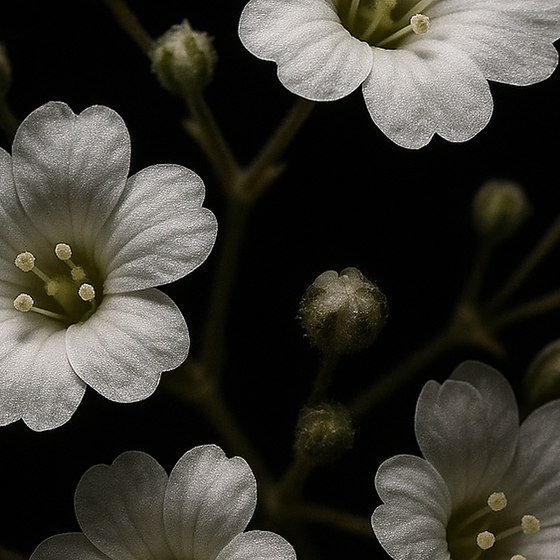
Гіпсофіла як парфумерна сировина
Ноти серця
Gypsophila paniculata
Фантазійний/концептуальний
Визначення

Baby's breath is the common name of Gypsophila paniculata, a flowering plant of the family Caryophyllaceae. Its scent has been described as sour milk, like a baby's spit-up.

КВІТКОВИЙ ЗЕЛЕНИЙ СОЛОДКИЙ ПУДРОВИЙ СВІЖИЙ
Common gypsophila, panicled baby's-breath, gyp
Type
Акорд
Olfactive family
Квіткові
Інструменти
Піраміда
ВВерхні ноти
СНоти серця
ББазові ноти
Країни-виробники
Азія Європа Північна Америка

Запах

The odor of gypsophila inflorescences is unpleasant. The cultivar 'Covent Garden Market' is non-scented.

Докладно

The plant is native to central and eastern Europe. It is an herbaceous perennial growing to 1.2 m (4 ft) tall and wide, with mounds of branching stems covered in clouds of tiny white flowers in summer. Its natural habitat is on the steppes in dry, sandy and stony places, often on calcareous soils.

The genus name comes from the Greek words for gypsum and loving, a reference to the gypsum-rich substrates on which some species grow.

The genus Gypsophila comprises approximately 150 species of annual or perennial herbaceous, creeping or cushion-forming plants, living mainly on the mountainous steppes of the north temperate part of the Old World. Each small flower has a cup-like calyx of white-edged green sepals containing five petals in shades of white or pink.

The major volatile compounds emitted from the inflorescences of the cultivar 'Bristol Fairy' were ocimene, 3-methylbutyric acid, 2-methylbutyric acid, ethanol and n-hexanol. The composition of volatiles varied among cultivars, and ocimene was the most abundant and common constituent detected in all gypsophila cultivars.

The two methylbutyric acids were identified as the compounds that characterize the unpleasant odor of gypsophila inflorescences. They were not detected in the volatiles emitted from 'Bristol Fairy' inflorescences at the bud stage; their emission increased gradually with bud opening and reached its highest level at the full open stage. They were highest in 'Bristol Fairy' and 'Golan', followed by 'Yukinko'.

Gypsophila paniculata is toxic to humans and can cause contact dermatitis. It is much used in the floristry trade, providing an effective backdrop for larger or more structured blooms. In the floristry trade it is often simply called gyp. It is commercially cultivated in Peru, forming a major portion of that country's flower exports.

—

Related: Acerola Blossom · Albizia · Anisaldehyde · Apple Blossom · Campion Flower · Cannonball Flower · Cotton Flower · Cyclamen

Цікавий факт

Gypsophila paniculata is classed as an invasive species in places around the Great Lakes, in the Pacific Northwest and in California, where it is a declared noxious weed. The genus Gypsophila is a source of saponins, whose detergent qualities make them useful in soap and shampoo.

Отримання й хімія

Ботанічна назва
Gypsophila paniculata
Зовнішній вигляд
Mounds of branching stems covered in clouds of tiny white flowers in summer
Синоніми
Common gypsophila, panicled baby's-breath, gyp
Статус IFRA
Див. примітку

No IFRA Standard for the material itself (51st Amendment)

У парфумерії

Ocimene, the most abundant volatile found in all the gypsophila cultivars studied, is used in perfumery for its sweet herbal scent.

Роль у формулі
01модифікатор
02фірмова нота
03сполучний компонент
04натуралізатор
05свіжість
Форми випуску
синтетичний акорд фантазійна нота

Див. також

7 ноти