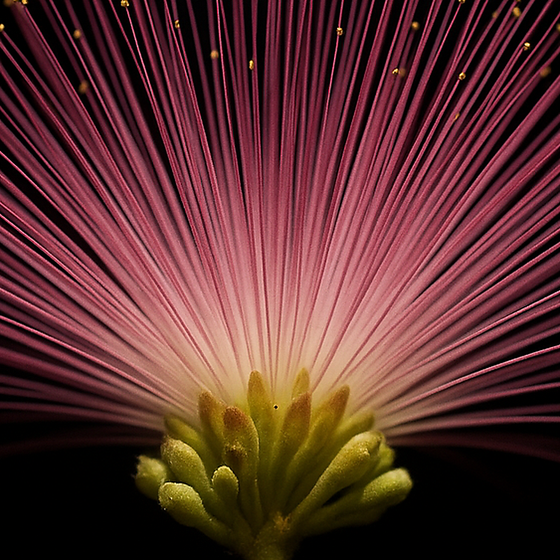
The genus Albizia is pantropical, occurring in Asia, Africa, Madagascar, America and Australia, but mostly in the Old World tropics. The plants are commonly called silk plants, silk trees, or sirises. Albizia can be told apart from the related genus Acacia by its stamens, which are joined at the bases instead of separate.
Albizia julibrissin
Albizia julibrissin is a small deciduous tree with a broad crown of level or arching branches, growing to 5-16 m (16-52 ft) tall. The flowers bloom throughout the summer in dense inflorescences that resemble starbursts of pink silky threads. Their colour runs from light to dark pink, and the prominent stamens are 2-3 cm long and white or pink with a white base. They have been observed to attract bees, butterflies and hummingbirds. The fruit is a flat brown pod 10-20 cm long, containing several seeds.
Origin and Distribution
Original habitats of the tree include regions from Iran (Persia) and the Republic of Azerbaijan to China and Korea. In the wild, the tree tends to grow in dry plains, sandy valleys, and uplands. It has become an invasive species in the United States. Its seeds have impermeable coats and can remain dormant for many years. The tree often dies at an early age from Fusarium wilt, a fungal disease for which there is no cure.
Names
The epithet julibrissin is a corruption of the Persian word gul-i abrisham. Albizia julibrissin is known by a wide variety of common names, such as Persian silk tree and pink siris. In the United States the species is called Chinese silk tree, silk tree or mimosa. The name 'Mimosa' has also been applied to several related species with similar pinnate or bipinnate leaves that are now classified in other genera, most commonly Albizia julibrissin and Acacia dealbata.
Uses
Albizias are important forage, timber and medicinal plants, and many are cultivated as ornamentals for their attractive flowers. Albizia julibrissin is widely planted as an ornamental in parks and gardens, grown for its fine leaf texture, flowers and attractive horizontal canopy. Silk tree wood may be used to make furniture, and the flowers are reportedly used to make teas. In Chinese medicine it is considered an antidepressant. The dried stem bark is used medicinally in China in the preparation of tonics and sedatives. The flowers provide nectar and pollen for bees. Leaf litter of the silk tree replenishes soil nutrients as it decomposes.