Breu-Branco

НатуральнийСМОЛИ Й БАЛЬЗАМИолеорезин · терпеновий
Верхні ноти·Ноти серцяПіраміда
—Сила
—Стійкість
1Походження
Зразок
Breu-Branco як парфумерна сировина
Верхні ноти й ноти серця
Protium heptaphyllum
Визначення

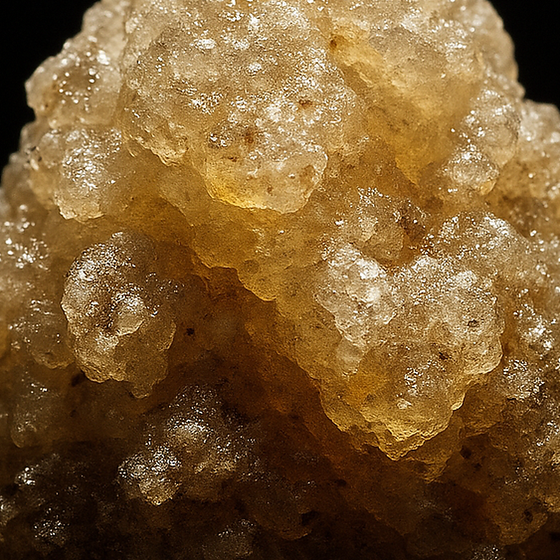
Breu branco is the oily resin that Protium heptaphyllum and other trees of the Burseraceae family exude from the trunk. The essential oil of the resin shows a predominance of monoterpene compounds.

СМОЛИСТИЙ ТЕРПЕНОВИЙ
Breu, Olíbano brasileiro, Resina de almecéga, Amazonic white pitch
Type
Складник
Olfactive family
Смолисті
Source
resin
Chemical class
Terpene mixture (triterpenes, mono- and sesquiterpenes)
Інструменти
Піраміда
ВВерхні ноти
СНоти серця
ББазові ноти
Країни-виробники
Бразилія

Запах

The oily resin that exudes from the trunk has a pleasant aroma.

Докладно

Breu branco is the oily resin that Protium heptaphyllum, a tree of the family Burseraceae, exudes from its trunk. Other members of the Burseraceae also exude such a resin. The tree is known as almécega, breu and almíscar, and it originated in South America. It is a large evergreen tree that can grow to be 10 to 20 meters tall.

The resin holds a mixture of triterpenes of the α-amyrin (ursane) and β-amyrin (oleane) series, together with an essential oil rich in mono- and sesquiterpenes. Acidic triterpenes make up 23.4% w/w of the raw resin. Monoterpenes are the main constituents of the volatile fraction, in the range between 85% and 98%. The volatile fraction of the resin includes the monoterpene hydrocarbons α-pinene, α-phellandrene, δ-3-carene and p-cymene. In one analysis the most abundant volatile compounds in the resin were α-pinene at 1.26% w/w and p-cymene at 1.11% w/w. The total content of volatile compounds in that resin was 5.07% w/w. Sesquiterpenes are present only to a limited extent. In the oil extracted in 2009, the major constituents were 3-carene, limonene and terpinolene. The volatile fraction also holds the oxygenated monoterpenes 1,8-cineole, trans-verbenol, terpinen-4-ol and p-cymen-8-ol, and the sesquiterpene β-E-caryophyllene.

The resin is traditionally used by the Amazon local population for making varnishes, wood boat sealants, fumigants and insect repellents. The resin has medicinal and insecticidal properties.

The tree

The tree is commonly found in Brazil, the Guyanas and Venezuela, and it flourishes in Amazonia, where it occupies the tropical rainforest. It is cultivated throughout Brazil because it adapts to sand and clay soils, but it cannot be cultivated in swampy soils or next to rivers with constant flooding. Local people harvest it for resin, food, wood and medical uses. The fruits, which appear from January to March, have a sweet and refreshing pulp that can be eaten fresh. The reddish wood is used in construction, floors, carpentry and joinery.

Цікавий факт

The Burseraceae, the family of Protium heptaphyllum, are also called the frankincense and myrrh family. The Protieae, the group of Burseraceae that includes Protium, originated in North America, migrated to Africa and Asia through the Tethys seaway, and then made its way back to South America by long-distance dispersal.

Отримання й хімія

Спосіб отримання

The resin is obtained from the trunk of the tree. The essential oil is extracted from the resin, with a yield (g/g) of 14.4% in 2009, 10.2% in 2011 and 10.7% in 2013.

Формула
Complex natural mixture (key constituents: terpinolene; p-cymene; p-cymene-8-ol)
Ботанічна назва
Protium heptaphyllum
Зовнішній вигляд
Oily resin
Синоніми
Breu, Olíbano brasileiro, Resina de almecéga, Amazonic white pitch
Статус IFRA
Див. примітку

No IFRA Standard for the material itself (51st Amendment)

У парфумерії

The resin is traditionally used by the Amazon local population for aromatic incense for religious rituals.

Роль у формулі
01модифікатор
02сполучний компонент
03формувач об’єму
04свіжість
Форми випуску
смола ефірна олія

Див. також

5 ноти