Ладан (frankincense (olibanum))

НатуральнийСМОЛИ Й БАЛЬЗАМИсмолистий · ладан
—Піраміда
—Сила
—Стійкість
7Походження
Зразок
Ладан (frankincense (olibanum)) як парфумерна сировина
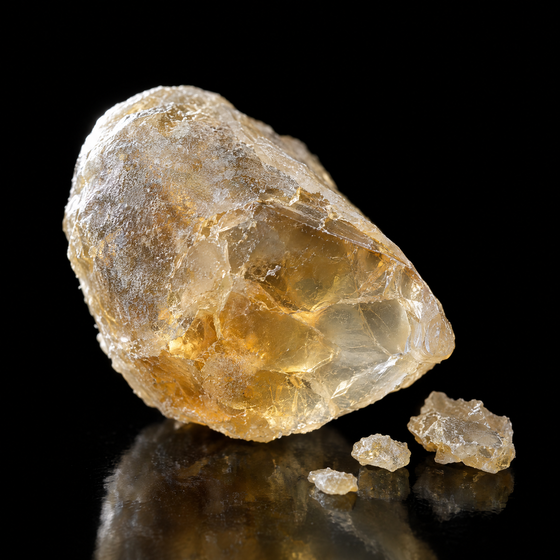
Boswellia sacra (family Burseraceae); B. carteri is a synonym
Визначення

Frankincense, also known as olibanum, is an aromatic resin used in incense and perfume, obtained from trees of the genus Boswellia in the family Burseraceae. The smell of the essential oil is described as terpenic, incense, peppery, spicy, old wood, woody, pine, resinous and green.

СОСНОВИЙ ЗЕЛЕНИЙ ПЕРЦЕВИЙ СМОЛИСТИЙ
Olibanum
Type
Складник
Olfactive family
Смолисті
Source
oleo-gum resin
Chemical class
aromatic resin
Інструменти
Країни-виробники
Сомалі Оман Ємен Ефіопія Еритрея Судан Індія

Запах

The oil is described overall as woody, fresh, aromatic, citrusy, spicy and green. It is also described as very fresh and bright, with a lemony smell that is slightly woody, green, terpenic/pine and peppery. Olibanum essential oil has a clean, bright citrus opening, often likened to lemon or orange peel, which gives way to a warm, resinous heart. Beneath this lies a subtle woody, slightly smoky dry-down.

Сорти й витримка

Докладно

Several species of Boswellia produce frankincense, including Boswellia sacra, B. frereana, B. serrata and B. papyrifera. Resin from each is available in various grades, which are affected by the time of harvest. The resin is hand-sorted for quality.

Frankincense or olibanum: the same material

The English word frankincense derives from the Old French expression franc encens, meaning 'true incense', maybe with the sense of 'high quality incense'. Olibanum comes from Medieval Latin, where it derived from λίβανος or libanus. Boswellia sacra is a tree native to Oman and Yemen, in the south of the Arabian Peninsula, and to Somalia and Ethiopia, in the Horn of Africa. Boswellia carteri was long considered an independent species, but in the 1980s it was determined to be a synonym of Boswellia sacra. Boswellia frereana grows in northern Somalia. Boswellia serrata grows in India, and Boswellia papyrifera in Ethiopia, Eritrea and Sudan.

Harvest and grades

The trees start producing resin at about eight to 10 years old. Today 90 percent of the world's production of frankincense comes from the Horn of Africa, predominantly from the border communities on the Somalia-Ethiopia border. Growing conditions vary significantly, affecting both tree development and resin produced. Trees in the narrow fog-laden zone where the desert meets the Dhofar mountain range, in the desert region of the Najd, grow extremely slowly and produce very high quality resin in large, white clumps. Generally speaking, the more opaque resins are the best quality.

Chemistry of the essential oil

The chemistry of the essential oil is mainly monoterpenes and sesquiterpenes, such as α-pinene, limonene and β-pinene. Steam-distilled frankincense oils do not contain the insufficiently volatile boswellic acids, which are triterpenoids, although they may be present in solvent extractions. Resins of B. carteri, native to Somaliland and Somalia, are rich in α-pinene and limonene, while Omani B. sacra is dominated by α-pinene. B. papyrifera, from Ethiopia and Sudan, has a notably different chemical profile, with octyl acetate as the predominant compound. Among various plants in the genus Boswellia, only Boswellia sacra, Boswellia serrata and Boswellia papyrifera have been confirmed to contain significant amounts of boswellic acids. Climate, geographical location and harvesting period may also affect the chemical composition of the oil.

Trade and conservation

In 1998, the International Union for Conservation of Nature warned that Boswellia sacra, one of the primary frankincense species, is near threatened. Recent studies indicate that frankincense tree populations are declining, partly from overexploitation. Boswellia papyrifera, found mainly in Ethiopia, Eritrea and Sudan, accounts for about two-thirds of global frankincense production. Most Boswellia grow in harsh, arid regions beset by poverty and conflict, where harvesting and selling the resin is one of the only sources of income for the inhabitants, resulting in overtapping.

Frankincense in PREMIEREPEAU perfumes

Frankincense is one of the materials in three PREMIEREPEAU perfumes. Albâtre Sépia, composed by Florian Gallo, combines it with white truffle and ink. Gravitas Capitale, by Grégoire Balleydier, places it among lemon, cardamom, tuberose and asphalt. Simili Mirage, by Claire Liégent, pairs olibanum with leather, thyme, sea salt and immortelle. You can try them together in the Discovery Set.

Цікавий факт

The frankincense tree Boswellia sacra was replanted in Israel in 2012, 1,500 years after dying out there. Frescos dated to around 1500 BC on the walls of the temple at Thebes commemorate a fleet that the Queen of Egypt sent to the Land of Punt; one of its five ships is shown carrying thirty-one small incense trees in tubs.

Отримання й хімія

Спосіб отримання

The resin is extracted by making a small, shallow incision on the trunk or branches of the tree or by removing a portion of the crust of it. It drains as a milky substance that coagulates in contact with air and is collected by hand. Tapping is done two to three times per year, with the final taps producing the best tears because of their higher aromatic terpene, sesquiterpene and diterpene content. The essential oil is extracted by hydro-distillation or steam distillation of the aromatic oleo-gum resin produced by the trees of the Boswellia genus.

Формула
Complex natural mixture (key constituents: α-pinene; limonene; β-pinene)
CAS
8016-36-2 (olibanum oil)
Ботанічна назва
Boswellia sacra (family Burseraceae); B. carteri is a synonym
Синоніми
Olibanum
Статус IFRA
Див. примітку

No IFRA Standard for the material itself (51st Amendment)

У парфумерії

Frankincense is one of the materials in three PREMIEREPEAU perfumes: Albâtre Sépia, Gravitas Capitale and Simili Mirage. The essential oil derived from the resin has become popular in perfumery and aromatherapy.

Форми випуску
смола ефірна олія

Див. також

8 ноти