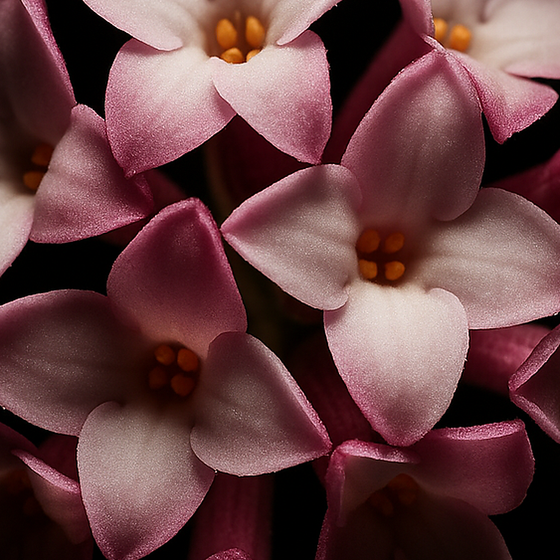
Daphne species are shrubs, with upright or prostrate stems. Daphne is a Eurasian genus, native to central and southern Europe and Asia. Some species are also found in north Africa. Many species flower in late winter or very early spring. The individual flowers completely lack petals and are formed by four, rarely five, petaloid sepals. The fruit is one-seeded and is either a fleshy berry or a dry and leathery drupe. Two species, Daphne bholua and Daphne papyracea, are harvested in Nepal and Bhutan for paper production. Many species are cultivated as ornamental shrubs in gardens.
Daphne odora is an evergreen shrub, grown for its very fragrant, fleshy, pale-pink, tubular flowers, each with four spreading lobes, and for its glossy foliage. It rarely fruits, producing red berries after flowering. It later spread from China to Japan and Korea. The Latin specific epithet odora means fragrant. In Korea, the plant is also poetically called "chullihyang" - a thousand-mile scent - referring to the delightful fragrance of the flowers. In Japan, the plant is more commonly known as jinchōge. Plants are not long lived, usually lasting eight to ten years. The cultivar 'Aureomarginata' has yellow edged leaves and is hardier and more suitable to cultivation than the plain-leaved forms. Daphne odora is also valued as a garden ornamental for its distinctive floral aroma.
Terpenoids including linalool, (Z)-β-ocimene, (R)-citronellol, geranial and geraniol were identified as the dominant volatile organic compounds of the flowers of Daphne odora. A total of 90 volatile compounds were detected in the flowers across five flowering stages. Total emission of floral volatiles peaked at 3957.48 ng∙g-1∙h-1 at full bloom. Terpenoids accounted for up to 99.07% of the total volatiles in the full blooming stages.
All parts of daphnes are toxic, the berries being particularly so. One active compound is daphnin, a glycoside, combining glucose with daphnetin. Some species have been shown to contain a further toxin, mezerein. Symptoms of ingestion include burning sensations and lesions of the mouth and upper digestive tract, gastroenteritis and diarrhoea. Some people experience dermatitis from contact with the sap of Daphne odora.
—
Related: Abelia · Almond Blossom · Alpha Terpineol · Alstroemeria · Alumroot · Amarillys · Amazon Moonflower · Amethyst Flower