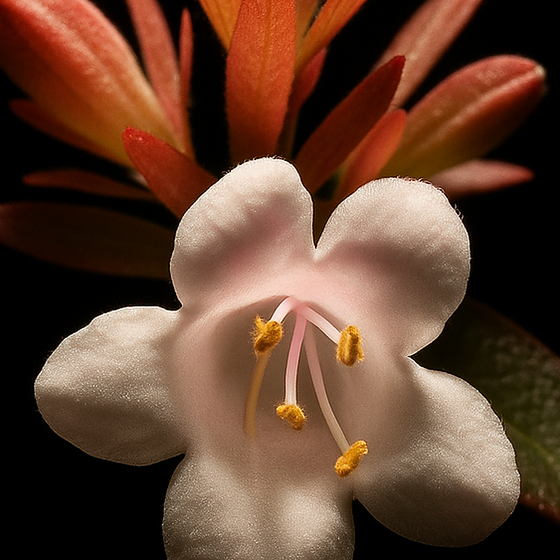
Абелія

АкордКВІТИквітковий · солодкий · пудровий
Ноти серцяПіраміда
—Сила
—Стійкість
—Походження
Зразок
Абелія як парфумерна сировина
Ноти серця
Abelia × grandiflora
Фантазійний/концептуальний
Визначення

Abelia is a genus of flowering shrubs in the honeysuckle family, Caprifoliaceae. Its flowers are usually scented.

КВІТКОВИЙ ЗЕЛЕНИЙ СОЛОДКИЙ ФРУКТОВИЙ СВІЖИЙ ВЕРШКОВИЙ
Abelia grandiflora, glossy abelia, Linnaea × grandiflora
Type
Акорд
Olfactive family
Квіткові
Source
flowers
Інструменти
Піраміда
ВВерхні ноти
СНоти серця
ББазові ноти
—Сила
Незначна
Незначна

Запах

The flowers of Abelia × grandiflora are fragrant, and the flowers of the genus are usually scented. Glossy abelia planted in mass adds a slight fragrance to the landscape. 2-Phenylethanol, another of the four, has a pleasant floral odor that is soft, like roses.

Докладно

Species of Abelia are shrubs from 1 to 6 m tall. The genus currently includes six species native to China, Taiwan, and Vietnam. The flowers are pendulous, white to pink, and bell-shaped, with a five-lobed corolla 1 to 5 cm long. The genus previously contained about 30 species and hybrids. Molecular phylogenetic studies showed that the genus was not monophyletic, and the majority of Abelia species have been transferred to other genera.

Origin and Cultivation

Glossy abelia, Abelia × grandiflora, is a hybrid shrub that is a cross between Abelia chinensis and Abelia uniflora. It was first raised in 1886 at the Rovelli nursery at Pallanza, now Verbania, on Lake Maggiore in Italy. It is used as an ornamental plant in specimen plantings in gardens, or in a mixed border with other shrubs. Though relatively easy to cultivate, it is not fully hardy and requires a sheltered position in full sun.

Abelia has an OPALS allergy scale rating of 5 out of 10, indicating moderate potential to cause allergic reactions. People allergic to honeysuckle may experience cross-reactive allergic reactions with Abelia.

Flower Volatiles

Four major volatile components emitted from flowers of Abelia grandiflora were identified: phenylacetaldehyde, benzaldehyde, 2-phenylethanol, and benzyl alcohol. Phenylacetaldehyde occurs extensively in nature because it can be biosynthetically derived from the amino acid phenylalanine. 2-Phenylethanol occurs widely in nature, being found in a variety of essential oils. It is found in extract of rose, carnation, hyacinth, Aleppo pine, orange blossom, ylang-ylang, geranium, neroli, and champaca.

Цікавий факт

Bees, butterflies, and hummingbirds are attracted to the flowers of glossy abelia. A blend of the four major flower volatiles was as effective as a cluster of flowers in stimulating upwind flight by male cabbage looper moths in a wind-tunnel test.

Отримання й хімія

Спосіб отримання

2-Phenylethanol, one of the four major volatiles of the flowers, is prepared commercially mostly by the Friedel-Crafts reaction between benzene and ethylene oxide in the presence of aluminium trichloride. Phenylacetaldehyde can be obtained via various synthetic routes, such as isomerization of styrene oxide.

Формула
Complex natural mixture (key constituents: phenylacetaldehyde C₈H₈O; benzaldehyde; 2-phenylethanol C₈H₁₀O; benzyl alcohol)
Ботанічна назва
Abelia × grandiflora
Зовнішній вигляд
Fragrant, bell-shaped flowers in clusters, white tinged pink, to 2 cm long
Сила запаху
Незначна
Синоніми
Abelia grandiflora, glossy abelia, Linnaea × grandiflora
Статус IFRA
Див. примітку

No IFRA Standard for the material itself (51st Amendment)

У парфумерії

Phenylacetaldehyde, one of the four major volatiles of abelia flowers, is added to fragrances to impart hyacinth, narcissi, or rose nuances. 2-Phenylethanol, another of them, is a common ingredient in flavors and perfumery, particularly when the odor of rose is desired.

Роль у формулі
01підсилювач дифузії
02модифікатор
03фірмова нота
04компонент піднесення
05сполучний компонент
06формувач об’єму
Форми випуску
синтетичний акорд фантазійна нота

Див. також

7 ноти