Едельвейс

НатуральнийКВІТИрослинний екстракт · косметичний інгредієнт
Ноти серцяПіраміда
—Сила
—Стійкість
1Походження
Зразок
Едельвейс як парфумерна сировина
Ноти серця
Leontopodium nivale subsp. alpinum
Визначення

Edelweiss is Leontopodium nivale, a mountain flower of the daisy or sunflower family Asteraceae. In cosmetics, edelweiss is used especially in anti-aging products for its antioxidant activity.

Leontopodium alpinum, Alpen-Edelweiß, stella alpina, étoile des Alpes
Type
Складник
Olfactive family
Квіткові
Source
flowers and leaves
Chemical class
Plant extract rich in polyphenols (glucaric and quinic acid derivatives)
Інструменти
Піраміда
ВВерхні ноти
СНоти серця
ББазові ноти
Країни-виробники
Швейцарія

Запах

The edelweiss extract in a glycerin and water base has a characteristic odor, which its specification does not describe further.

Теруар і походження

Докладно

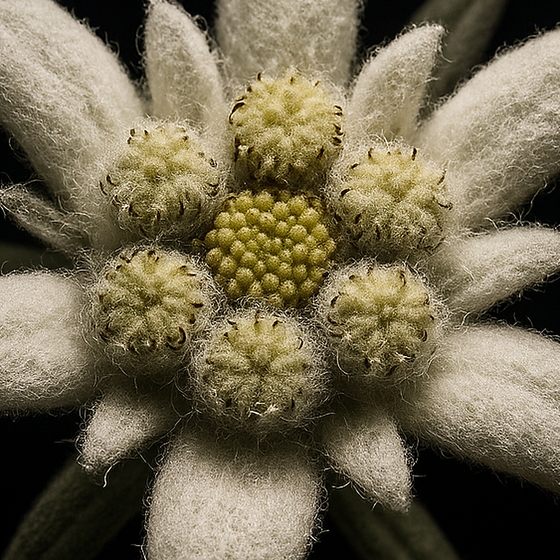
Edelweiss is a scarce, short-lived flower found in remote mountain areas. It prefers rocky limestone places at about 1,800-3,400 metres altitude. Its leaves and flowers are covered with white hairs and appear woolly. The dense hairs appear to protect the plant from cold, aridity, and ultraviolet radiation. The woolly tissue has a sub-micrometer internal structure that contributes to scattering and absorption of near-ultraviolet radiation. It is the national flower of Austria and Switzerland. It is a non-toxic plant.

Explore all seven extraits in the Discovery Set.

Description, names and taxonomy

Flowering stalks grow 3-20 centimetres tall in the wild and up to 40 cm in cultivation. Each bloom consists of five to six small yellow clustered florets. The flowers bloom between July and September. The name edelweiss comes from German and is a compound of edel 'noble' and weiß 'white'. It is called stella alpina in the Italian-speaking Alps and étoile des Alpes in the French Alps. The genus name Leontopodium combines the Greek words for 'lion' and 'foot'. In 2003, Leontopodium alpinum was re-classified as a subspecies of Leontopodium nivale.

Habitat and conservation

Its range is centred on the Alps and extends west to the Pyrenees and east into parts of the Balkans and the Apennines. Populations are typically restricted to exposed calcareous scree and rocky cliffs, often on north-facing slopes. Plants are adapted to high UV, strong winds, wide temperature fluctuations and thin soils. The IUCN considers the species of least concern. Its assessment notes historic population declines in places due to overcollection for souvenirs and horticulture and to local habitat loss. The plant is a protected species in many countries.

Chemistry

The most abundant compounds identified so far are derivatives of quinic acid (chlorogenic acid and di-caffeoylquinic acid) and of glucaric acid (leontopodic acids A and B). The two leontopodic acids are specific to edelweiss and are derivatives of glucaric acid substituted with caffeoyl and 3-hydroxybutanyl groups. They show strong antioxidant potential.

Uses

In traditional medicine, edelweiss was used as a remedy for digestive and respiratory illnesses, as powder, infusion and tincture. The INCI name of one cultivated extract is Leontopodium Alpinum Flower / Leaf Extract.

Symbolism

Edelweiss has been used as a symbol for alpinism, for rugged beauty and purity associated with the Alps and Carpathians. It is also a national symbol of Bulgaria, Slovenia and Italy.

Цікавий факт

According to folk tradition, giving this flower to a loved one is a promise of dedication. In 1856, Austrian Emperor Franz Joseph I picked an edelweiss from a steep rock for his wife Sisi, saying it was the first in his life that he had picked himself. The edelweiss has been worn as a cap emblem by Austrian troops and displayed on Austrian coins. Edelweiss Day is celebrated on the 5th of March.

Отримання й хімія

Спосіб отримання

To meet industry demand, alternative technologies such as crop cultivation and cell tissue culturing have been implemented. Callus culture, which uses non-differentiated, proliferating and metabolically active cells, is a developing technique for producing useful compounds. One cosmetic extract comes from the variety Leontopodium alpinum 'Helvetia', cultivated between 1000 m and 1500 m altitude in the Swiss Alps.

CAS
391900-47-3
Ботанічна назва
Leontopodium nivale subsp. alpinum
Зовнішній вигляд
Small yellow florets surrounded by fuzzy white bracts
Синоніми
Leontopodium alpinum, Alpen-Edelweiß, stella alpina, étoile des Alpes
Статус IFRA
Див. примітку

No IFRA Standard for the material itself (51st Amendment)

У парфумерії

A usage note for the flower and leaf extract says it is not for fragrance use and not for flavor use. Its listed cosmetic use is skin conditioning. The cultivated extract is described as helping slow the premature aging of skin and supporting the skin's protective barrier.

Див. також

7 ноти