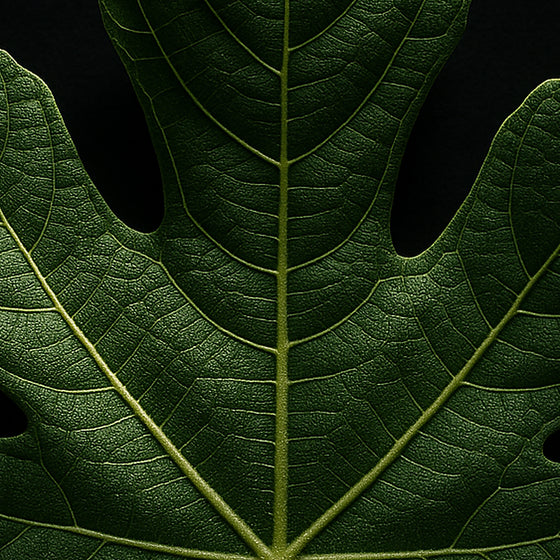
Ficus carica is a species of tree or shrub in the family Moraceae, native to the Mediterranean region and to western and southern Asia. Its fragrant leaves are some 20 cm long and 14 cm wide, rough and deeply lobed. The tree has milky sap, produced by laticifer cells.
Explore all seven extraits in the Discovery Set.
The material
Fig leaf absolute is supplied as a dark green solid paste and is classed among botanical powders and extracts. The IFRA Standards library holds a prohibition standard for the material, published in January 2006 and carried in the 40th Amendment; the standard covers CAS 68916-52-9 and 90028-74-3.
Botany and distribution
Ficus carica is the type species of the genus Ficus, which comprises over 800 tropical and subtropical plant species. The plant is a deciduous tree or large shrub, growing up to 7-10 m tall, with smooth white bark and large leaves with three to five deep lobes. It is gynodioecious. What is called the fig is a hollow, fleshy structure, the syconium, lined with numerous small unisexual flowers; botanically it is an infructescence containing many small fruits. The fig wasp Blastophaga psenes enters through a narrow opening at the apex of the fruit to pollinate the flowers, although F. carica does not always require pollination by a wasp.
The fig is commonly grown in an area that extends from Asiatic Europe to North India, and it is also grown as a crop in most Mediterranean countries because of their warm climates. Worldwide, over a million tons of figs are produced. About 80% of the overall production took place in Egypt, Israel, Algeria, Iran, Morocco, Spain and the United States, and Turkey is the top producer of dried figs.
Chemistry
GC-MS analysis of the volatile oil of the leaves of Ficus carica identified 121 volatile constituents. The major components of the leaf volatile oil include psoralen (10.12%), β-damascenone (10.17%), benzyl alcohol (4.56%), behenic acid (4.79%) and bergapten (1.99%).
Of the 121 leaf constituents, 103 were identified for the first time in that study. The volatile oil of the fruits is different: its major components are furfural (10.55%), 5-methyl-2-furaldehyde (10.1%) and benzeneacetaldehyde (6.59%), and 108 constituents were identified in the fruits. Eighteen constituents occur in both leaves and fruits.
Phototoxicity
The common fig contains significant quantities of two furanocoumarins, psoralen and bergapten. Psoralen and bergapten are found in the milky sap of the leaves and shoots of Ficus carica but not in the fruits. Contact with the milky sap of Ficus carica followed by exposure to ultraviolet light can cause phytophotodermatitis, a potentially serious skin inflammation. Phytophotodermatitis is a phototoxic inflammatory reaction of the skin resulting from contact with a light-sensitizing botanical agent followed by exposure to ultraviolet A light. The milky sap of fig leaves can cause phytophotodermatitis if used accidentally or inappropriately. A literature search revealed 19 cases of fig leaf-induced phytophotodermatitis reported between 1984 and 2012.
The photosensitizing substances in phototoxic plants are furanocoumarins, which are activated by long-wavelength ultraviolet light. Bergapten and xanthotoxin, two linear furanocoumarins derived from psoralen, are invariably found in plants associated with phytophotodermatitis. A reaction typically begins within 24 hours of exposure and peaks at 48-72 hours after exposure. Although the plant is not poisonous in itself, F. carica is listed in a US government database of poisonous plants.
Leaves in folk medicine
Fresh fig leaves have been used to treat constipation, and fig leaf extracts have been reported to lower blood sugar levels.