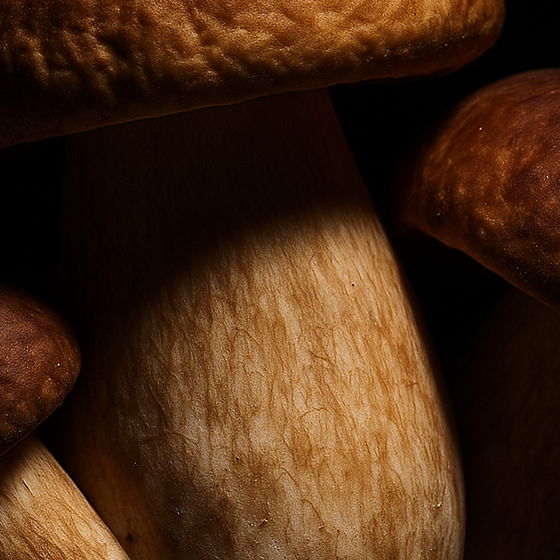
Білий гриб

Натуральний і синтетичнийФРУКТИ, ОВОЧІ Й ГОРІХИземлистий · горіховий · деревний

Сім ароматівОдин із них дивиться на вас

Ноти серцяПіраміда
3/5Сила
—Стійкість
·Походження
Зразок
Білий гриб як парфумерна сировина
Ноти серця
Boletus edulis
Визначення

Damp earth split open. The smell of a knife through a fresh porcini cap — raw, fungal, faintly metallic, like wet forest floor mixed with blood and hazelnut. The molecule responsible is 1-octen-3-ol, called 'mushroom alcohol' in flavor chemistry, detectable by the human nose at roughly one part per billion.

ЗЕМЛИСТИЙ ГРИБНИЙ МЕТАЛІЧНИЙ ЗЕЛЕНИЙ ГОРІХОВИЙ УМАМІ
PORCINI KING BOLETE BOLETUS EDULIS
Type
Складник
Olfactive family
Зелені
Source
fungi (Boletus edulis); synthetic 1-octen-3-ol
Chemical class
secondary allylic alcohol (C8 oxygenated volatile)
Інструменти
Піраміда
ВВерхні ноти
СНоти серця
ББазові ноти
3/5Сила
Середня
інтенсивність запаху
Країни-виробники
Італія, Франція, Китай, Туреччина, Польща (збирають у дикій природі; B. edulis неможливо вирощувати)

Запах

Raw, damp, fungal. The immediate impression of fresh-cut porcini is a wet, earthy, distinctly mushroom note — not the sweet earthiness of truffle, but something cooler, more vegetal, closer to the smell of soil after rain mixed with cut grass. A metallic, slightly blood-like edge comes from 1-octen-3-one, the ketone companion to mushroom alcohol. Behind the mushroom blast sits a faint nuttiness, almost like raw hazelnut shell, and a green-herbaceous undertone from terpene co-volatiles. Dried porcini shifts the profile: the fresh-mushroom sharpness recedes, replaced by a rounder, more umami-rich, almost brothy warmth, with pyrazine-derived roasted and cocoa-like qualities that develop during dehydration. Compared totruffle (sulfurous, garlicky, more penetrating), porcini is softer, more vegetal, less confrontational.

Докладно

1-Octen-3-ol (CAS 3391-86-4, C₈H₁₆O, MW 128.21) is the molecule that smells like mushroom. Known in flavor chemistry as 'mushroom alcohol,' it is the single compound most responsible for the characteristic aroma of fresh Boletus edulis — and of mushrooms in general. The human nose detects it at approximately 1 ppb in air. Its ketone analogue, 1-octen-3-one (CAS 4312-99-6, C₈H₁₄O, MW 126.20), is even more potent: threshold around 0.03 ppb, with a more metallic, raw-mushroom character.

Explore all seven extraits in the Discovery Set.

Chemistry and Biosynthesis

Both compounds are C8 oxygenated volatiles biosynthesised from linoleic acid via the lipoxygenase pathway. Lipoxygenase oxidises linoleic acid to 10-hydroperoxy-octadecadienoic acid; hydroperoxide lyase then cleaves the chain at C10–C11, releasing the C8 fragment. The reaction occurs rapidly when mushroom tissue is damaged — cutting, drying, or chewing triggers a burst of mushroom aroma. The natural enantiomer in Boletus edulis is (R)-1-octen-3-ol, which carries a stronger, more characteristic mushroom odor than the (S)-form.

The Mushroom

Boletus edulis is an ectomycorrhizal basidiomycete — it lives in obligate symbiosis with the roots of spruce, pine, beech, and oak across temperate and boreal forests of Europe, Asia, and North America. It cannot be cultivated commercially. Every porcini mushroom on the market was foraged from a forest floor. HS-SPME-GC-MS analyses of dried B. edulis (Zhang et al., Food Research International, 2020; Li et al., Food Chemistry: X, 2024) consistently identify 1-octen-3-ol, 1-octen-3-one, 3-octanone, benzaldehyde, and various pyrazines as key aroma-active volatiles. The volatile profile varies significantly by geographic origin.

In Perfumery

Porcini mushroom absolute exists as a niche raw material — produced by solvent extraction of dried Boletus edulis, yielding a dark, viscous concentrate with an intense earthy-umami character. It is not a mainstream perfumery ingredient. More commonly, perfumers use synthetic 1-octen-3-ol to construct mushroom or forest-floor accords. At trace doses in a composition, it reads not as 'mushroom' but as damp earth, wet leaves, undergrowth — a humus note that grounds green or woody structures. Patchouli and vetivershare some of this damp-earth territory, but 1-octen-3-ol provides a specifically fungal, loamy quality that neither terpene-rich oil can replicate.

Related Notes

See also: Patchouli, Vetiver, White Truffle.

Цікавий факт

Boletus edulis cannot be cultivated. Despite decades of commercial attempts, no one has succeeded in growing porcini mushrooms at scale. The fungus requires a living ectomycorrhizal partnership with specific tree species — its mycelium wraps around tree rootlets in a mutualistic exchange of sugars for mineral nutrients. Without the tree, no fruiting body forms. Every porcini mushroom sold worldwide — estimated at over 100,000 tonnes annually — is wild-foraged, making it an economically significant organisms that humans harvest but cannot farm.

Отримання й хімія

Спосіб отримання

Two forms exist. Porcini mushroom absolute is produced by solvent extraction (typically hexane or ethanol) of dried Boletus edulis caps and stems. The yield is very low — precise figures are not published by suppliers, and the material remains a specialty item. The absolute is a dark brown, viscous paste with an intense earthy-umami odor. Synthetic 1-octen-3-ol (CAS 3391-86-4) is the more common perfumery material. It is manufactured via acid-catalysed hydration of 1,2-octadien-3-ol, or by Grignard reaction of vinyl magnesium bromide with hexanal. Both routes yield a colorless liquid, bp 174-175 degrees C, density 0.84 g/mL. In nature, 1-octen-3-ol is not extracted but biosynthesised in situ by the mushroom's own lipoxygenase enzymes, which oxidise membrane-bound linoleic acid and cleave the resulting hydroperoxide to release the C8 alcohol. This reaction fires when tissue is disrupted — which is why mushrooms smell most intensely when sliced or dried.

Формула
C₈H₁₆O (1-Octen-3-ol)
CAS
3391-86-4 (1-Octen-3-ol, key aroma compound)
Ботанічна назва
Boletus edulis
Зовнішній вигляд
Colorless to pale yellow liquid
Сила запаху
Середня
Синоніми
PORCINI KING BOLETE BOLETUS EDULIS
Статус IFRA
Без обмежень

No known restrictions

Фізичні властивості
Температура кипіння
174-175 °C @ 760 mm Hg (1-octen-3-ol)
Температура плавлення
-27 °C (1-octen-3-ol)
Температура спалаху
60 °C (140 °F) TCC
Відносна густина
0.835-0.845 @ 25 °C
Показник заломлення
1.431-1.442 @ 20 °C

У парфумерії

Heart-to-base modifier, earth note, humus accord builder. 1-Octen-3-ol and its ketone analogue 1-octen-3-one function as the molecular signature of the fungal kingdom in perfumery. At sub-perceptible doses (well below 0.1% of a formula), they introduce a damp, loamy, forest-floor quality without reading as overtly 'mushroom.' This humus quality grounds green compositions, lends naturalistic depth to mossy-woody accords, and can simulate the smell of wet earth without the ozonic synthetics typically used. The mushroom note occupies a specific niche between vetiver's smoky rootiness, patchouli's fermented earthiness, and truffle's sulfurous pungency. It shares olfactory territory with oakmoss (now IFRA-restricted) and can partially substitute its damp-forest quality in modern chypre reconstructions. Porcini mushroom absolute, when available, is used in niche perfumery at trace concentrations as a naturaliser — it lends a raw, organic, almost umami-like richness. Synthetic 1-octen-3-ol is the practical workaround: stable, inexpensive, and effective.

Роль у формулі
01модифікатор
02натуралізатор
03фірмова нота
Форми випуску
абсолют синтетична речовина

Див. також

6 ноти