Виноградне листя

АкордЗЕЛЕНІ НОТИ, ТРАВИ Й ФУЖЕРНІ АКОРДИсвіжий · зелений · фруктовий

Сім ароматівОдин із них дивиться на вас

Ноти серцяПіраміда
—Сила
—Стійкість
—Походження
Зразок
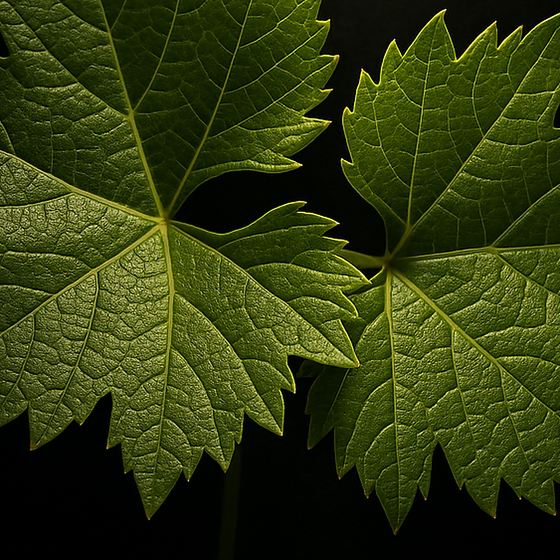
Виноградне листя як парфумерна сировина
Ноти серця
Vitis vinifera
Фантазійний/концептуальний
Визначення

Grape leaves are the leaves of the grapevine plant, used in the cuisines of a number of cultures.

КВІТКОВИЙ ЦИТРУСОВИЙ ЗЕЛЕНИЙ СОЛОДКИЙ ФРУКТОВИЙ СВІЖИЙ
Type
Акорд
Olfactive family
Ароматичні
Source
Leaves of the grapevine plant
Інструменти
Піраміда
ВВерхні ноти
СНоти серця
ББазові ноти

Запах

The leaf alcohol cis-3-hexen-1-ol, one of the green leaf volatiles, has an intense grassy-green odor of freshly cut green grass and leaves. The leaf aldehyde cis-3-hexenal has an intense odor of freshly cut grass and leaves. In grapes and wines, the green leaf volatiles are characterized by green, fresh, fruity and floral aromas.

Докладно

The plant

Vitis vinifera, the common grape vine, is a species of flowering plant native to the Mediterranean region, Central Europe and southwestern Asia. Its leaves are alternate, palmately lobed and deciduous, with three to five pointed lobes, coarsely prickly-toothed margins and a heart-shaped foot. They measure 5 to 20 cm (2 to 8 in) long and broad.

In the kitchen

Grape leaves may be obtained fresh, or preserved in jars or cans. The leaves are commonly rolled or stuffed with mixtures of meat and rice to produce dolma, often called sarma, which is found widely in the Mediterranean, Caucasus, Balkans and Middle East. When cut into smaller pieces they are used as a savory addition to soups that include greens and cabbage. Canned grape leaves (cooked, salted) are 76% water, 12% carbohydrates, 4% protein and 2% fat. A 100-gram reference amount of the canned leaves supplies 69 calories. In the Mediterranean Basin, leaves and young stems are traditionally used to feed sheep and goats after grapevine pruning.

Green leaf volatiles

Green leaf volatiles are a class of organic compounds released by plants. The class includes C6 aldehydes such as (Z)-3-hexenal and n-hexanal, and derivatives such as (Z)-3-hexenol and (Z)-3-hexen-1-yl acetate. In plants, cis-3-hexenal is formed from linolenic acid: a lipoxygenase first forms a hydroperoxide, and a hydroperoxide lyase then forms the hemiacetal, the precursor of the volatile C6 compound.

Terpenes in the leaves

Monoterpenoids, above all linalool, β-myrcene, geraniol and α-terpineol, are present in the leaves of muscat grapes in larger amounts than in the leaves of non-muscat grapes. The same difference is found in the fruit, but it is smaller in the leaves.

Related: Acronychia Pedunculata · Adoxal · Agave · Algae · Aloe Vera · Aromatic Notes · Asparagus · Avocado

Отримання й хімія

Спосіб отримання

A hexane extraction of plant material gives a concrete, which ethanol then turns into an absolute.

Ботанічна назва
Vitis vinifera
Зовнішній вигляд
Glossy dark green on top, light green below
Статус IFRA
Див. примітку

No IFRA Standard for the material itself (51st Amendment)

У парфумерії

The green fragrance family is marked by pronounced cut grass, crushed green leaf and cucumber-like scents. A green note of this kind is rendered with leaf alcohol, cis-3-hexen-1-ol, which is used to create green, fresh, outdoor-inspired scents. Its esters are also raw materials for flavor and fragrance.

Роль у формулі
01модифікатор
02компонент піднесення
03сполучний компонент
04натуралізатор
05формувач об’єму
06свіжість
Форми випуску
синтетичний акорд фантазійна нота

Див. також

8 ноти