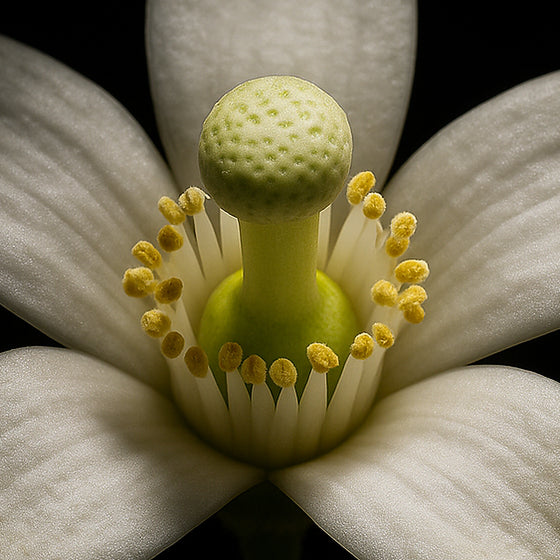
The grapefruit tree is evergreen and usually grows to around 4.5-6 m (15-20 ft) tall, although it may reach 13.7 m (45 ft). It produces 5 cm (2 in) white flowers with four or five petals. The name grapefruit may allude to clusters of the fruit on the tree, which often appear similar to bunches of grapes. The leaves are up to 15 cm (6 in) long, thin, glossy, and dark green. The fruit has a yellow-orange skin, is generally an oblate spheroid, and measures 10 to 15 cm (4 to 6 in) in diameter. Its flesh is segmented and acidic, and the pulp may be white, pink, or red, with the redder varieties generally the sweetest.
Parentage of the Grapefruit
The grapefruit is a citrus hybrid created through an accidental cross between the sweet orange (C. × sinensis) and the pomelo (C. maxima). Both parents were introduced to the Caribbean from Asia in the 17th century. The pomelo was the female parent and the sweet orange, itself a hybrid, was the male. The pomelo is the largest citrus fruit and is native to Southeast Asia. The pomelo is an ancestor of both the bitter orange and the grapefruit. The bitter orange is a natural hybrid between the pomelo and the mandarin. The lemon is a hybrid of the bitter orange and the citron.
The Fruit in Use
Grapefruit juice contains about half the citric acid of lemon juice and nearly 50% more than orange juice. In Costa Rica the fruit is often cooked with sugar to balance its sourness, and in Haiti it is used mainly for its juice and also for jam. The juice contains furanocoumarins that interfere with the metabolism of many drugs. The tree is subject to several citrus diseases, including citrus tristeza virus, citrus canker, and citrus greening disease.
Volatile Composition of the Flowers
The flowers of Citrus paradisi were analysed by solid phase microextraction together with those of four other citrus species, and monoterpene hydrocarbons and their oxygenated derivatives were the most abundant groups of compounds. In grapefruit flowers the largest components were limonene (22.4%), sabinene (14.7%), linalool (11.2%), β-ocimene (8.6%) and 2-hexanal (5.3%). Grapefruit leaves differ, with sabinene (27.4%) ahead of limonene (15.8%). Fewer studies exist on the volatiles of citrus flowers than on those of the rind. Many compounds of the peel, among them limonene, linalool, geraniol and β-caryophyllene, are also reported in citrus blossom and neroli, but perillaldehyde, carvone, valencene and nootkatone, found in the peel, are not always reported in blossoms.
Aroma Compounds of Grapefruit
Grapefruit mercaptan is a monoterpenoid thiol found in grapefruit and is the chemical constituent primarily responsible for the aroma of grapefruit. Its characteristic aroma belongs to the R enantiomer alone, and the detection threshold of that enantiomer, 0.000034 nanograms per litre of air, is the lowest recorded. Nootkatone is a sesquiterpenoid ketone and the most valuable aroma compound of grapefruit; it was originally isolated from the wood of the Alaskan yellow cedar and is made commercially from valencene by allylic oxidation.
The Pomelo Parent
The pomelo tree can be 5-15 metres (16-50 feet) tall, and its flowers, produced singly or in clusters, are fragrant and yellow-white. The pomelo is similar in taste to a sweet grapefruit, and its flesh is less acidic than that of the grapefruit.
Explore all seven extraits in the Discovery Set.