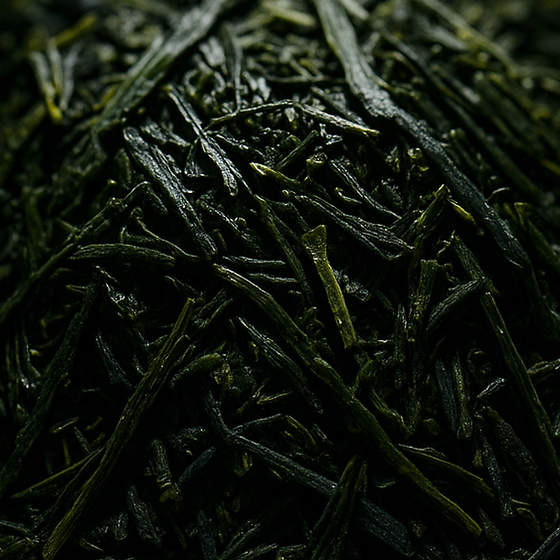
Гьокуро

НатуральнийЗЕЛЕНІ НОТИ, ТРАВИ Й ФУЖЕРНІ АКОРДИзелений · свіжий · насичений
Ноти серцяПіраміда
—Сила
—Стійкість
1Походження
Зразок
Гьокуро як парфумерна сировина
Ноти серця
Camellia sinensis
Визначення

Gyokuro, or jade dew, is a type of green tea from Japan that is grown under shade rather than in full sun. The characteristic smell of shaded teas such as gyokuro is described as similar to that of aonori, a type of seaweed.

Herbacé
99
Vert
71
Frais
63
Aromatique
50
Boisé
43
Terreux
20
Jade dew, jewel dew, pearl dew, precious dew
Type
Складник
Olfactive family
Ароматичні
Source
Tea leaves (Camellia sinensis)
Інструменти
Піраміда
ВВерхні ноти
СНоти серця
ББазові ноти
Країни-виробники
Японія

Запах

Japanese green teas often exhibit a fresh and marine aroma, very similar to seaweed. This seaweed aroma is more prominent in teas with a high concentration of amino acids including high grade sencha, kabusecha and gyokuro. Shading gives the tea leaves a distinctive green, seaweed-like scent. The wet leaves of gyokuro may smell like cooked asparagus. In some Japanese teas the wet leaves smell not only of seaweed but of sea water. Gyokuro has a special aroma, originally called the rice-straw smell because it is produced by shading tea plants with rice-straw. Too much dimethyl sulfide leads to an unpleasant odor, but a small amount mixes with the other aroma components to create a refreshing and pleasant aroma of tea.

Теруар і переробка

Докладно

The Japan Tea Central Association defines gyokuro as a tea manufactured in the same manner as sencha from tea leaves picked from covered tea gardens that are almost completely shaded from sunlight for about 20 days. Anything shaded for under twenty days is considered kabuse tea. Most sencha is from the Yabukita cultivar of Camellia sinensis, while gyokuro is often made from a specialised variety such as Asahi, Okumidori, Yamakai, and Saemidori.

The period of shading can vary from twenty to thirty days. The shading causes both the amino acid L-theanine and the alkaloid caffeine in the tea leaves to increase, and the catechins and tannins to decrease. Gyokuro also has higher chlorophyll content. These chemical differences give the tea more umami, a savory sweetness, and less bitterness and astringency. The increased L-theanine content elicits the increased umami taste of gyokuro. The higher grades of gyokuro are shaded more extensively and for longer times. Theanine makes up about 1 to 2 percent of the dry weight of green tea leaves.

The odor of gyokuro is associated with dimethyl sulfide, which is formed during processing by thermal degradation of S-methyl methionine. In green tea generally, the fleshy and greenish aroma that is typical of it is composed of (Z)-3-hexenol, (E)-2-hexenol, nonanal and (Z)-3-hexenyl hexanoate. Roast aroma, produced by pyrazines, is found in Japanese green teas because they are heated after production.

Most gyokuro is grown in the Fukuoka, Kyoto, and Mie prefectures. Gyokuro is one of the most expensive types of sencha available in Japan.

Brewing gyokuro is generally done with lower temperature water, between 40 and 70 celsius depending on the leaf and personal preference. The traditional Japanese method of brewing uses a high water to leaf ratio, usually around 5 grams of leaves for 150 millilitres of water. The same gyokuro can be re-infused three or four more times for 20-30 seconds once the leaves have opened.

—

Related: Acronychia Pedunculata · Adoxal · Agave · Algae · Aloe Vera · Aromatic Notes · Asparagus · Avocado

Цікавий факт

Theanine was isolated in 1950 by a laboratory in Kyoto from gyokuro leaf, which has high theanine content. In 2008, the production volume of gyokuro in Mie Prefecture increased more than 40 times compared to the previous year, from 3 tons in 2007 to 132 tons.

Отримання й хімія

Спосіб отримання

Shading may be done with a scaffolding built over the tea field or by covering the plants directly with the shading material. The process is often done in stages, initially blocking 70% of the sunlight, and ramping up to 80 and 90 percent before harvesting. Like standard sencha, gyokuro is steamed after harvesting, usually in industrial machinery. After steaming, the leaves are dried and rolled, traditionally by hand, but it is now common to use industrial machinery to roll them.

Ботанічна назва
Camellia sinensis
Синоніми
Jade dew, jewel dew, pearl dew, precious dew

Див. також

7 ноти