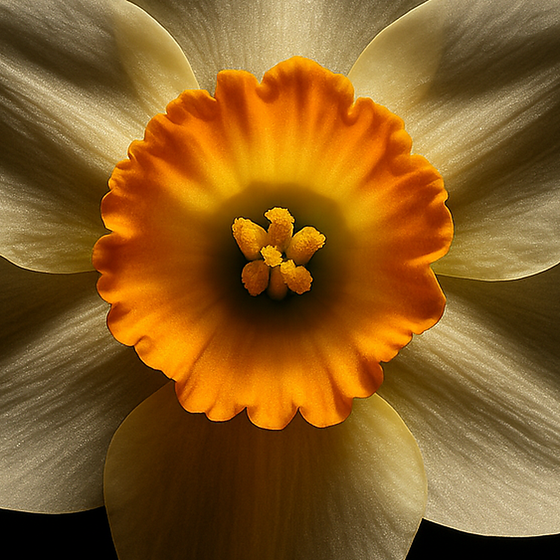
Нарцис

НатуральнийКВІТИквітковий · зелений · солодкий
Ноти серцяПіраміда
3/5Сила
400годСтійкість
2Походження
Зразок
Нарцис як парфумерна сировина
Ноти серця
Narcissus spp.
Визначення

Narcissus absolute is a fragrance material prepared from the flowers of Narcissus poeticus. Its odour type is green.

Floral
92
Vert
88
Doux
52
Terreux
45
Foin
60
Indolique
70
Narcissus flower absolute, Narcissus spp. absolute
Type
Складник
Olfactive family
Квіткові
Source
flowers
Chemical class
complex natural
Інструменти
Піраміда
ВВерхні ноти
СНоти серця
ББазові ноти
3/5Сила
Середня
інтенсивність запаху
Стійкість на блотері
400годин · 17 днів
1 год6 год24 год3 дн.7 дн.400 год
за 100 %
Країни-виробники
Нідерланди Франція

Запах

At 10% in triacetin the odour is described as green, cortex, sweet, jasmin, hay, tonka and castoreum. The odour is green, earthy and woody. In appropriate dilution it releases light floral notes (rose or jasmine) and deep floral notes (ylang-ylang, tuberose, orris and violet). It also shows balsamic notes (styrax) and woody, earthy scents (oakmoss or patchouli).

The floral character is green, intoxicating, rich and mellow, with hay and honey undertones. Smelling it in a 10% solution or less is recommended.

Теруар і походження

Докладно

The plant

Narcissus poeticus is also called the poet's narcissus and pheasant's eye. Narcissus poeticus belongs to the family Amaryllidaceae. It is native to central and southern Europe. The flower is extremely fragrant, with a ring of tepals in pure white and a short corona of light yellow with a distinct reddish edge. Poet's daffodil is cultivated in the Netherlands and southern France for its essential oil.

Essential oils and extracts used in the perfumery industry are mostly produced from N. jonquilla, N. poeticus, N. tazetta and some other species. While all narcissi are poisonous when eaten, poet's daffodil is more dangerous than others, acting as a strong emetic and irritant. The scent can be powerful enough to cause headache and vomiting if a large quantity is kept in a closed room.

Narcissus poeticus is a wild, bulbous herbaceous plant that grows 20 to 40 cm tall. Its leaves are green, narrow and long, and it blooms in late spring (April to May) with one white flower per stem. It is naturalised in Great Britain, Belgium, Germany, Turkey, New Zealand and much of the eastern United States, and it has long been cultivated in Europe.

The Netherlands, the most important source of flower bulbs worldwide, is also a major centre of narcissus production. Narcissi account for about 1,800 hectares of the 16,700 hectares under cultivation for flower bulbs there. Absolutes are also sold from other species: one supplier lists an absolute of N. tazetta var. chinensis as a yellow to amber yellow liquid.

Composition

More than 430 volatile compounds have been reported in Narcissus spp. The major components of N. poeticus absolute from the Massif Central in France are α-terpineol (23.7%), methyl (E)-isoeugenol (20.0%) and benzyl benzoate (19.4%). The main volatiles of N. tazetta absolute from Italy were γ-terpinene (27.21%), methyl cinnamate (15.84%), benzyl acetate (9.58%), benzyl alcohol (4.79%) and benzyl benzoate (4.00%).

Flowers from Sirente-Velino in the Abruzzo region gave cinnamyl alcohol (30.2 μg/g), benzyl benzoate (28.5 μg/g), isoeugenol methyl ether (28.1 μg/g), (Z)-ocimene (25.2 μg/g) and isoeugenol (22.9 μg/g) as the quantitatively major compounds. In supercritical CO2 extracts of N. poeticus, benzyl benzoate (9.44-10.22%), benzyl linoleate (1.72-2.17%) and benzyl alcohol (0.18-1.00%) were the major volatiles among aromatic compounds, and α-terpineol dominated among oxygenated monoterpenes (1.08-3.42%).

The main constituents of Chinese narcissus flowers were (E)-β-ocimene (62.73-66.06%) and benzyl acetate (11.65-25.02%), together with (Z)-β-ocimene, 1,8-cineole and linalool. In plants from Greece, (E)-ocimene (61.12%) was dominant for N. tazetta and benzyl acetate (19.36%) for N. serotinus.

Properties

The absolute is soluble in alcohol and insoluble in water. It should be stored in a cool, dry place in tightly sealed containers, protected from heat and light. Its shelf life is 12 months or longer if stored properly.

The genus and the figure

The genus is generally considered to have about ten sections with approximately 70-80 species. Narcissus occurs primarily in the Mediterranean region, with a centre of diversity in the Iberian Peninsula. The genus arose between the Late Oligocene and the Early Miocene, in the Iberian Peninsula and adjacent areas of southwest Europe. A few species extend the range into southern France, Italy and the Balkans, among them N. poeticus, N. serotinus and N. tazetta. The flowers are generally white and yellow, and orange or pink in garden varieties.

In Greek mythology, Narcissus is a handsome youth who becomes enamoured with his own reflection in a pool of water. In the most famous version, by the Roman poet Ovid, Narcissus rejects numerous suitors, including the nymph Echo. By the influence of Nemesis he becomes infatuated with his reflection, stays by the pool until he dies, and a narcissus flower later grows in that place. The mythological figure Narcissus is the origin of the term narcissism.

Explore all seven extraits in the Discovery Set.

—

Related: Abelia · Almond Blossom · Alpha Terpineol · Alstroemeria · Alumroot · Amarillys · Amazon Moonflower · Amethyst Flower

Цікавий факт

According to Plutarch, the name narkissos has been connected, because of the plant's narcotic properties, with the Greek word narkē, meaning numbness. Pliny wrote that the plant was named for its fragrance, not for the youth Narcissus. There is no evidence for the flower being named after Narcissus. The fragrance of Narcissus poeticus, which grows in Greece, has been described as intoxicating. A version of the myth by the poet Parthenius of Nicaea, composed around 50 BC, was rediscovered in 2004 among the Oxyrhynchus papyri at Oxford; it is very concise and makes no mention of Echo. Narcissus appears in nearly 50 Pompeian wall paintings.

Отримання й хімія

Спосіб отримання

The absolute is prepared from a concrete that is extracted with petroleum ether from the flowers of Narcissus poeticus. A few larger users of the absolute buy the concrete and carry out the final alcohol washings themselves. N. poeticus inflorescences have also been extracted with supercritical CO2, pure or mixed with 5% ethanol as co-solvent, at 40 °C. Extract yields varied from 1.63% at 12 MPa to 3.12% at 48 MPa with 5% ethanol. In total, 116 volatile compounds were identified in the extracts.

Формула
Complex natural mixture (key constituents: α-terpineol; methyl (E)-isoeugenol; benzyl benzoate)
CAS
68917-12-4
Ботанічна назва
Narcissus spp.
Зовнішній вигляд
dark green brown oily liquid
Сила запаху
Середня
Стійкість
400 hours at 100.00%
Синоніми
Narcissus flower absolute, Narcissus spp. absolute
Статус IFRA
Див. примітку

No IFRA Standard for the material itself (51st Amendment)

Фізичні властивості
Температура спалаху
167.00 °F. TCC ( 75.00 °C. )
Відносна густина
0.92400 to 0.99800 @ 25.00 °C.

У парфумерії

Narcissus fragrance is used almost exclusively in high class perfumes for lotions where alcohol solubility is a necessity. The absolute is used in classical perfumes in combination with rose, jasmine and violet. It is also used in modern perfumes, especially for a strong, pungent, green, woody and deep floral scent. This scent blends well with many other floral absolutes, such as ylang-ylang, jasmine, neroli, mimosa, clove bud carnation and others. The floral concrete or absolute has been used as a principal ingredient in about 11% of modern quality perfumes. Usage levels up to 2.0% in the fragrance concentrate are recommended. It is not for flavor use.

Роль у формулі
01фірмова нота
02підсилювач дифузії
03природність
04сполучний компонент
05складність
Форми випуску
абсолют

Див. також

6 ноти