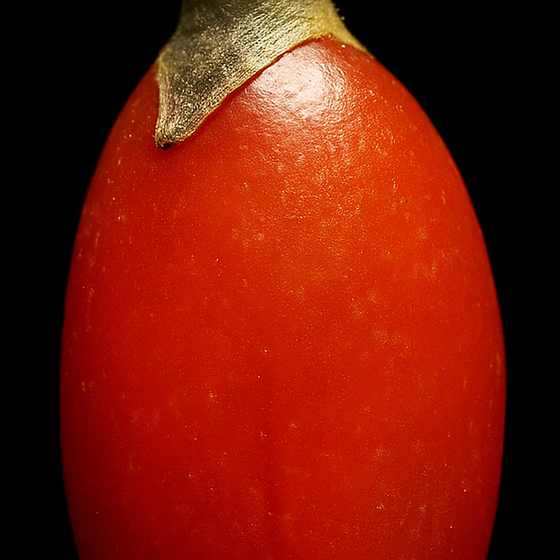
Lycium barbarum is a shrub native to China. It is one of two species of boxthorn from which the goji berry or wolfberry is harvested, the other being Lycium chinense. Its fruit is a bright orange-red, ellipsoid berry 1-2 cm in diameter. The plant is a deciduous woody shrub that typically grows to a height of 1-3 metres, with weak arching branches. Each berry holds between 10 and 60 seeds, depending on cultivar and fruit size. In the Northern Hemisphere flowering occurs from June through September and berries mature from August to October, depending on latitude, altitude and climate. The two species are similar but can be distinguished by differences in taste and sugar content.
Chemistry
Polysaccharides and proteoglycans are the main compounds in the fruit. Polysaccharides make up about 30% of the pulp. Carotenoid pigments are the second major group, chiefly zeaxanthin dipalmitate. Flavonoids derived from myricetin, quercetin and kaempferol have also been detected, along with the fatty acids hexadecanoic, linoleic and myristic acid. The roots contain betaine, choline, linoleic acid and β-sitosterol. The alkaloid atropine, common in plants of the family Solanaceae, is not detectable.
Volatile Chemistry
A survey of 104 goji berry samples from Ningxia, Gansu, Qinghai and Xinjiang, oven dried and ground, screened 275 components and identified 30 volatile compounds. The identified compounds fall into 8 categories. Hexanal and heptanal are among the identified compounds. Other identified compounds include 3-furaldehyde, 6-methyl-5-hepten-2-one, dimethyl succinate, 2-undecenal, octyl formate and a series of alkanes. Aldehydes, esters and alcohols dominate the aroma-active compounds, contributing fruity and floral notes. Phenolic compounds such as 3-methylphenol may introduce subtle woody undertones. Hexanal is an alkyl aldehyde that the flavor industry uses to produce fruity flavors. The scent of hexanal resembles freshly cut grass. Lycium chinense (wolfberry) is among the natural sources of safranal, the constituent primarily responsible for the aroma of saffron.
Origin and Production
The shrub is an important commercial crop in northern China, especially in the Ningxia Hui Autonomous Region. China is the main supplier of wolfberry products globally. Some 61% of commercially produced wolfberries in China come from L. barbarum plantations in the Ningxia region, mainly in Zhongning County. The plant is also cultivated in the Xinjiang Uyghur Autonomous Region of western China. Goji cultivation also occurs in Gansu, Qinghai Province, and the Haixi Mongol and Tibetan Autonomous Prefecture. Lycium barbarum has been cultivated in China along the fertile floodplains of the Yellow River for more than 600 years. In Ningxia, L. barbarum is also planted to control erosion and reclaim irrigable soils from desertification. In the first decade of the 21st century, farmers in Canada and the United States began cultivating goji on a commercial scale. Ningxia, centred on Zhongning County, totalled 200,000 acres as of 2005 and produced 13,000 tons of fruit in 2001, which was 42% of the national total. In 2023 the national cultivation area was 325,000 mu, about 21,667 ha, supporting a national wolfberry economy of 29 billion yuan. The main export products are beverages, juice concentrate, dried berries, snacks, and freeze-dried juice powder and berries. Australia imports most of its goji berries from China.
Uses and History
The genus name Lycium was assigned by Linnaeus in 1753. The Latin name lycium comes from the Greek word lykion, which refers to the ancient region of Lycia in Anatolia. The word goji approximates the pronunciation of gǒuqǐ in several Chinese dialects. The fruit has been an ingredient in East Asian traditional medicine, namely traditional Chinese, Japanese and Korean medicine, since at least the 3rd century AD. The berries of L. barbarum are the only therapeutic-grade wolfberries used by practitioners of traditional Chinese medicine. Young wolfberry shoots and leaves are harvested commercially as a leaf vegetable. The berries are used in dishes as either a garnish or a source of sweetness. Since the early 21st century the dried fruit, occasionally compared to raisins, has been marketed as a health food, with unsupported health claims about its benefits. Dried and fresh berries have been included in many snack foods and food supplements, such as granola bars. Whole and ground seeds and seed oil are also sold. Lycium barbarum has been used since the 18th century in the United Kingdom for hedging, especially in coastal districts. In the English-speaking world, the name goji berry has been used since around 2000.
—
Related: Acai Berry · Aldehyde C 16 Strawberry · Ashberry · Barberry · Bearberry · Blackberry · Blueberry · Boysenberry