


Mandarinenblätter
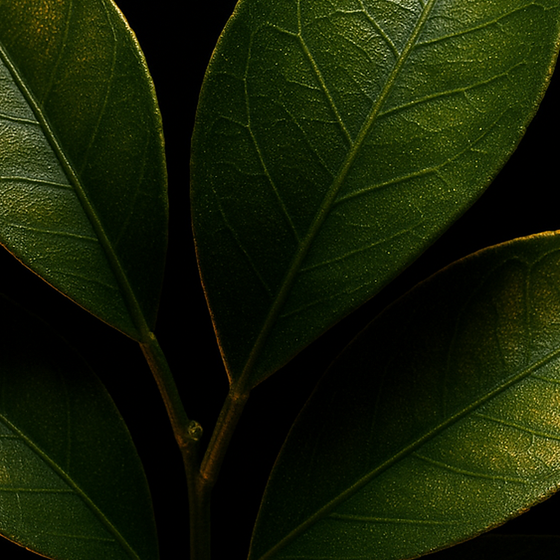
Mandarinenblätteröl, auch Petitgrain Mandarine genannt, wird aus den Blättern und kleinen Zweigen von Citrus reticulata destilliert. Sein Geruch wird als süß, reichhaltig, tieffruchtig, traubenartig und blumig beschrieben.
- Typ
- Zutat
- Duftfamilie
- Aromatisch
- Quelle
- Blätter und Zweige
- Chemische Klasse
- komplex natürlich (ätherisches Öl)
Duft
Terroir & Verarbeitung
Die ganze Geschichte
Wussten Sie schon?
Die Süßorange trägt sowohl Mandarinen- als auch Pampelmusen-Erbgut in sich; eine Genomstudie aus dem Jahr 2025 stützte ihre Herkunft aus einer Kreuzung von Bitterorange und Mandarine. Der Fruchtname Mandarine gelangte über das schwedische mandarin apelsin ins Englische, mit einem englischen Beleg aus dem Jahr 1771. Das schwedische apelsin verbindet Wörter für Apfel und China.
Extraktion & Chemie
Extraktionsmethode
Die Wasserdampfdestillation der Blätter des Citrus reticulata-Baums liefert das Öl. Die Ölausbeute aus 500 Gramm frischen Blättern von Citrus reticulata lag zwischen 0,078 und 0,232 Gewichtsprozent. Petitgrain Mandarine wird aus Blättern und Zweigen von Bäumen destilliert, die Mandarinenfrüchte tragen. Bitterorangen-Petitgrain wird ebenso wie die Blätter und grünen Zweige mit Wasserdampf destilliert.
- Formel
- Komplexes Naturstoffgemisch (Hauptbestandteile: Methyl-N-methylanthranilat C₉H₁₁NO₂; γ-Terpinen; Limonen)
- CAS
- 8014-17-3 (Petitgrain-Mandarinöl); 84929-38-4 (Mandarinenextrakt)
- Botanische Bezeichnung
- Citrus reticulata
- Aussehen
- Flüssig; blassgelb bei den sechs 2022 untersuchten ägyptischen Kultivaren und bernsteinfarben bis blass rötlich-braun in der kommerziellen Spezifikation von PCW.
- Geruchsintensität
- Mittel
- Synonyme
- Petitgrain Mandarine, Mandarinenblatt
Für den Rohstoff selbst gibt es keinen IFRA-Standard (51. Änderung). Sein Bestandteil Methyl N-methylanthranilat, erfasst vom IFRA-Standard „Methyl N-methylanthranilat“ (Änderung 51), ist in Fertigprodukten der Kategorie 4 auf 0,10 % begrenzt, alle Quellen eingerechnet; die Einsatzmenge des Blattöls hängt von seiner Zusammensetzung und den übrigen Inhaltsstoffen ab. Sein Potenzial, in nitrosierenden Systemen Nitrosamine zu bilden, verlangt eine Meldung an nachgelagerte Anwender, damit diese geeignete Schutzmaßnahmen erwägen können.
- Flammpunkt
- 58 °C (geschlossener Tiegel; PCW-PGM-2-Spezifikation)
- Dichte
- 0,920–1,040 (20 °C/4 °C; PCW-PGM-2-Spezifikation)
- Brechungsindex
- 1,494–1,544 (nD20; PCW-PGM-2-Spezifikation)
- Hinweis
- Physikalische Spezifikationen für PCW PGM-2 Petitgrain-Mandarinenöl (10. Februar 2026); die Werte können von Öl zu Öl variieren. Methyl-N-methylanthranilat, ein Hauptbestandteil der 1997 untersuchten italienischen Öle, hat eine molare Masse von 165,19 g/mol.
In der Parfümerie
Petitgrainöle werden in der Parfümerie und in der Aromatherapie als frisch duftende ätherische Öle verwendet.
Siehe auch
7 NotenQuellen
31- Italian Citrus petitgrain oils. II. Composition of mandarin petitgrain oilMondello, Basile, Previti and Dugo (1997), Journal of Essential Oil Research 9(3), 255–266; DOI 10.1080/10412905.1997.10554241. FAO AGRIS record of the original Italian industrial leaf-oil study.
- Methyl N-methylanthranilatePubChem
- IFRA Standards, 51st AmendmentIFRA
- petitgrain mandarin oilThe Good Scents Company
- PetitgrainWikipedia
- Mandarin orangeWikipedia
- IFRA Standard: Methyl N-methylanthranilateIFRA
- Guidance for the use of IFRA Standards — 51st AmendmentIFRA; natural complex substances and contributions from other sources, including §§7.11–7.12.
- Italian Citrus Petitgrain Oils. Part I. Composition of Bitter Orange Petitgrain OilMondello, Dugo, Dugo and Bartle (1996), Journal of Essential Oil Research 8(6), 597–609; DOI 10.1080/10412905.1996.9701026. Primary compositional study.
- Citrus reticulata Leaves Essential Oil as an Antiaging Agent: A Comparative Study between Different Cultivars and Correlation with Their Chemical CompositionsFahmy et al. (2022), Plants 11(23), 3335; DOI 10.3390/plants11233335. Original six-cultivar Egyptian leaf-oil experiment; cited for extraction, appearance and composition, not clinical efficacy.
- Petitgrain Mandarinier Essence — PGM-2 Technical Data Sheet, 10 February 2026Parfum Cosmetic World (PCW); current primary supplier specification for Italian Citrus reticulata leaf oil. Product-specific identity, colour, physical properties and origin.
- Characterization of Italian Citrus Petitgrain OilsDugo et al. (1996), Perfumer & Flavorist 21 (May/June), 17–28; original analytical research on industrial leaf oils, with geographic and extraction context. Publisher-hosted original PDF.
- Natural Isolates from Seville Bitter Orange TreeBoelens and Oporto (1991), Perfumer & Flavorist 16 (November/December); primary industrial research distinguishing flower, leaf and peel products. Publisher-hosted original PDF.
- Chemical variability of peel and leaf essential oils of mandarins from Citrus reticulata BlancoLota, de Rocca Serra, Tomi and Casanova (2000), Biochemical Systematics and Ecology 28(1), 61–78; DOI 10.1016/S0305-1978(99)00036-8. Original GC, GC/MS and 13C-NMR study of 41 cultivars under common cultivation conditions.
- Citrus reticulata — Ecocrop record 718FAO Ecocrop; institutional description of mandarin morphology, cultivation and frost sensitivity. Cultivar-dependent agronomic ranges, not oil-production statistics.
- Citrus reticulata (PROSEA)Sumeru Ashari, Plant Resources of South-East Asia, Fruits and nuts account, reproduced by Pl@ntUse/Pl@ntNet. Historical cultivation and trade data, including Indonesia in 1986; not a current leaf-oil market survey.
- Genomics of the origin and evolution of CitrusWu et al. (2018), Nature 554, 311–316; DOI 10.1038/nature25447. Original genomic analysis of ancestral citrus lineages, admixture and domestication.
- Origin and de novo domestication of sweet orangeLiu et al. (2025), Nature Genetics 57, 754–762; DOI 10.1038/s41588-025-02122-4. Original phased-genome and hybridization study supporting a sour-orange × mandarin parental model.
- Chinese loanwords in the OEDIsabel de la Cruz-Cabanillas (2008), Studia Anglica Posnaniensia 44; p.264 discusses mandarin, Swedish transmission and the 1771 English citation. Institutional repository of Adam Mickiewicz University.
- Heter det en eller ett apelsin?Swedish Institute for Language and Folklore (ISOF), Frågelådan; institutional explanation of apelsin as appel (apple) plus Sina (China).
- Petitgrain Mandarinier Égypte / Petitgrain Mandarin EgyptA. Fakhry & Co.; primary producer record naming Citrus reticulata Blanco, Egyptian product origin and the oil’s sweet, deep-fruity, grape-like, floral character.
- Aceite Esencial de Petitgrain Mandarina — Ficha Técnica, 30 November 2022Essentiales Mart S.L.; primary supplier specification naming Citrus reticulata leaf oil, Spain, and steam distillation of branches, leaves and flowers. Country evidence is product-specific.
- Pharmacographia — Other Products of the genus CitrusF. A. Flückiger and D. Hanbury, second edition (1879), p.128; contemporaneous scholarly account of petitgrain from immature oranges and from orange leaves/shoots. Project Gutenberg transcription.
- Petit-grain — Vocabolario on lineIstituto della Enciclopedia Italiana Treccani; literal French meaning and distinction between bitter-orange petitgrain and leaf/twig oils from other citrus trees.
- Petitgrain Mandarin oil — Citrus reticulataPurity Egypt; primary supplier record of leaf distillation, identity and perfumery/aromatherapy applications. An application listing, not evidence of therapeutic efficacy.
- Petitgrain Mandarin Oil (Citrus reticulata Blanco var. mandarin), FEMA 2854Flavor and Extract Manufacturers Association; institutional identity record, CAS 8014-17-3. Flavoring identity is not unrestricted fragrance-use approval.
- Compendium of food additive specifications, Addendum 13 — methyl N-methylanthranilate, No.1545FAO/WHO JECFA, 65th meeting (2005), Section C; institutional compound identity, formula and molecular-weight specification. Cited for the constituent, not the whole essential oil.
- Origin and de novo domestication of sweet orange — full textLiu et al. (2025), Nature Genetics 57, 754–762; DOI 10.1038/s41588-025-02122-4. NIH PMC access to the same original phased-genome and hybridization study cited at its publisher URL; not a second independent experiment.
- Pharmacographia, second edition (1879), p.128 — Other Products of the genus CitrusFriedrich A. Flückiger and Daniel Hanbury. Project Gutenberg transcription of the historical scholarly account; alternate access to the same edition as the existing cache URL. Distinguishes immature-orange distillation from leaves and shoots.
- Petitgrain Mandarin Oil — Product Specification Sheet, version 03, 24 June 2020Pure Essential Oils & Herbs Co. (Purity Egypt), product PSD04400. Primary Egyptian leaf/twig oil specification, identity, steam distillation and sensory description. Product-specific figures differ from PCW; no cross-product physical range is inferred.
- Citrus reticulata BlancoInternational Plant Names Index (IPNI)
