


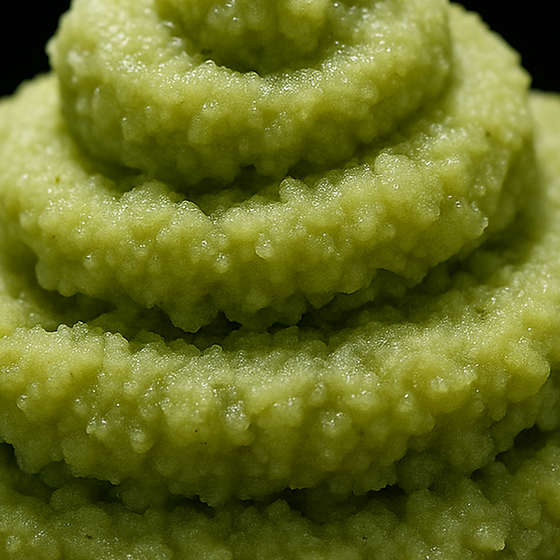
Wasabi, auch Japanischer Meerrettich genannt, ist eine Pflanze aus der Familie der Kreuzblütengewächse (Brassicaceae). Sie wird wegen ihrer Rhizome angebaut, die zu einer Paste zerrieben als scharfes Gewürz zu Sushi und anderen Speisen dienen.
- Typ
- Rohstoff
- Duftfamilie
- Würzig
- Quelle
- Rhizom
- Chemische Klasse
- Isothiocyanate
Duft
Die ganze Geschichte
Wussten Sie schon?
Der chemosensorische Rezeptor TRPA1, das sensorische Nervenziel des Senföls, wird auch als Wasabi-Rezeptor bezeichnet. Synthetisches Allylisothiocyanat wird zudem in Feuermeldern für Gehörlose eingesetzt.
Extraktion & Chemie
Extraktionsmethode
Allylisothiocyanat entsteht durch Hydrolyse von Allylglucosinolat, katalysiert durch Myrosinase, die bei der Zellruptur frei wird, wenn die Pflanze teilweise mazeriert, zum Beispiel gerieben, wird.
- Formel
- Komplexes Naturstoffgemisch (Hauptbestandteile: Allylisothiocyanat C₄H₅NS; 6-(Methylsulfinyl)hexylisothiocyanat; 7-Methylthioheptylisothiocyanat; 8-Methylthiooctylisothiocyanat)
- Botanische Bezeichnung
- Eutrema japonicum (Syn. Wasabia japonica)
- Aussehen
- Natürlich grün
- Geruchsintensität
- Hoch
- Synonyme
- Japanischer Meerrettich, Wasabia japonica
Kein IFRA-Standard für den Stoff selbst (51. Amendment)
- Hinweis
- N/A – begrenzte Daten zur Extraktion in der Parfümerie
In der Parfümerie
Allylisothiocyanat, die Verbindung hinter der Schärfe des Wasabi, wird auch als Aromastoff in Saucen und Würzmitteln verwendet.
Siehe auch
8 NotenQuellen
9- Health Benefits, Applications, and Analytical Methods of Freshly Produced Allyl IsothiocyanateFoods (2025)
- Important Odorants of Four Brassicaceae Species, and Discrepancies between Glucosinolate Profiles and Observed Hydrolysis ProductsFoods (2021)
- Allyl IsothiocyanatePubChem
- IFRA Standards, 51st AmendmentIFRA
- WasabiWikipedia
- Allyl isothiocyanateWikipedia
- EutremaWikipedia
- Allyl thiocyanate — Natural product or artifact in Crucifer extracts?Chromatographia (1992)
- Eutrema japonicum Koidz.International Plant Names Index (IPNI)
