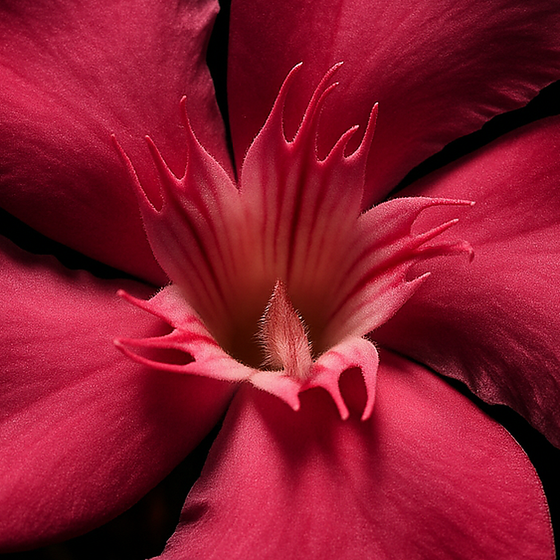
Oleander (Nerium oleander) is a shrub or small tree native to the Mediterranean region east to southern Asia, ranging from Morocco and Portugal east to India and Myanmar. It is the only species currently classified in the genus Nerium, in the dogbane family Apocynaceae.
Plant
Oleander grows to 2-6 metres (7-20 feet) tall. Its leaves are in pairs or whorls of three, thick and leathery, and dark green. The flowers grow in clusters at the end of each branch and are pink in natural wild plants. Cultivars with white to dark red, larger or double flowers are also common in cultivation.
Oleander is also cultivated widely in temperate and subtropical areas as an introduced ornamental and landscaping plant. It is tolerant to both drought and inundation, but not to prolonged frost.
Scent chemistry
Linalool gives a light, floral, slightly spicy scent, while benzaldehyde is linked to the almond note of the flower.
Toxicity
Oleander is among the most toxic ornamental plants, and its harmful effects come mainly from a group of cardiac glycosides, chiefly oleandrin. All parts of the plant are poisonous, even when dried. Its bitterness makes it unpalatable to humans and most animals, so poisoning cases are rare and the general risk of human mortality is low. Ingestion of larger amounts may cause nausea, vomiting, excess salivation, abdominal pain, bloody diarrhoea and irregular heart rhythm. Prolonged contact with sap may cause skin irritation, eye inflammation and dermatitis.
Oleandrin is a cardiac glycoside that interferes with essential processes in the cell, most importantly by inhibiting the Na-K ATPase. Oleandrin forms colourless, odourless, acicular crystals that are very bitter.
Folklore and history
The ancient city of Volubilis in Morocco may have taken its name from the Berber name alili or oualilt for the flower. The toxicity of the plant has made it the centre of an urban legend documented on several continents and over more than a century. In the legend, a family or a group of scouts succumbs after eating food roasted over a campfire using oleander sticks.
Pliny the Elder described a region of Pontus where honey was poisoned by bees that had pollinated poisonous flowers. These flowers have sometimes been mistranslated as oleander, but oleander flowers are nectarless and cannot transmit toxins through nectar.
Explore all seven extraits in the Discovery Set.
—
Related: Acerola Blossom · Albizia · Anisaldehyde · Apple Blossom · Babys Breath · Campion Flower · Cannonball Flower · Cotton Flower