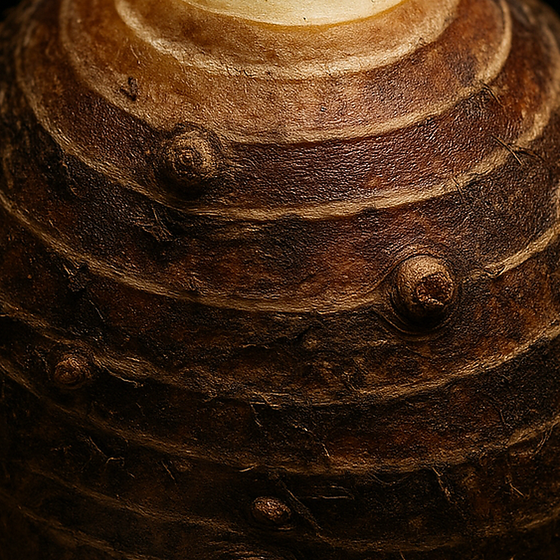
Taro, also known as dasheen, is the most widely cultivated species of several plants in the family Araceae that are used as vegetables for their corms, leaves, stems and petioles. Colocasia esculenta is a perennial, tropical plant. The plant has rhizomes of different shapes and sizes. The leaves are up to 40 by 25 centimetres and sprout from the rhizome. The leaves are dark green above and light green beneath. Taro corms are a food staple in African, Caribbean, Oceanian, East Asian, Southeast Asian and South Asian cultures.
Cultivation
Flooded cultivation has some advantages over dry-land cultivation, among them higher yields (about double) and out-of-season production. Flooding also facilitates weed control. Manmade floodplains for taro cultivation, called repo, are commonly found throughout tropical Polynesian societies. Taro and eddoes do well in deep, moist or even swampy soils where the annual rainfall exceeds 2,500 mm. Eddoes are more resistant to drought and cold. The crop attains maturity within six to twelve months after planting in dry-land cultivation and after twelve to fifteen months in wetland cultivation. The crop is harvested when the plant height decreases and the leaves turn yellow. World taro production in 2022 was 17.7 million tonnes.
Nutrition
Cooked taro is 64% water and 35% carbohydrates, and contains negligible protein and fat. A reference amount of 100 grams of taro supplies 142 calories of food energy. Cooked taro is a rich source of vitamin B6 (25% of the Daily Value), vitamin E (20%) and manganese (21%), while phosphorus and potassium are present in moderate amounts (10-11%). Raw taro leaves are 86% water, 7% carbohydrates, 5% protein, and 1% fat. Raw taro leaves contain substantial amounts of vitamins and minerals, especially vitamin K at 103% of the Daily Value.
Culinary use
In Japan, satoimo tubers are often prepared by simmering in fish stock (dashi) and soy sauce, and the stalk, called zuiki, can be prepared in several ways depending on the variety.
Aroma chemistry
Taro corm consists mostly of water and starch. 2-Acetyl-1-pyrroline gives freshly baked bread, jasmine rice, basmati rice, the herb pandan and bread flowers their customary smell. 2-Acetyl-1-pyrroline is also important in the aroma of other foods, such as pandan leaf, popcorn and Mediterranean sausage. 2-Acetyl-1-pyrroline is a substituted pyrroline and a cyclic imine as well as a ketone. 2-Acetyl-1-pyrroline is a relatively unstable compound. Its structural homolog 6-acetyl-2,3,4,5-tetrahydropyridine has a similar smell, and both compounds have odor thresholds below 0.06 ng/L.
In gas-chromatography olfactometry of a pumpkin fruit sample with a 'taro-like' aroma, the odor called taro corresponded to 2-acetyl-1-pyrroline. Among 12 additional pumpkin samples, 2-acetyl-1-pyrroline was found only in the two with a 'taro-like' aroma. 2-Acetyl-1-pyrroline is the key volatile of rice and is also found in coconut, mung bean, muskmelon, cucumber, winter melon and sorghum; it has also been detected in taro. Furans have been documented in taro corm cooked at high temperatures as products of sugar degradation.
Poi
The volatile compounds of commercial poi, which ferments as it ages, have been profiled by two-dimensional gas chromatography. A total of 56 analytes from 11 compound classes were identified across three commercial brands. Fresh samples of all brands contained 4,4-dimethoxy-3-methylbutan-2-one, while all aged samples contained 2,5-dimethylfuran. 2,5-Dimethylfuran forms in carbohydrate-rich fermentation conditions.