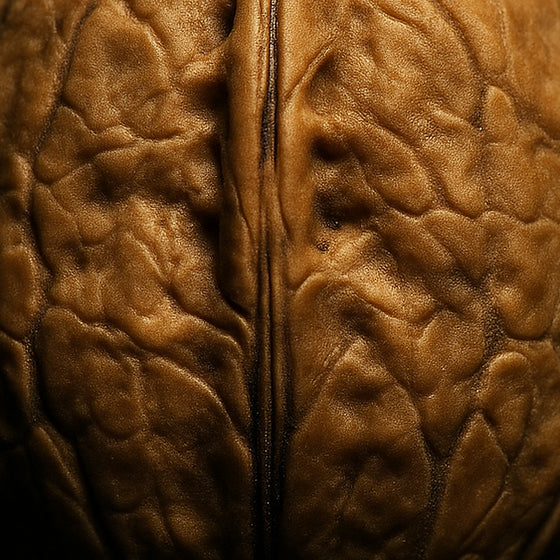
Juglans regia is a large deciduous tree, attaining heights of 10-25 metres. It is native to Eurasia in at least southwest and central Asia and southeast Europe, but its exact natural area is obscure due to its long history of cultivation. The species has numerous cultivars which produce the edible walnut consumed around the world. Its high-quality fruits are eaten both fresh or pressed for their richly flavoured oil. English (or Persian) walnuts without shells are 4% water, 15% protein, 65% fat, and 14% carbohydrates, including 7% dietary fiber. The genus name Juglans comes from the Latin jovis, meaning Jupiter, and glans, meaning an acorn or nut, and the epithet regia means royal, a reference to the quality of the fruit and edible nuts. Its closest relative is Juglans sigillata from western China and the far northeast of India, which differs chiefly in having leaves with 9-11 leaflets and nuts with a much thicker, harder shell.
What Walnut Actually Smells Like
An aroma extract dilution analysis of fresh walnut kernels resulted in 50 odor-active compounds. Of these, 37 had not been reported as fresh walnut kernel volatiles before. Quantitations revealed 17 odorants with concentrations in the walnuts that exceeded their odor threshold concentrations. Aroma reconstitution and omission experiments showed that the characteristic aroma of fresh walnuts is best represented by a binary mixture of sotolon and (2E,4E,6Z)-nona-2,4,6-trienal. The natural concentration of each of the two compounds was about 10 μg/kg. Oxidation products of fatty acids form the largest group among the 50 compounds, including 16 aldehydes, 3 ketones and 5 lactones. The odor threshold concentration is 0.23 μg/kg for sotolon and 1.1 μg/kg for (2E,4E,6Z)-nona-2,4,6-trienal, which gives them odor activity values of 46 and 9.3 in the kernels.
In sensory tests, the walnut note was strongest when both compounds were present at 10 μg/kg, about the same concentrations as in the walnuts. Moderate intensity of the walnut note was still perceptible when one of the two compounds was present at 10 μg/kg and the other one at 3 μg/kg. When one of the two compounds was decreased to 1 μg/kg, the walnut character was only weak. Sotolon contributes somewhat more to the walnut character than (2E,4E,6Z)-nona-2,4,6-trienal.
Sotolon
Sotolon is a butenolide lactone and an extremely potent aroma compound. It is the major aroma and flavor component of fenugreek seed and lovage. Sotolon is also present in molasses, aged rum, aged sake and white wine, flor sherry and roast tobacco. It has also been found in the dried fruiting bodies of the mushroom Lactarius helvus. Its formula is C₆H₈O₃ and its molar mass is 128.127 g/mol.
Walnut Oil
Virgin walnut oil consists of polyunsaturated fatty acids (72% of total fats), particularly alpha-linolenic acid (14%) and linoleic acid (58%), oleic acid (13%), and saturated fats (9%). It also contains aldehydes, tocopherol and many phenolic compounds, including tannins, ellagic acid and flavonoids. The oil is light-coloured and delicate in flavour and scent, with a nutty quality. Walnut oil is chiefly used as a food ingredient, particularly in salad dressings. It has a low smoke point, which limits its use for frying. Like all nut, seed and vegetable oils, it can turn rancid. Linoleic acid, the major component of walnut oil, is a drying oil, which means that in air it polymerizes, forming strong but flexible films, useful in oil paints and varnishes. Its short drying time and lack of yellow tint make it a good oil paint base thinner and brush cleaner.
Husk and Juglone
Walnut hulls contain diverse phytochemicals, such as polyphenols, that stain hands and can cause skin irritation. Seven phenolic compounds, including ferulic acid, vanillic acid, coumaric acid, syringic acid, myricetin and juglone, have been identified in walnut husks. Juglone, also called 5-hydroxy-1,4-naphthalenedione, is a phenolic organic compound with the molecular formula C₁₀H₆O₃. It is a yellow solid. Juglone occurs naturally in the leaves, roots, husks, fruit and bark of plants in the Juglandaceae family, particularly the black walnut. Other plants often will not grow under walnut trees because the fallen leaves and husks contain juglone, a chemical which acts as a natural herbicide. Before oxidization, juglone exists in plants such as walnuts in the form of colorless hydroxyjuglone, which is rapidly oxidized to juglone once exposed to air. Juglone is sometimes used as an herbicide, as a dye for cloth and inks, and as a coloring agent for foods and cosmetics.
Culinary Uses
Walnut is an important ingredient in baklava, Circassian chicken and potica. Nocino is a liqueur made from unripe green walnuts steeped in alcohol with syrup added.
—
Related: Acetophenone · Almond · Benzaldehyde · Black Walnut · Brazil Nut · Breadnut · Candlenut · Cashew