Ефірна олія агарового дерева

НатуральнийДЕРЕВИНА Й МОХИдеревний · тваринний · димний
Базові нотиПіраміда
—Сила
—Стійкість
8Походження
Зразок
Ефірна олія агарового дерева як парфумерна сировина
Базові ноти
Aquilaria malaccensis / Aquilaria crassna
Визначення

Agarwood oil is an essential oil distilled from agarwood, the resinous heartwood of Aquilaria trees. Its odour is very rich, deep and complex, with an enveloping woody note and warm, animalic accents.

Boisé
95
Fumé
83
Animalique
56
Balsamique
41
Résineux
41
Cuiré
26
oud oil, agar wood oil, aloe wood oil
Type
Складник
Olfactive family
Деревні
Source
heartwood
Chemical class
complex natural (essential oil)
Інструменти
Піраміда
ВВерхні ноти
СНоти серця
ББазові ноти
Країни-виробники
Індонезія Малайзія Лаос Таїланд Індія Камбоджа Китай В’єтнам

Запах

The odour of agarwood is complex and pleasing, with few or no similar natural analogues. The richness of the oil comes from balsamic, leathery and smoky facets. At 100 per cent, the odour is described as sweet agarwood, woody, balsam, sandalwood, leathery, fruity, smoky, animal and tobacco. A Cambodian oud is described as fresh-woody, balsamic and animal-barnyard. Another Cambodian oud starts with a smoky, bitter-sweet tobacco and woody note, and its base notes are fruity, with details of sweet berries. A Laos oil is described as belonging to the animal family, with leather, woody-smoky and fruity qualities. One agarwood oud oil is described as bitter-sweet and woody, with animalic notes and a leather character.

Теруар і зрілість

Докладно

Aquilaria is a genus of large evergreens native to Southeast Asia and South Asia, with seventeen species, of which nine are known to produce agar wood. Aquilaria malaccensis, the major source of agarwood, is a tree of the family Thymelaeaceae. The fragrant resin of agarwood forms as the outcome of complex biotic, abiotic and physical stress on Aquilaria trees. In A. malaccensis, the resin is produced by the tree in response to infection by a parasitic ascomycetous mould, Phaeoacremonium parasitica. The unaffected wood of the tree is relatively light in colour. The resin dramatically increases the mass and density of the affected wood and changes its colour from pale beige to yellow, orange, red, dark brown or black. In natural forests, only about 7 out of 100 Aquilaria trees of the same species are infected and produce agar wood.

Until recently agarwood was primarily produced from A. malaccensis, and A. crassna and A. sinensis are the other two members of the genus that are commonly harvested. Gyrinops trees can also produce agarwood. Trade data show that A. crassna, followed by A. malaccensis and A. filaria, were the major species used for oil production over the last 10 years. Infected trees produce resin from the age of 15 years, and trees aged 50 years and more produce the best yields of agarwood.

More than 150 chemical compounds have been identified in agarwood oil, and its composition is exceedingly complex. The main chemical constituents of agarwood are sesquiterpenes and chromones. The major constituents of agarwood oil are sesquiterpenes, whose chemical structure makes them very difficult, and hence extremely expensive, to synthesize. Among the most prominent groups of compounds in agarwood are agarofurans, cadinanes, eudesmanes, valencanes, guaianes, prezizanes, vetispiranes and 2-(2-phenylethyl)chromones. Among the chromones of agarwood, 2-(2-phenylethyl)chromones are currently the most commonly isolated types. Jinkoh-eremol, jinkohol and jinkohol II are sesquiterpene alcohols discovered in an agarwood, most likely from A. malaccensis. In oil from Aquilaria subintegra, β-agarofuran, α-eudesmol, karanone, α-agarofuran and agarospirol were major components in most of the incubated samples.

The aromatic qualities of agarwood vary with the species, the geographic location, the branch, trunk or root of origin, the time since infection, and the methods of harvesting and processing. Synthetically induced agarwood has aromas different from those of naturally formed agarwood. The price per kilogram of agarwood can range from US$100 to US$100,000 depending on the quality of the material. Fake and adulterated wood is often pushed into markets as cheaper agarwood. Agarwood oil is one of the most expensive essential oils. Agarwood oil is used in aromatherapy, medicinal applications, incense, perfume and religious ceremonies in Southeast Asian countries and the Middle East. During 2008-2018, a total of 18,775 kg and 1854 L of agarwood oil were imported, mainly into Saudi Arabia, Singapore and the UAE.

Agarwood was described as a fragrant product as early as 1400 BCE in the Vedas of India. Appendix II of CITES includes all known Aquilaria species, which places major restrictions on trade of agarwood tissue and raw materials. Aquilaria malaccensis is now considered critically endangered on the IUCN Red List.

Explore all seven extraits in the Discovery Set.

—

Related: Agarwood Oud · Australian Oud · Cambodian Oud · Chinese Oud · Indian Oud · Indonesian Oud · Laotian Oud · Malaysian Oud

Отримання й хімія

Спосіб отримання

Oud oil can be distilled from agar wood using steam. Traditionally, harvested agarwood chips have been soaked in water before hydrodistillation, which aims to increase oil yield. Woodchips of Aquilaria subintegra were hydrodistilled in a Clevenger-type apparatus for 48 h. Incubating woodchips with lactic acid bacteria supernatants gave an oil yield of 0.45% w/w, against 0.22% w/w for water. Oil yields are generally very low, and the extraction process is reported to be very tedious and time-consuming. Treating Aquilaria crassna with an enzyme mixture before supercritical fluid extraction significantly increased the extraction yield. A common method in planted forestry is to inoculate trees with the fungus. In artificial induction, nail or axe wounds are made in the wood, which is then exposed to infection by fungi such as Phialophora parasitica. When a tree is ready to be harvested, it is felled, the bark is removed, and the wood is carved to remove the parts not stained with agarwood.

Формула
Complex natural mixture (key constituents: agarospirol C₁₅H₂₆O; β-agarofuran; α-eudesmol; karanone)
CAS
94350-09-1
Ботанічна назва
Aquilaria malaccensis / Aquilaria crassna
Зовнішній вигляд
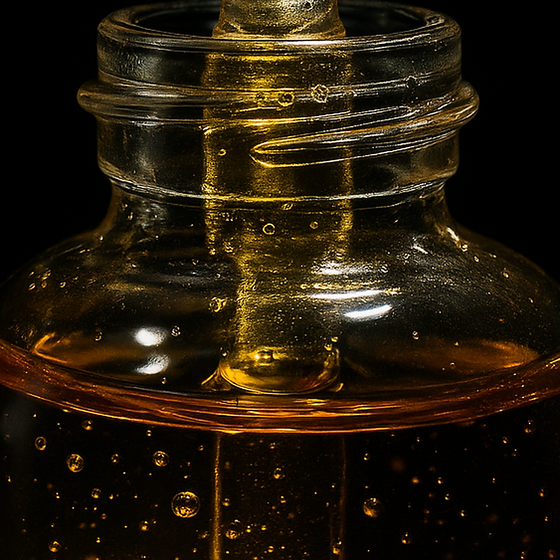
Orange to green-brown viscous liquid
Синоніми
oud oil, agar wood oil, aloe wood oil
Статус IFRA
Див. примітку

No IFRA Standard for the material itself (51st Amendment)

Фізичні властивості
Температура спалаху
61.00 °C (141.00 °F, TCC)

У парфумерії

Agarwood oil is used in many oriental fragrances, where it sits at the heart of woody and leathery accords. In the Middle and Far East, agarwood is traditionally burned as incense or used to make attars and perfume oils. Agarwood is used in the perfume industry, especially by Arabic brands. Oud is valued for its distinctive fragrance in Middle Eastern and South Asian cultures, and is used in colognes, incense and perfumes. Synthetic agarwood compounds are used to make poor-quality fragrances and incense sticks, and there are currently no synthetic substitutes for high-grade incense or oil.

Роль у формулі
01фіксатор
02фірмова нота
03тепло
Форми випуску
ефірна олія

Див. також

6 ноти